
Coming back to the gym after weeks or months off isn’t just about walking in and grabbing your old weights. A well-designed workout program after a long break protects you from injury, kills the frustration cycle, and gets you back to your previous level two to three times faster than a brute-force return. With AIVancePro’s conversational AI coach, your return-to-training plan adapts to your break length, training history, and current fitness, every session becomes a measured step forward, not a setback.
Whether you’re returning from vacation, an injury, burnout, or just life getting in the way, the principles stay the same: regress to progress, listen to your body, and accept that the first three weeks rebuild the foundation, not break records.
Why a Progressive Return Is Non-Negotiable
After four to six weeks without training, your strength on compound lifts drops about 5 to 10%. That’s not the main problem though, neuromuscular coordination drops faster. Your nervous system has partly forgotten how to recruit muscle fibers efficiently for a squat or bench press. A load can feel heavy not because you’re weaker, but because the wiring is rusty.
Connective tissue, tendons, ligaments, rebuilds even slower than muscle. That’s exactly why comeback injuries (elbow tendinitis on bench, knee pain on squat, low-back tweaks on deadlift) are so common. You pick a load you feel capable of, your muscle follows, but the tendon isn’t there yet.
A solid workout program after a long break respects the recovery hierarchy: nervous system → connective tissue → muscle mass → cardio capacity.
Assess Your Situation Before Programming
Before jumping into any plan, spend five honest minutes on a self-assessment:
- Exact break length: 2 weeks, 2 months, a year? Calibration changes everything.
- Reason for stopping: vacation (full recovery), injury (zones to protect), burnout (manage the mental return), illness (cardio is hit).
- Pre-break level: beginner, intermediate, advanced? Advanced lifters recover faster thanks to muscle memory.
- Current cardio: do four flights of stairs leave you winded? Cardio is reset, prioritize it.
- Mobility: sitting still stiffens hips, shoulders, ankles. Quick test: can you hold a full squat for 30 seconds without leaning?
Write the answers down somewhere. In AIVancePro, Vance the AI coach asks exactly these questions on day one to calibrate your comeback.
Weeks 1-2: The Mandatory Deload Phase
The first two weeks are not about progress. They’re about waking your body up without breaking it.
Recommended structure:
- 3 full-body sessions per week (Mon/Wed/Fri works well)
- 50 to 60% of your pre-break working weights
- 3 sets of 10 reps on compounds
- RPE 6-7 max (you could do 3-4 more reps per set)
- 60 to 90 seconds rest
- 10-minute warm-up before every session, non-negotiable
Sample session:
- Squat, 3×10 at 50% 1RM
- Bench press, 3×10 at 50%
- Lat pulldown or assisted pull-ups, 3×10
- Romanian deadlift, 3×10 light
- Dumbbell shoulder press, 3×10
- Plank, 3×30s
The goal is to re-stimulate every muscle group two to three times a week without triggering soreness that locks you out for four days. If you finish a session feeling frustrated you didn’t push harder, that’s the right signal. It’s the goal.
Weeks 3-4: Loading Back Up
Once the foundation is rebuilt, you can ramp intensity. By now, your nervous system has caught up, soreness windows are shorter, and movements feel smooth again.
Structure:
- Still 3 sessions a week (full-body or upper/lower if that’s what worked before)
- 70 to 80% of pre-break loads
- 3 to 4 sets of 8 to 10 reps
- RPE 7-8
- 90 to 120 seconds rest on compounds
This is also when you reintroduce exercises that stress tendons more: weighted push-ups, dips, heavier lunges. Progress slowly.
Weeks 5-8: Back to Your Level
From week 5, you can return to your usual split, push/pull/legs, upper/lower, or 4×full-body, whichever worked for you before. Loads should be at 90-100% of your previous records, and you can start chasing progression again.
One caveat: if you had an injury during the break, don’t reintroduce risky patterns without clearance from a physiotherapist. Substitute instead of forcing.
This is also when you can re-engage specific work: hypertrophy peaks, strength-focused blocks, or recomp depending on your goals.
How AIVancePro Adapts Your Comeback
The problem with a generic back-to-training plan is that it doesn’t know whether you’re coming off a 6-week pause after a muscle tear, or a 6-month pause after pregnancy. The needs are radically different.
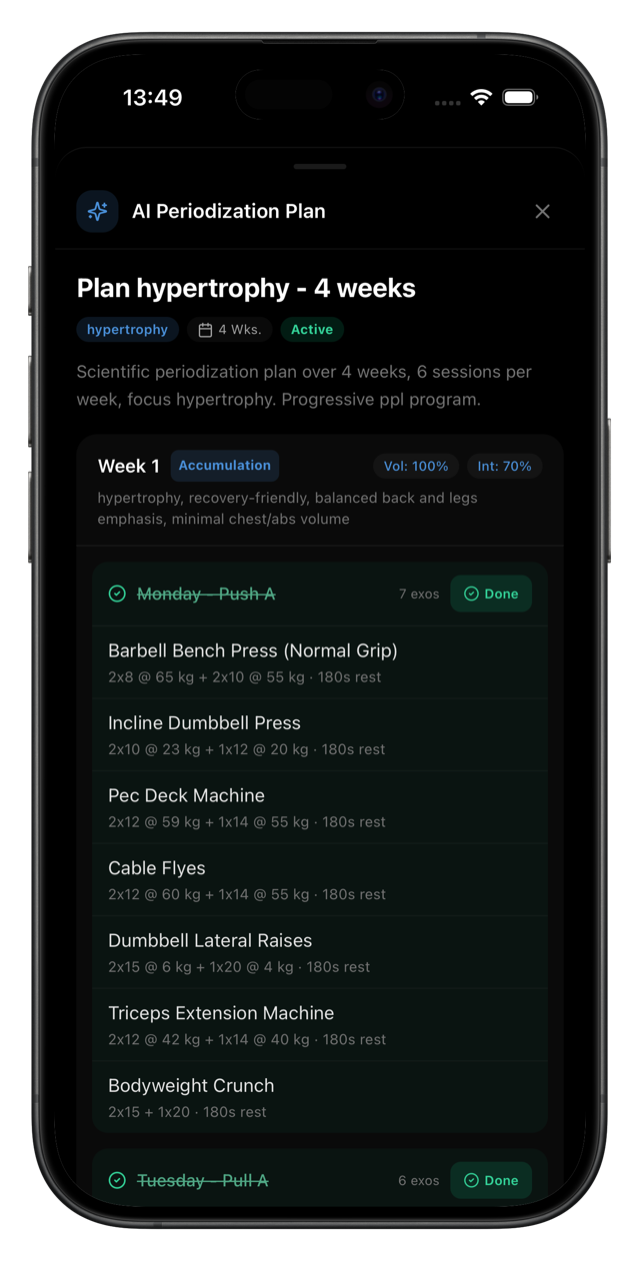
AIVancePro solves this through a natural-language conversation with Vance, the AI coach: you explain your break, current sensations, constraints (equipment available, weekly frequency, residual pain), and Vance builds a progressive plan specific to your case, then adjusts it every week based on your session feedback.
Concrete example: if you type “came back yesterday, squat at 60 kg felt heavy when I used to do 100 kg easy,” Vance automatically lowers the next session’s loads and inserts hip mobility work. Conversely, if you recover sensations fast, it accelerates the ramp so you don’t stall in an over-conservative phase.
That real-time adjustment is what separates a true workout program after a long break from a static PDF routine.
Common Mistakes to Avoid
- Trying to lift your old weights on day one: guaranteed tendinitis or strain. Ego is the enemy.
- Skipping warm-up: 10 minutes of mobility plus 1-2 working approach sets per heavy lift. Mandatory.
- Neglecting cardio: if you’ve been off for a while, add 2-3 sessions of 20-30 minutes moderate cardio (bike, brisk walk, rower). Your cardio-respiratory system needs it as much as your muscles.
- Ignoring sleep and nutrition: 7-8 hours of sleep and around 1.6 g of protein per kg bodyweight. Without that, recovery takes twice as long.
- Comparing to others: your gym neighbor isn’t returning from the same starting point. Your only competitor is you, last week.
Conclusion
Smartly returning to lifting after a long break means accepting three to four weeks of patience to buy yourself months of clean, injury-free progression. The rule is simple: regress to progress. With AIVancePro, you don’t have to guess percentages, volumes, or rebuild your plan alone, the conversational AI coach personalizes every return week based on how you actually feel, not a static template. Your first month is €3.49, which fully covers your structured comeback program before you decide whether the subscription is worth it for you long-term.
Health disclaimer: this article is informational. If you’re returning after an injury, surgery, pregnancy, or illness, consult a doctor or physiotherapist before starting a structured program.
FAQ
How long to get back to my level after 3 months off?
Expect 6 to 8 weeks to recover 90% of your performance, thanks to muscle memory if you had 1+ year of training. Beginners take longer because neuromuscular memory is less ingrained.
Can I do cardio during the deload phase?
Yes, it’s actually recommended. 2-3 sessions of 20-30 minutes in zone 2 (bike, brisk walk) on lifting off-days. Don’t overdo it or it eats into your strength recovery.
What if I only have home equipment for my comeback?
Push-ups, pull-ups, bodyweight squats, lunges, dips between two chairs: more than enough for the first 2-4 weeks. AIVancePro generates a program tailored to your available equipment.
When can I start chasing progression again?
Around week 5-6, when loads are at 85-90% of pre-break and technique sensations are back. Before that, it’s reconstruction, not progression.
Should I eat more during the comeback?
If you gained fat during the break, stay in a slight deficit (-200 kcal). Otherwise, hit maintenance + 1.6 g/kg protein. True bulking can wait for the progression phase, not the comeback.
← Back to blog