The push pull legs program (PPL) is one of the most effective and widely used training splits for building muscle and strength. Whether you’re training 3 or 6 days a week, PPL gives you a clear framework to organize your sessions, maximize recovery, and track your progress session by session.
What Is the Push Pull Legs Program?
The push pull legs program divides your training into three session types based on movement patterns:
- Push: exercises where you push weight away from your body, chest, front and lateral delts, triceps
- Pull: exercises where you pull weight toward you, back, rear delts, biceps
- Legs: quads, hamstrings, glutes, calves
This grouping is straightforward and highly effective. Synergistic muscles work together in each session. They then have 48-72 hours to recover before being trained again. No overlap, no conflict, just clean stimulation and recovery cycles.
PPL has been a staple of bodybuilders and strength athletes for decades. It remains popular because the logic is sound and the results are consistent across training levels.
Why PPL Outperforms Other Training Splits
Optimal training frequency
In the 6-day version, you hit each muscle group twice per week. Research consistently shows that training a muscle 2× per week produces more hypertrophy than training it once (Schoenfeld et al., 2016). PPL achieves this naturally without forcing awkward scheduling.
Clean muscle recovery
Unlike poorly designed bro splits where triceps appear on chest day AND shoulder day, PPL groups muscles logically. Your chest and triceps are only in Push sessions, they recover during Pull and Legs, then get stimulated again at the next Push.
Easy progress tracking
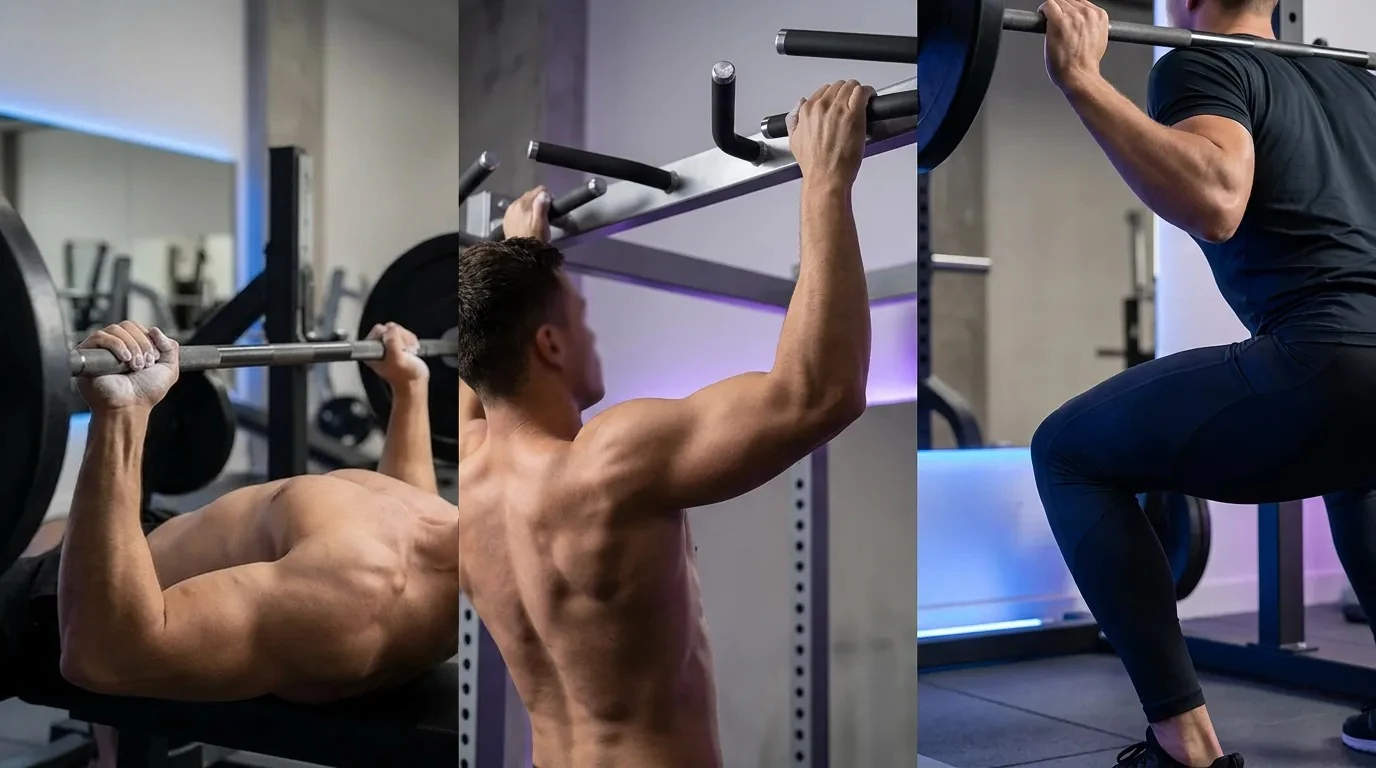
Each session has its key benchmark exercises. You know exactly what you lifted at your last Push (bench press), Pull (barbell row), or Legs (squat). Beating your previous performance becomes a simple, repeatable system.
Scalable to your schedule
PPL works as a 3-day program (one stimulus per muscle group per week) or a 6-day program (two stimuli per week). Miss a session? The structure still holds without major disruption.
How to Structure Your PPL Week
3-Day Version (Frequency: 1× per muscle group)
Best for beginners and those with limited training time.
| Day | Session |
|---|---|
| Monday | Push |
| Wednesday | Pull |
| Friday | Legs |
6-Day Version (Frequency: 2× per muscle group)
Best for intermediates and advanced lifters looking to maximize hypertrophy.
| Day | Session |
|---|---|
| Monday | Push A |
| Tuesday | Pull A |
| Wednesday | Legs A |
| Thursday | Push B |
| Friday | Pull B |
| Saturday | Legs B |
| Sunday | Rest |
In the 6-day version, use A/B variants to diversify exercise selection while targeting the same muscle groups.
Push Workout: Exercises and Order
The Push session targets chest, anterior and lateral deltoids, and triceps.
Sample Push Session (60-75 min)
- Barbell Bench Press, 4 sets × 4-6 reps (strength focus)
- Incline Dumbbell Press, 3 sets × 8-12 reps (upper chest)
- Overhead Press (barbell or dumbbells), 4 sets × 6-10 reps (shoulders)
- Lateral Raises, 4 sets × 12-15 reps (medial delts)
- Tricep Dips or Cable Pushdowns, 3 sets × 8-12 reps
- Overhead Tricep Extension, 3 sets × 12-15 reps
Key principle: always start with heavy compound movements (bench press, overhead press) when your neuromuscular capacity is at its peak. Finish with isolation work.
To get the most chest growth out of your Push days, build them around the best chest exercises for hypertrophy.
Pull Workout: Exercises and Order
The Pull session targets lats, traps, rhomboids, rear delts, and biceps.
Sample Pull Session (60-75 min)
- Pull-ups (pronated grip) or Lat Pulldown, 4 sets × 5-8 reps
- Barbell Row, 4 sets × 6-8 reps (back mass)
- Single-Arm Dumbbell Row, 3 sets × 10-12 reps (each side)
- Face Pulls, 3 sets × 15-20 reps (rear delts + shoulder health)
- Barbell Curl, 3 sets × 8-10 reps
- Hammer Curl, 3 sets × 10-12 reps
Don’t skip face pulls. They strengthen the external rotators and posterior deltoid, balancing the internal rotation stress from all your pressing. They’re the most underrated exercise in any push pull legs workout program.
Legs Workout: Exercises and Order
The Legs session is typically the hardest, and the most skipped. It targets quads, hamstrings, glutes, and calves.
Sample Legs Session (60-75 min)
- Barbell Squat, 4 sets × 4-6 reps (foundational lift)
- Leg Press, 3 sets × 10-12 reps (quad volume)
- Walking Lunges with Dumbbells, 3 sets × 12 reps per leg
- Romanian Deadlift (RDL), 3 sets × 8-10 reps (hamstrings)
- Lying Leg Curl, 3 sets × 10-12 reps
- Standing Calf Raises, 4 sets × 15-20 reps
Non-negotiable: squat first, always. It’s the most demanding exercise neurologically and muscularly, don’t push it to the end of the session.
PPL 3 Days vs 6 Days: Which Should You Choose?
This isn’t about motivation, it’s about your current context and recovery capacity.
3-day PPL is right for you if:
- You have less than 12 months of consistent training
- You’re recovering slowly (poor sleep, high stress, caloric deficit)
- You have 3 sessions of 60-90 minutes per week available
6-day PPL is right for you if:
- You have 1+ years of training experience
- Your progress has plateaued on the 3-day version
- You’re sleeping 7-9 hours, eating in a slight surplus, and managing stress effectively
An intermediate lifter who jumps to 6 days without adjusting sleep and nutrition will regress, not progress. Recovery is the limiting factor, not training volume.
Common Mistakes to Avoid
Skipping or rushing Legs Your legs contain the largest muscle groups in your body (quads, glutes, hamstrings). Neglecting them undermines your overall progress, both in muscle mass and total hormonal response from heavy compound work.
Stacking too many exercises 5-6 exercises per session is enough. Beyond that, you’re trading quality for quantity. Every set should be executed with full intent and focus, not on autopilot at the end of a long session.
No progressive overload A push pull legs program without progressive overload is just a routine. Track your weights and reps. Aim to progress every 1-2 weeks on your main compound lifts.
Wrong sequencing in 6-day version Don’t run two Push sessions back-to-back. The Push/Pull/Legs rotation exists to ensure optimal recovery between sessions, respect it.
Conclusion
The push pull legs workout program is one of the most reliable and battle-tested training frameworks available. Whether you train 3 or 6 days a week, consistent execution and progressive overload matter far more than program complexity.
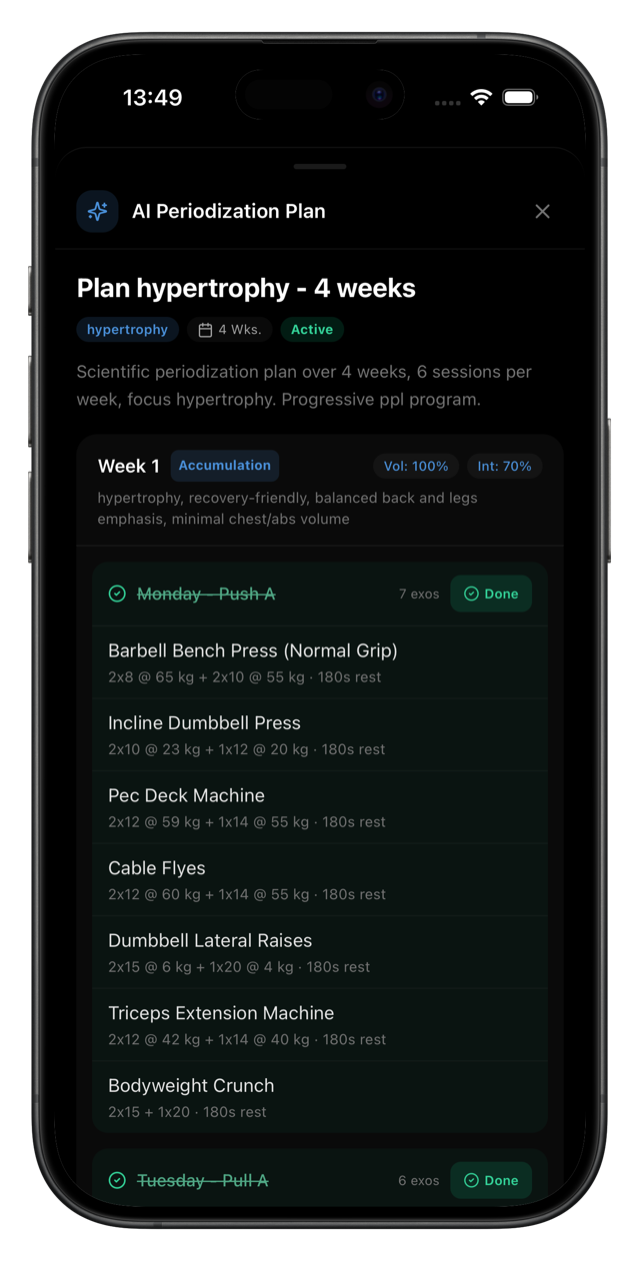
If you want a personalized PPL plan that adapts to your actual performance, AIVancePro is an AI fitness coach that generates and adjusts your training program in real time. Available on iOS, first month at €3.49.
Health disclaimer: This article is for informational purposes only. Consult a healthcare professional or certified coach before starting a new training program, especially if you have a history of injuries.
FAQ
Is the push pull legs program good for beginners?
The 3-day version works well for beginners. Prioritize technique over load, master the squat, bench press, and barbell row before chasing heavy weights.
How long does a PPL session take?
Between 60 and 90 minutes. Past 90 minutes, intensity typically drops and the quality-to-volume ratio deteriorates. 60 focused minutes outperform 2 hours of drifting.
Can I combine PPL with cardio?
Yes. Add 20-30 minutes of light cardio (brisk walk, cycling) after lifting sessions or on rest days. Avoid high-intensity interval training the day before Legs.
Should I use different exercises each session in 6-day PPL?
Ideally yes, use A/B variants to diversify the training stimulus. In the 3-day version, stick to the same exercises and focus purely on progressive overload.
How do I know when I’m ready to move from 3-day to 6-day PPL?
If your gains have stalled for 4-6 weeks despite solid nutrition and sleep, training frequency may be the limiting factor. Test 2 weeks at 6 days and assess your recovery response before committing.
← Back to blog