
Back width comes from vertical pulls, back thickness comes from horizontal pulls. That’s the whole rule: pull-ups and lat pulldowns widen your lats, while barbell and dumbbell rows thicken your traps, rhomboids and mid-back. There isn’t one magic movement, a truly massive back is built by combining both. In this guide, you’ll learn exactly which exercises serve each goal and how to program them together.
| Goal | What it develops | Movement type | Signature exercises |
|---|---|---|---|
| Back width | Lats, teres major (the V-taper) | Vertical pulls | Pull-ups, wide-grip lat pulldown, dumbbell pullover |
| Back thickness | Traps, rhomboids, spinal erectors | Horizontal pulls | Barbell row, T-bar row, one-arm dumbbell row |
Understand Back Anatomy Before Picking Exercises
The back isn’t a single muscle. To develop it properly, you need to understand its main muscle groups and what they do:
- Latissimus dorsi (lats): the muscle responsible for the V-taper and overall back width.
- Trapezius (upper, mid, lower): gives visible thickness from the side.
- Rhomboids: located between the shoulder blades, they reinforce mid-back thickness.
- Spinal erectors: the chain along the spine, essential for posture and stability.
- Teres minor, teres major, infraspinatus: secondary muscles that complete the lat work.
The rule is simple: width = vertical pulls (overhead down to torso), thickness = horizontal pulls (in front of you, toward your stomach). Neglect either, and your back will look incomplete.
Best Exercise for Back Width: The Pull-Up
If one movement had to embody width, it would be the pronated-grip pull-up (palms facing forward). It’s the compound exercise that recruits the lats most effectively over their full range of motion.
Why pull-ups dominate:
- Full lat stretch at the top of the movement.
- Maximum contraction at the bottom, scapulae depressed and retracted.
- Total-body recruitment, leading to functional strength gains.
- No machine fully replicates this stretch.
Clean execution:
- Grip slightly wider than shoulder-width, palms forward.
- Start hanging fully, arms extended, scapulae relaxed.
- Pull by thinking of bringing your elbows toward your hips (not your chin).
- Rise until your chest nearly touches the bar.
- Controlled descent over 2-3 seconds.
If you can’t do pull-ups yet: start with assisted machines, resistance bands, or lat pulldowns with progressive load. Progress should happen week by week.
Width variants:
- Wide-grip pronated pull-up: even more focus on the outer lat fibers.
- Wide-grip lat pulldown: a great alternative once you’re already doing 8-10 pull-ups per set.
- Dumbbell pullover: pure lat isolation through stretch.
Best Exercise for Back Thickness: The Barbell Row
For thickness, nothing beats the bent-over barbell row (Pendlay row or Yates row depending on the variant). It’s the exercise that loads the rhomboids, mid-traps, and central back area the most.
Why the barbell row is unbeatable:
- Heavy loading possible (often 220 lb+ for an intermediate lifter).
- Massive mid-back recruitment.
- Spinal erectors work as stabilizers.
- Direct carryover to all your other back exercises.
Clean execution:
- Feet hip-width apart, barbell in front of you.
- Hips back, flat back, torso at about 45° (Yates) or parallel to the floor (Pendlay).
- Grip the bar pronated, slightly wider than shoulders.
- Pull the bar to the lower sternum / upper abdomen.
- Elbows close to the body, scapulae squeezed at the top.
- Controlled descent without losing tension.
Common mistake: using torso momentum to cheat reps. If you stand up on every rep, lighten the load. 8 strict reps beat 12 sloppy ones.
Thickness variants:
- One-arm dumbbell row: more range of motion, fixes asymmetries.
- T-bar row: great for heavy loading with less lower-back stress.
- Seated cable row: controlled version to finish the session.
Back Width vs Thickness: Do You Have to Choose?
Short answer: no. A complete back blends both. But depending on your build and goals, you can lean toward one or the other.
You want the V-taper (width focus):
- 60% vertical pulls, 40% horizontal pulls.
- Focus on pull-ups, wide grips, lat pulldowns.
- Pullover for finishing isolation.
You want a massive look from the side (thickness focus):
- 60% horizontal pulls, 40% vertical pulls.
- Focus on barbell rows, T-bar, dumbbell rows.
- Specific trap work (shrugs, face pulls).
You want a balanced back (recommended for most):
- 50/50 vertical and horizontal split.
- Vary the angles: high pulley, neutral grip, supinated grip.
- A complete back session = 2 vertical + 2 horizontal + 1 isolation.
Optimal Back Routine for Thickness and Width
Here’s a session that hits both dimensions in a single workout, to program 1-2 times per week.
| Exercise | Sets | Reps | Rest | Target |
|---|---|---|---|---|
| Pronated pull-up | 4 | 6-10 | 2 min | Width |
| Barbell row | 4 | 6-8 | 2 min | Thickness |
| Neutral-grip lat pulldown | 3 | 10-12 | 90 s | Width |
| One-arm dumbbell row | 3 | 10-12 / arm | 90 s | Thickness |
| Cable face pull | 3 | 15 | 60 s | Mid-trap / rear delts |
| Dumbbell pullover | 3 | 12-15 | 60 s | Lat stretch |
Weekly volume: 16-20 working sets for the back is the range that maximizes hypertrophy for most intermediate lifters.
Progressive overload: add 5 lb or 1 rep per exercise every week as long as you can execute cleanly. It’s the only way to keep growing.
Mistakes That Sabotage Your Back Development
Pulling with biceps instead of back. Biceps should assist, not drive. Initiate every rep with your shoulder blades, not your arms.
Cutting range of motion. A half pull-up doesn’t recruit the lat at the bottom. A row that stops 12 inches from your stomach leaves the rhomboids unemployed.
Always using the same grip. Pronated, supinated, neutral, wide, narrow, each variation stimulates different fibers. Rotate every 4-6 weeks.
Underestimating the mind-muscle connection. The back is the hardest area to feel. Before every set, do 30 seconds of activation: slow movements, focused contraction of the lats and rhomboids.
Too much volume without recovery. The back is a large muscle group. 48 to 72 hours of recovery between back sessions is necessary.
How AIVancePro Adapts Your Back Routine Automatically
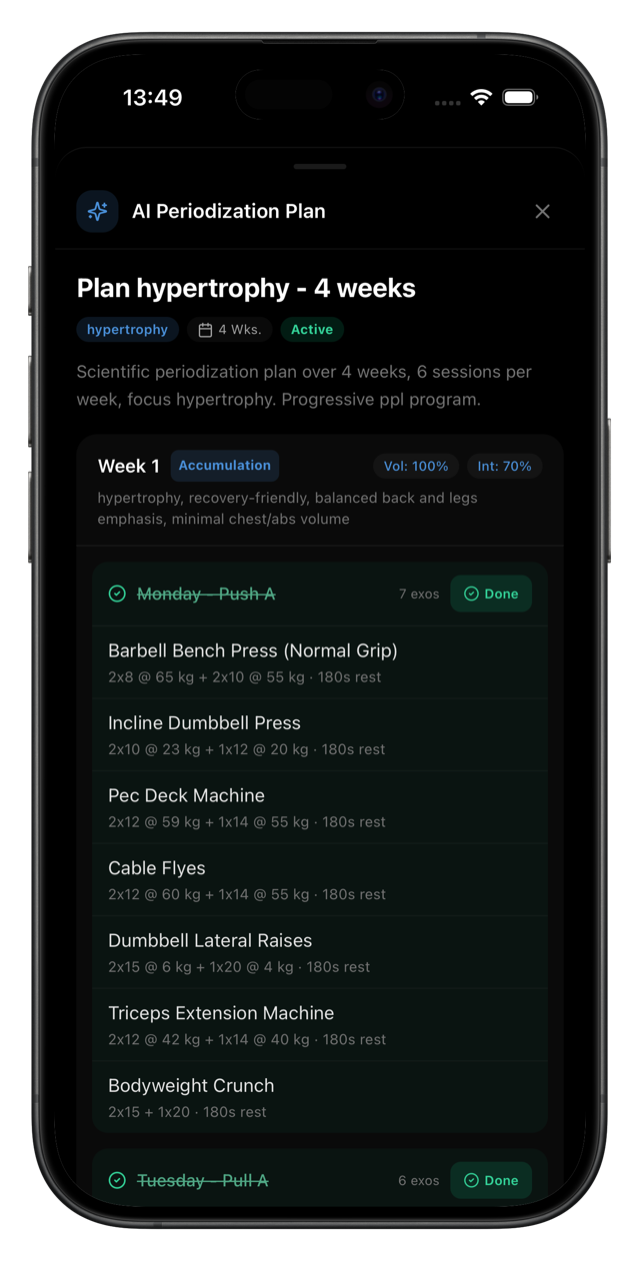
Building an optimal back routine means adjusting volume, intensity, and exercise selection based on your level and weak points. AIVancePro analyzes your performance session after session and personalizes your sets and reps to prioritize what needs to grow most: width if your V is flat, thickness if your back lacks density. The integrated AI conversational coach answers in real time when you have doubts about form or load. Available on iOS, with first month at 3.49€.
Conclusion
The best back exercises for thickness and width aren’t a single move, it’s the combo of pull-ups (for width) and barbell rows (for thickness) that builds a complete back. Master both movements, add variants for different angles, apply progressive overload, and your back will grow week after week. Stay patient: the back takes time, but the payoff is spectacular.
Health disclaimer: this content is informational. If you have a back condition, lower-back pain, or cervical issues, consult a doctor or physiotherapist before starting this type of training.
FAQ
What are the best back width exercises?
Pronated pull-ups, wide-grip lat pulldowns, and dumbbell pullovers are the most effective back width exercises. All three load the lats through a long range of motion, which is what visually widens the back. If you can’t do pull-ups yet, start with assisted variations or lat pulldowns and progress the load weekly.
What builds back thickness the fastest?
Heavy horizontal rows: the bent-over barbell row first, supported by T-bar rows, one-arm dumbbell rows, and seated cable rows. They target the traps, rhomboids, and spinal erectors, the muscles that give the back its density when seen from the side.
Should I train more for width or thickness?
It depends on your current physique and aesthetic goal. For an athletic V-shape, prioritize width (pull-ups, lat pulldowns). For a back that impresses from the side, prioritize thickness (rows). Most lifters benefit from a 50/50 balance.
How often should I train back per week?
Two sessions per week is ideal for most: one with width focus, one with thickness focus, spaced 48-72 hours apart. In a push/pull/legs split, you can also include back once per week with higher volume.
Pull-ups or rows: which should I start with?
Start your back day with pull-ups while you have full energy: it’s the most technically demanding move. Barbell row comes second, followed by isolation work.
Can you build a big back without equipment?
It’s possible but limited. Pull-ups, inverted rows on a low bar, and superman are the basics. Beyond a certain level, you’ll need added load (weighted vest, loaded backpack) or dumbbells.
How long until I see back results?
Expect 8-12 weeks of consistent training (2 sessions/week) with progressive overload and proper nutrition to see visible changes: lats getting wider, mid-back gaining density.
← Back to blog