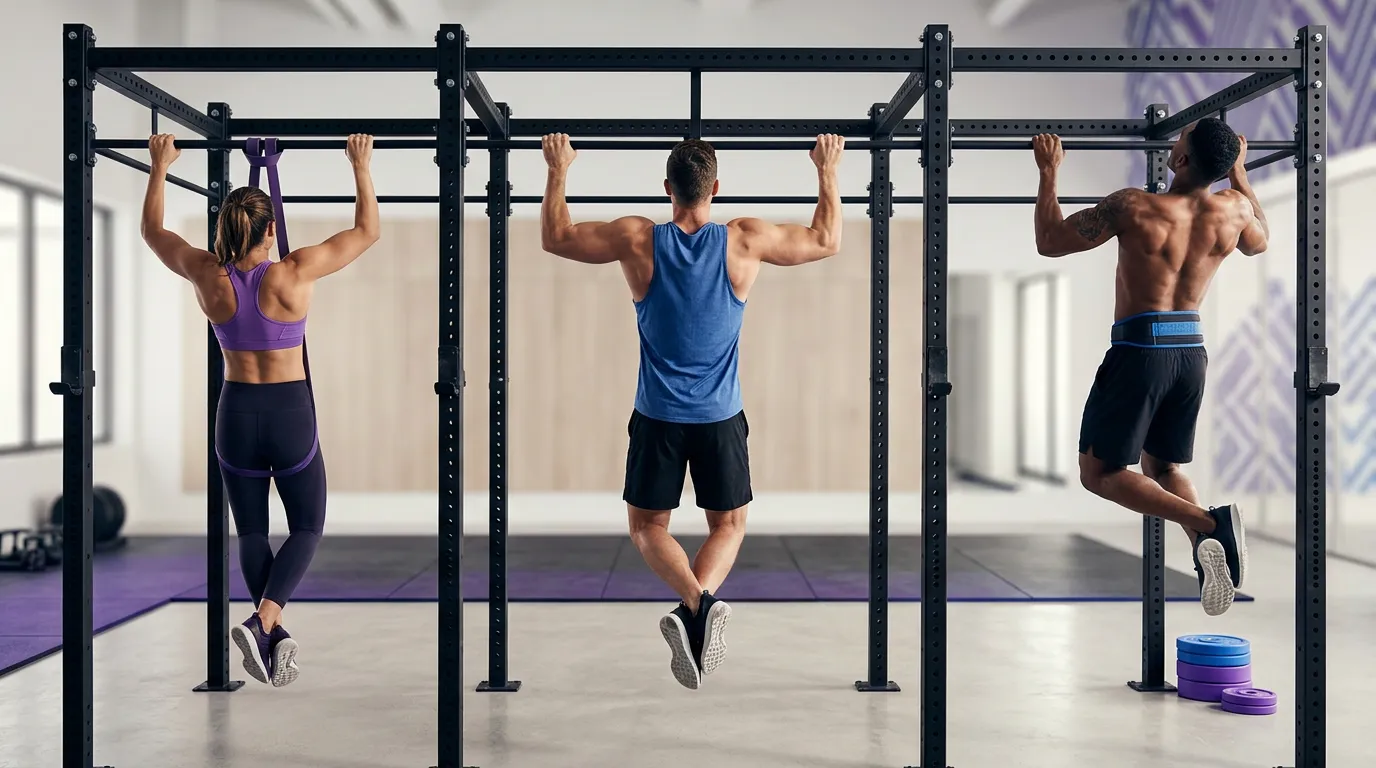
If improving your pull-ups is on your training agenda, you’ve picked one of the most rewarding goals in strength training. The pull-up is the most complete upper body bodyweight exercise, and one of the most unforgiving to master. Whether you can’t do a single rep or you’ve been stuck at 6-7 for months, this guide gives you a concrete action plan to break through your plateau.
Why Pull-Ups Are the Gold Standard for Back Strength
Pull-ups simultaneously recruit the latissimus dorsi, lower trapezius, rhomboids, biceps brachii, brachioradialis, and the abdominals as stabilizers. It’s a multi-joint movement with an exceptional strength-to-hypertrophy ratio.
Unlike lat pulldowns, pull-ups force you to move your actual bodyweight with zero mechanical assistance. Military branches worldwide use them as a baseline fitness test for exactly this reason: there’s no way to game the result.
Research confirms that pronated-grip pull-ups (palms facing away) activate the latissimus dorsi more effectively than the lat pulldown machine across a full range of motion. For back strength and hypertrophy, they remain the benchmark exercise.
The 5 Mistakes Holding You Back
Before diving into programming, let’s identify the most common, and often invisible, roadblocks:
Relying on momentum (kipping) Kipping pull-ups originated in CrossFit as a metabolic conditioning tool. For building raw pulling strength, you need strict movement. Momentum masks weaknesses and prevents the targeted neuromuscular adaptations you’re after.
Ignoring the eccentric phase Lowering yourself slowly (4-6 seconds) generates significantly higher mechanical tension than the upward phase. Most people drop too fast, that’s wasted progress on every single rep.
Adding volume too quickly Piling on sets without consolidating movement quality leads to plateaus and tendon issues. Progressive overload should be subtle: +1 rep per week on your working sets is enough in the intermediate phase.
Neglecting shoulder stabilizers Pull-ups require a solid rotator cuff and active serratus anterior. When these muscles are weak, you compensate with the upper trapezius, and you’ll plateau fast, often with shoulder pain as an early warning sign.
Too much volume crammed into one session, not enough frequency 50 pull-ups in a single weekly session is less effective than 25 pull-ups spread across 3 sessions. Training frequency is massively underrated in pull-up progression.
Training Programs by Level
Beginner: 0-5 pull-ups
If you can’t complete a full pull-up yet, start by building the specific strength pattern:
Weeks 1-4: Eccentric + isometric training
- 3×5 negative pull-ups: step or jump to the top position, lower yourself in 6 seconds minimum
- 3×20 seconds active hang (tight grip, scapulae depressed downward)
- 3×10 Australian pull-ups (body angled back, heels on the floor, bar at hip height)
- Frequency: 3 sessions/week, 48h between each
Weeks 5-8: First assisted pull-ups
- Thick resistance band: 3×6-8 assisted pull-ups
- 3×5 negatives with deeper control (8 seconds down)
- Dumbbell rows: 3×10 per side
Target at 8 weeks: perform 3 clean, unassisted pull-ups.
Intermediate: 5-12 pull-ups
You can do sets of 5-6 but can’t crack 8-10. Two proven protocols:
Grease The Groove (GTG) Do 50% of your max reps every 1-2 hours throughout the day (4-6 passes). If your max is 8, do sets of 4. No accumulated fatigue, maximum neural signal. Typically adds 3-4 reps to your max within 3-4 weeks of consistent practice.
Structured 3×/week program:
- Session A: 5 sets of [max − 2] reps
- Session B: 4 sets of [max − 1] reps
- Session C: 3 sets to failure
- Progression: add +1 rep to Session A every 2 weeks
Advanced: 12+ pull-ups
Beyond 12-15 clean reps, volume alone stops being the primary driver, you need added load.
Weighted pull-ups, 4-week strength cycle:
- Week 1: 5×3 at +5 kg / 11 lbs
- Week 2: 5×3 at +7.5 kg / 16 lbs
- Week 3: 4×2 at +10 kg / 22 lbs
- Week 4: deload, bodyweight only, 3×max
Variations to bust plateaus:
- Close-grip supinated pull-ups (chin-ups): more biceps involvement, different ROM
- Neutral grip pull-ups: reduced acromioclavicular stress
- L-sit pull-ups: integrated core demand throughout the movement
Essential Complementary Exercises
To improve your pull-ups, strengthen every link in the chain:
Barbell or dumbbell rows (4×8-10) Same muscle chain as the pull-up, in the horizontal plane. Ideal for correcting imbalances and reinforcing the rhomboids that stabilize the scapula during the pull.
Hammer curls / brachialis curls (3×12) The brachialis is often the limiting muscle in pull-ups for intermediate lifters, not the lats. Isolate it with neutral-grip curls.
Face pulls, band or cable (3×15) Protects the rotator cuff and strengthens mid and lower trapezius. Non-negotiable if you’re regularly bench pressing or doing any overhead work.
Dead hangs (3×30-60 seconds) Builds grip strength, provides passive shoulder traction, and decompresses the cervical spine. Place them at the end of your session.
Scapular pull-ups From a dead hang, depress your shoulder blades downward without bending your elbows. This micro-movement activates the serratus anterior and builds the scapular stability essential to a proper pull-up.
Optimal Frequency and Volume
The principle is straightforward: train as often as possible without accumulating excessive fatigue.
Connective tissue (tendons, ligaments) is the limiting factor, not muscle. Tendons recover in 48-72h, muscle fibers in 24-48h. The sweet spot for most people: 3 sessions per week with at least one rest day between each.
Weekly target volume (all methods combined):
- Beginner: 30-50 reps/week
- Intermediate: 50-80 reps/week
- Advanced: 80-120 reps/week (weighted reps included)
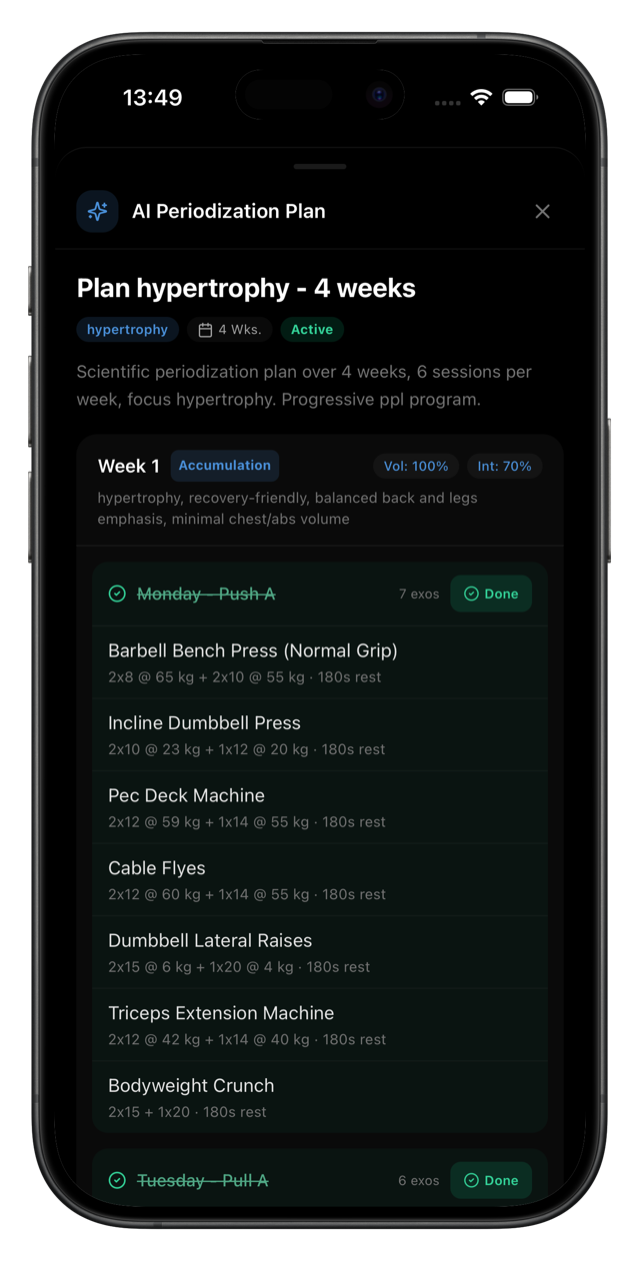
Apps like AIVancePro can structure a pull-up progression plan based on your current level and track weekly numbers automatically, useful for staying in the right volume zone without second-guessing your programming.
Nutrition and Recovery
The latissimus dorsi is a large muscle group. Pull-up progress depends as much on recovery as on training volume:
Protein Target 1.6-2g per kilogram of bodyweight daily. Without adequate protein intake, structural adaptations, including tendon remodeling, are significantly slowed.
Sleep Growth hormone is primarily secreted during deep sleep. 7-9 hours per night enables optimal neuromuscular and tendon recovery.
Active recovery On non-training days, light walking, swimming, or mobility work maintains blood flow without taxing the central nervous system.
Health disclaimer: This content is for informational purposes only. If you experience joint pain (shoulder, elbow, wrist) during or after pull-ups, consult a physical therapist before continuing your training.
FAQ
How long does it take to do your first pull-up?
Starting from zero, most people need 4-8 weeks of targeted work (negatives, active hangs, Australian pull-ups) to complete their first clean pull-up. Results vary based on starting bodyweight and how consistently you train.
Are resistance bands actually useful?
Yes, as a transitional tool, not a permanent crutch. Bands reduce load at the bottom of the movement (where it’s hardest to initiate) but not at the top. Use them for 3-4 weeks, then wean off by switching to progressively thinner bands.
Which grip builds strength fastest?
The supinated grip (palms facing you, chin-up) engages the biceps more efficiently and is mechanically easier. Great for building initial strength. The pronated grip (palms facing away, pull-up) is harder but more functionally transferable. Start with supinated until you hit 8-10 clean reps, then shift to pronated.
Can you do pull-ups every day?
At low volume (3-5 reps per pass) and moderate intensity, yes, that’s the Grease The Groove principle. Daily sets to failure lead to tendon overuse quickly. Alternate high-intensity days with very low-volume recovery days.
Why do my traps shrug up during pull-ups?
This is usually a sign of weak serratus anterior or lower trapezius. Add scapular pull-ups and face pulls to your routine to correct this compensatory movement pattern before it causes shoulder impingement.
Summary
Improving your pull-ups is a matter of method, not genetics. With the right program for your level, adequate training frequency, and targeted accessory work, most people can go from 0 to 10+ pull-ups in 3-6 months.
Start with negatives as a beginner. Apply Grease The Groove if you’re stuck in the intermediate range. Switch to weighted pull-ups as soon as you can perform 12 clean reps. For a personalized progression plan, AIVancePro offers bodyweight training programs adapted to your current level, available on iOS, first month at €3.49.
← Back to blog