Training volume is one of the most debated topics in strength training. How many sets per muscle group per week do you actually need to build muscle? Too few and you leave gains on the table. Too many and you risk overtraining and regression. Here’s what the science says, and how to apply it immediately.
Why Weekly Volume Is the Primary Driver of Muscle Growth
Training volume, the total number of working sets performed for a muscle group each week, is, alongside intensity, the main determinant of hypertrophy. Meta-analyses including Schoenfeld et al. (2017) confirmed a clear dose-response relationship: within certain limits, more volume produces more muscle growth.
Not all sets are equal, though. A working set is one taken close to muscular failure, typically within 1-3 reps of your limit. Warm-up sets don’t count. This distinction matters enormously: 10 quality working sets outperform 20 half-hearted ones every time.
Volume also needs to be progressive. A beginner doesn’t need 20 sets per muscle per week, 5-8 sets drive significant growth at that stage. An advanced lifter may need 15-20 to keep progressing. Calibrating volume to your training age is the art of smart programming.
What the Research Actually Recommends
Current sports science consensus points to 10 to 20 sets per muscle group per week as the optimal range for hypertrophy in most trained individuals:
- Below 5-6 sets/week: insufficient stimulus for meaningful growth, except in complete beginners
- 6 to 10 sets: maintenance or slow progression, appropriate for beginners
- 10 to 20 sets: optimal hypertrophy zone for intermediate and advanced lifters
- Above 20 sets: diminishing returns for most, with increased injury and fatigue risk
Krieger’s 2010 analysis showed that multiple sets produced roughly 40% more hypertrophy than single-set training, a compounding advantage over months and years. Keep in mind these are population averages. Some lifters thrive on 25+ sets per week, others hit their ceiling at 12. Individual auto-regulation is essential.
MEV, MAV, and MRV: The Three Volume Thresholds You Need to Know
Three concepts from Renaissance Periodization are invaluable for personalizing your volume:
MEV (Minimum Effective Volume) is the minimum weekly sets needed to trigger muscle adaptation, roughly 4 to 10 sets per week depending on the muscle group and your training age. Below MEV, you’re maintaining at best.
MAV (Maximum Adaptive Volume) is the range where you progress optimally, typically between 10 and 20 sets per week. Within this range, each additional set still yields a measurable hypertrophy benefit without overwhelming recovery.
MRV (Maximum Recoverable Volume) is the ceiling beyond which your body can’t recover adequately to adapt positively. Consistently exceeding your MRV leads to stagnation, chronic fatigue, and potential regression. This threshold is highly individual, it depends on training age, genetics, nutrition, sleep quality, and stress levels.
The winning strategy: start near MEV, progressively increase toward MAV over 4-6 weeks, then take a deload week (reduce volume by 40-50%) before starting a new block at a slightly higher baseline.
Weekly Sets by Muscle Group: Reference Table
Different muscle groups respond differently to volume. Muscles involved in many compound movements, back, quads, generally tolerate more direct volume than smaller isolation muscles like biceps and triceps.
| Muscle Group | MEV | MAV | MRV |
|---|---|---|---|
| Chest | 6 sets | 10-16 sets | 20 sets |
| Back (lats + traps) | 8 sets | 12-20 sets | 25 sets |
| Shoulders (deltoids) | 6 sets | 10-16 sets | 20 sets |
| Biceps | 4 sets | 8-14 sets | 18 sets |
| Triceps | 4 sets | 8-14 sets | 18 sets |
| Quadriceps | 8 sets | 12-18 sets | 22 sets |
| Hamstrings | 6 sets | 10-16 sets | 20 sets |
| Calves | 6 sets | 10-16 sets | 20 sets |
| Abs | 4 sets | 8-14 sets | 20 sets |
These values assume adequate protein intake (≥1.6g/kg bodyweight) and quality sleep (7-9 hours). Poor sleep or insufficient nutrition dramatically reduces your MRV.
How to Distribute Volume Across Your Week
Total weekly volume matters, but how you spread it is almost equally important. The golden rule: train each muscle group at least twice per week.
Why? Each training stimulus triggers a muscle protein synthesis window lasting approximately 48-72 hours. Beyond that, the anabolic signal fades. Training a muscle twice weekly maintains a near-continuous growth signal in the targeted fibers.
In practice, 16 chest sets split into 2 sessions of 8 (Monday and Thursday) outperforms a single 16-set session. Execution quality stays high throughout, fatigue is better managed, and recovery is optimized between sessions.
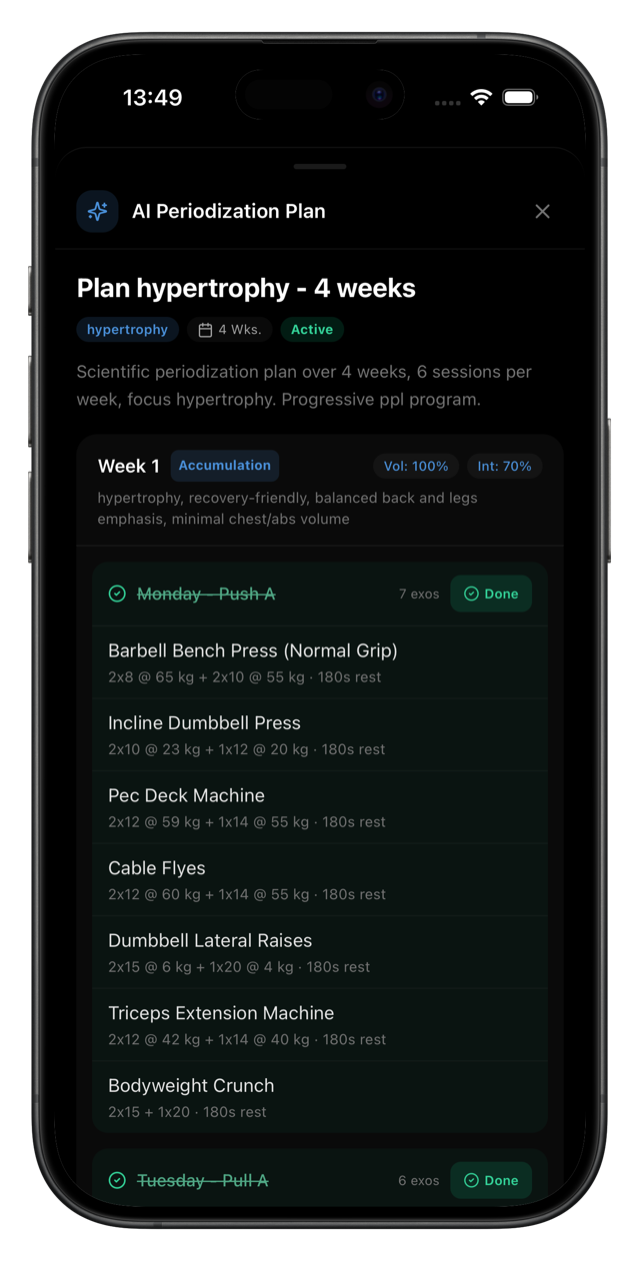
This distribution can be automatically calculated based on your available training days and priority muscles, which is exactly what AIVancePro’s AI coaching engine does when building your personalized program.
Progressive Volume Overload: How to Keep Growing
Staying at the same set count week after week is one of the primary causes of training plateaus. To keep progressing, you must apply progressive overload to volume, not just to load.
Practically: if you performed 10 back sets last week with full recovery and maintained strength, add 1-2 sets this week. Continue for 4-6 weeks until approaching your MRV, then take a deload week before starting a new block at a slightly higher baseline.
This accumulation → deload → renewed accumulation cycle is the structure of block periodization. It allows continuous progress while preventing chronic overtraining.
Warning signs you’ve exceeded your MRV: strength declining across multiple sessions, soreness persisting into your next training session, poor recovery despite adequate sleep, falling motivation, and general irritability. These signals call for an immediate deload.
The 3 Most Common Volume Mistakes
Mistake 1: Jumping to high volume too soon. The enthusiastic beginner doing 25 chest sets in week one ends up with severe soreness and a forced rest week. Start at a moderate volume around MEV and increase gradually. A useful rule: don’t increase total weekly volume by more than 10% per week.
Mistake 2: Never progressing your volume. Keeping the same program with the same sets for months means the body fully adapts to the stimulus and growth stops. Progressive volume overload isn’t optional, it’s the condition of long-term progress.
Mistake 3: Counting sets without assessing quality. Twenty sets with insufficient load or excessive reserves won’t produce the same results as 12 sets taken close to muscular failure. Proximity to failure, not raw set count, is the primary driver of the hypertrophic stimulus.
Conclusion
How many sets per muscle group per week for optimal hypertrophy? For most lifters, the sweet spot sits between 10 and 20 weekly sets, distributed across at least 2 sessions per muscle group. Start conservatively around 8-10 sets, build progressively over 4-6 weeks, monitor recovery signals, and schedule regular deload weeks.
If you want a program that automatically calculates and adjusts your volume week to week based on your actual progress, AIVancePro builds fully personalized training plans with AI-driven volume progression. Available on iOS, first month at €3.49.
This article is for educational purposes only and does not replace advice from a qualified health professional or certified coach. Consult a physician before significantly changing your training program, especially if you have a history of musculoskeletal injuries.
FAQ
How many sets per muscle group per week for a beginner?
6 to 10 sets per muscle group per week is plenty for beginners. The novelty stimulus is powerful enough that even moderate volume drives significant growth in the early months. Build gradually before targeting 15-20 sets.
Is the same volume recommendation applicable to all muscle groups?
No. Larger muscle groups like back and quads tolerate more volume than smaller ones like biceps and triceps. The back can benefit from 15-25 weekly sets in advanced lifters, while biceps often saturate at 12-16 sets.
What happens if I consistently exceed my MRV?
Your body can’t recover adequately between sessions. You’ll notice progressive strength decline, persistent soreness, degraded sleep quality, and sharply reduced training motivation. Take an immediate deload week and reassess your total volume.
How often per week should each muscle group be trained?
Research recommends a minimum of twice per week for optimal hypertrophy. Three times per week can benefit advanced lifters, provided total volume is intelligently distributed to avoid overloading joints and tendons.
How do I know if my volume is too high?
Warning signs: strength declining across consecutive sessions, soreness still present at your next session, poor sleep quality despite sufficient rest, and sharply falling training motivation. If you’re experiencing 2-3 of these simultaneously, reduce your volume by 30-50% for one week.
← Back to blog