If you’re stuck between a split vs full body workout, you’re not alone, it’s one of the most asked questions in lifting after “how many sets for chest?”. The good news: there’s a clear answer based on your profile and goal. This guide will help you decide.
Full body and split: two different philosophies
A full body routine hits every major muscle group in each session. Squat, bench press, row, core, all in one workout, repeated 2 to 3 times a week.
A split routine separates muscles by day: chest/triceps Monday, back/biceps Wednesday, legs Friday. Each muscle group is targeted once per week with high volume.
The difference isn’t just scheduling. It changes stimulation frequency, volume per session, recovery, and most importantly, the results you’ll get.
Why full body works for most people
Full body checks several boxes for the majority of lifters.
High training frequency. Each muscle is stimulated 2 to 3 times a week. The science is clear since Schoenfeld’s 2016 meta-analysis: at equal volume, higher frequency maximizes muscle protein synthesis.
Time-efficient. Three 60-minute sessions a week cover all your muscles. If you miss one session, you haven’t neglected an entire muscle group for the week.
Beginner-friendly. You practice compound lifts (squat, deadlift, bench press) every session. Repetition speeds up technical mastery much faster than once-a-week split work.
Great for fat loss. Energy expenditure per session is high, and your metabolism stays elevated longer thanks to EPOC (post-exercise oxygen consumption).
Why split workouts have their place
Split routines have real strengths, given the right profile.
High volume per muscle group. You can do 16 to 20 sets of chest in a single session. For an advanced lifter chasing maximum hypertrophy, this is very effective.
Localized recovery. You don’t hit a muscle again for 5 to 7 days. If your chest is still sore from Monday, you can still train back on Wednesday with no compromise.
Mental focus and pump. Many athletes love the total focus on one muscle group. Mind-muscle connection and pump are dialed in.
Suited to advanced lifters. After 2-3 years of serious training, your body needs significant weekly volume to keep progressing. Split routines fit that volume without overloading every session.
The drawbacks to know
No system is perfect. Watch out for these.
Full body: hard to fit big volume without 90-minute sessions. Cumulative fatigue from compounds can limit performance on later exercises, especially if you stack heavy squats and heavy bench in the same session.
Split: one stimulation per week per muscle is weak if you skip a session. Plateau risk increases after a few months if you don’t manipulate variables (intensity, tempo, volume). It’s also less compatible with aggressive cuts, where fatigue limits the number of effective sets.
Which program fits your profile?
Here’s what works in practice:
| Profile | Recommended program | Frequency |
|---|---|---|
| Beginner (0-12 months) | Full body | 3 sessions/week |
| Intermediate (1-3 years) | Upper/Lower or Push/Pull/Legs | 4 sessions/week |
| Advanced (3+ years) | Classic split | 5-6 sessions/week |
| Returning from a break | Full body | 2-3 sessions/week |
| Fat loss goal | Full body | 3-4 sessions/week |
| Pure mass building | Split or PPL | 5-6 sessions/week |
Push/Pull/Legs (PPL) is an excellent middle ground: three themed sessions repeated twice a week, giving frequency 2 per muscle group. It’s often the best entry point when moving from full body to split.
How to combine both across the year
You don’t have to pick once and for all. Smart periodization alternates the two approaches across phases:
- Mass-building blocks (8-12 weeks): split to maximize volume
- Cutting phases: full body to preserve metabolism and muscle
- Returning from injury or break: full body to rebuild motor patterns
- Strength-focused blocks: full body with low reps and long rest
This alternation breaks routine and keeps stimulating different adaptations. Many advanced lifters cycle through 3-4 blocks per year.
Nutrition and recovery still rule
Whether you go split or full body, two variables decide your results beyond the program itself.
Protein intake should hit 0.7 to 1 g per pound of bodyweight (1.6-2.2 g per kg) per day. Without this, neither approach delivers visible results. Spread across 3-4 meals, it works even better.
Sleep is non-negotiable: 7 to 9 hours a night. Muscle protein synthesis peaks during deep sleep, and anabolic hormones (GH, testosterone) follow the same rhythm.
A perfect program on paper never compensates for poor recovery. That’s the first thing to audit if you stagnate.
Conclusion
Between split vs full body workout, there’s no universal winner. For 80% of lifters, beginners, intermediates, and anyone with a packed schedule, full body 3 times a week delivers the best results. Advanced lifters chasing maximum volume thrive on a structured split or PPL.
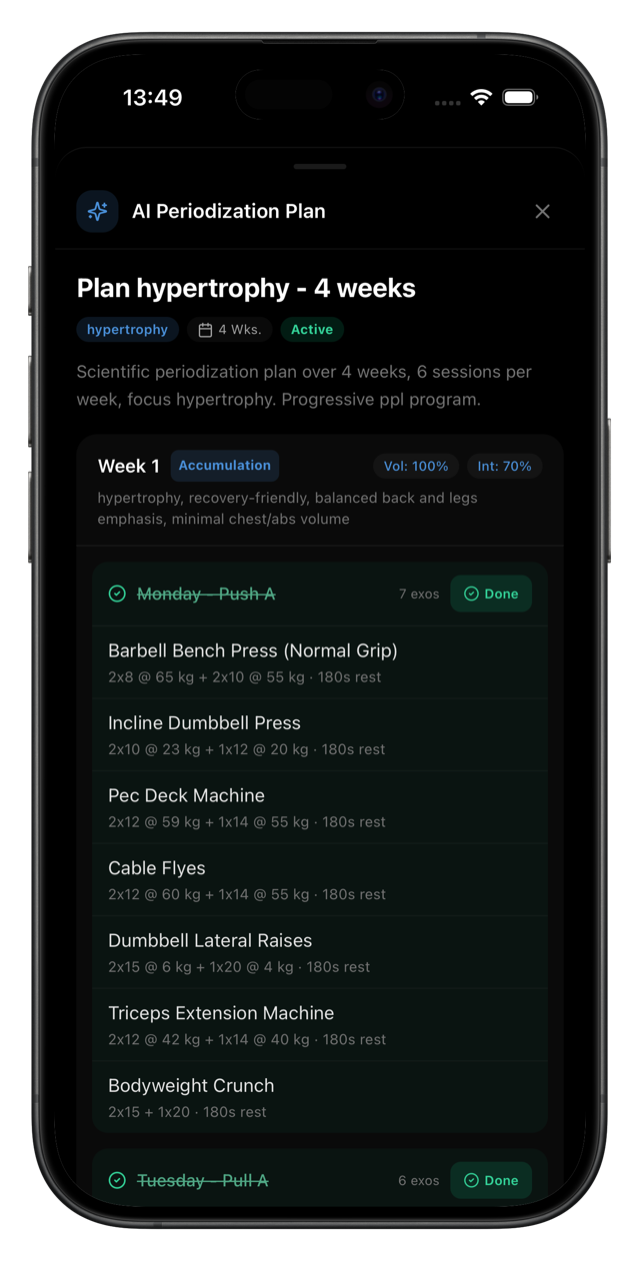
To help you structure your program and match volume to your real progression, AIVancePro offers an integrated AI coach that adjusts your sessions one at a time, whether you’re running full body or split. The app tracks load, fatigue, and history to suggest the optimal next session. Available on iOS, first month at 3.49€.
Health disclaimer: The advice in this article is for informational purposes only. Before starting a new training program, especially if you have a medical history, consult a healthcare professional or certified coach.
FAQ
Is full body less effective than split for muscle gain?
No, not inherently. At equivalent weekly volume, full body produces gains at least comparable, often superior, thanks to higher stimulation frequency. Advanced lifters may simply need more weekly volume than fits into 3 full body sessions.
How long does a full body session take?
60 to 75 minutes, warm-up included. Past that, execution quality drops and cortisol rises. A dense 60-minute session beats a 90-minute marathon.
Can you mix full body and split in the same week?
Rarely, and it’s hard to manage. You’ll either overlap muscle groups without enough recovery, or create irregular frequency. Pick an approach for 8 to 12 weeks, then switch.
Which split should an intermediate use?
Push/Pull/Legs (PPL) on 6 days, or Upper/Lower on 4 days. Both deliver frequency 2 per muscle group, the proven optimum from research.
Is full body good for fat loss?
Excellent. Per-session calorie burn is high, EPOC is elevated, and you preserve muscle thanks to frequency. It’s the go-to format during a cut.
← Back to blog