
Starting a workout program can feel overwhelming. Hundreds of YouTube channels, conflicting Reddit threads, and supplement companies screaming at you from every angle. Let’s cut through the noise. This beginner workout program is built on actual sports science, designed to get you strong and muscular as efficiently as possible, without the fluff.
Why Most Beginners Fail (And What Actually Works)
Walk into any gym and you’ll spot two types of beginners: those wandering aimlessly between machines, and those copying a pro bodybuilder’s 6-day split from Instagram. Both approaches fail for the same reason, they ignore how a beginner body actually responds to training.
Here’s the reality: as a beginner, your nervous system adapts faster than your muscles. This is a massive advantage. It means you can, and should, train more frequently than advanced athletes. A full-body program hitting every muscle group 3x per week is dramatically more effective than a bro split where you train chest once a week and call it a day.
The Science Behind Training Frequency
Muscle protein synthesis (MPS), the process through which muscles grow, peaks around 24-36 hours post-training and returns to baseline within 48 hours. This means if you train chest on Monday and don’t touch it again until the following Monday, you’re leaving 5+ days of potential growth completely on the table. A 3x/week full-body program keeps MPS elevated more consistently, week after week. Once you can train chest several times a week, pick your pressing movements from our guide to the best chest exercises for mass.
The 3-Day Full Body Program
Schedule: Monday / Wednesday / Friday (or any 3 non-consecutive days that fit your life)
Workout Template
| Exercise | Sets | Reps | Rest |
|---|---|---|---|
| Squat | 3 | 8-10 | 2 min |
| Bench Press | 3 | 8-10 | 2 min |
| Barbell Row | 3 | 8-10 | 2 min |
| Overhead Press | 3 | 8-10 | 90 sec |
| Barbell Curl | 2 | 10-12 | 60 sec |
| Tricep Pushdown | 2 | 10-12 | 60 sec |
| Plank | 3 | 30 sec | 45 sec |
Progressive Overload: The Engine of Growth
One rule to live by: when you hit 3 sets of 10 clean reps, add 5 lbs (2.5 kg) next session. This is progressive overload, the single most important concept in strength training. Your muscles adapt to stress. The only way to keep growing is to keep increasing that stress in a controlled, systematic way. No progressive overload = no progress.
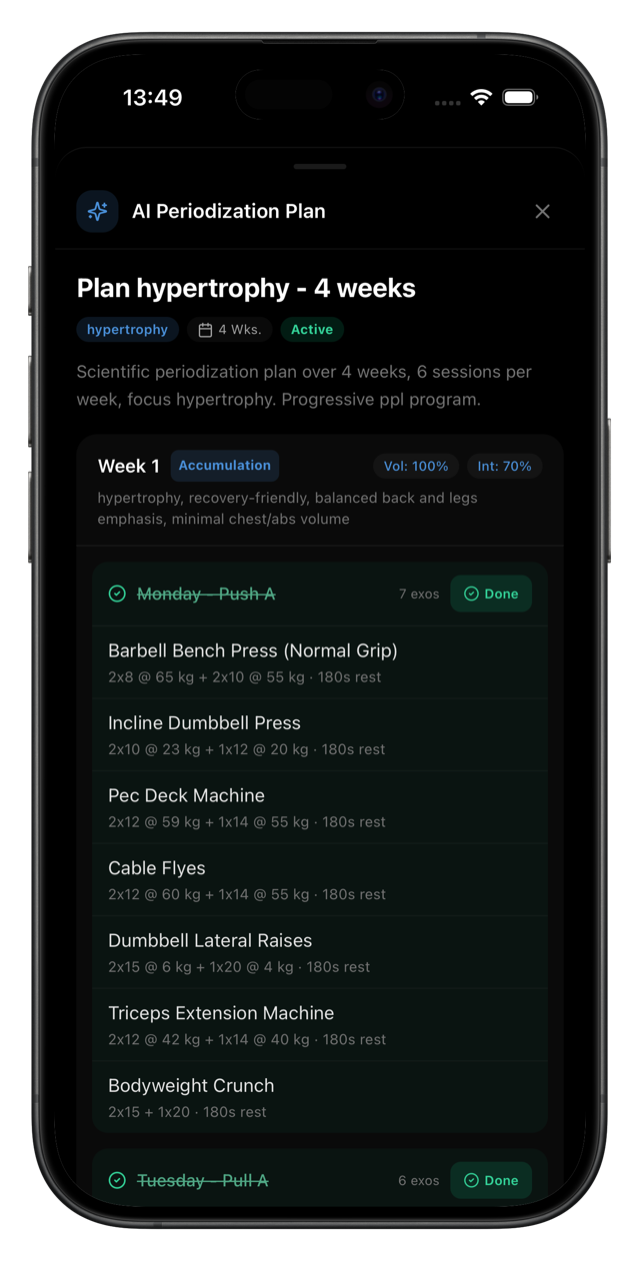
AIVancePro tracks your progressive overload automatically so you never have to guess what weight to use next session.
Technique First, Weight Second
American gym culture glorifies heavy weight above all else. Ego lifting is real, it’s everywhere, and it gets people hurt. Before you add plates, master the movement pattern. A 135 lb squat with perfect form builds more muscle than a 225 lb squat with caving knees and a rounding lower back, and it keeps you in the gym instead of in physical therapy.
The Big 4 Movements to Master First
- Squat: Knees tracking over toes, chest up, depth at least to parallel
- Bench Press: Shoulder blades retracted and depressed, slight arch, bar touching lower chest
- Deadlift: Neutral spine, hinge at the hips, bar dragging up your shins throughout the lift
- Barbell Row: Flat back, elbows driving back and up, hard squeeze at the top
Check out our complete beginner training guide for detailed technique breakdowns on each of these movements.
Nutrition for Muscle Growth
Training is the stimulus. Nutrition is the raw material. Without adequate protein and total calories, muscles simply don’t grow, no matter how hard or how smart you train.
Protein: The Non-Negotiable
The current scientific consensus: 1.6-2.2g of protein per kilogram of bodyweight per day maximizes muscle protein synthesis (Stokes et al., 2018, British Journal of Sports Medicine). For a 180 lb (82 kg) person, that translates to 130-180g of protein daily.
Top protein sources to prioritize:
- Chicken breast, turkey, lean ground beef
- Eggs and Greek yogurt
- Salmon, tuna, shrimp
- Cottage cheese
- Lentils and chickpeas (great for plant-based athletes)
Caloric Surplus vs. Maintenance
As a beginner, body recomposition is a real thing, you can genuinely gain muscle and lose fat simultaneously, even at maintenance calories. This is a beginner-exclusive advantage. A modest surplus of 200-300 calories accelerates muscle gain without piling on excessive fat. Start at maintenance, assess after 4 weeks, adjust from there.
Our complete nutrition guide covers macros, meal timing, and everything you need to know about eating for performance.
Recovery: Where Growth Actually Happens
You don’t grow in the gym. You grow in the 48 hours after the gym. Recovery isn’t a passive process, it’s where the actual adaptation takes place, and most beginners completely ignore it.
Sleep: Your Anabolic Window
7-9 hours per night isn’t a suggestion, it’s a physiological requirement. Deep sleep (NREM stage 3) is when growth hormone is released and muscle repair happens at full capacity. Chronically short-changing sleep tanks testosterone levels, elevates cortisol, and directly sabotages your recovery and progress. No supplement on the market compensates for consistently bad sleep.
Rest Days Are Part of the Program
Taking rest days doesn’t make you lazy, it means you understand basic physiology. Your muscles don’t grow during the training session; they grow during rest. On recovery days, prioritize:
- Light walking or mobility work (not a second workout)
- Consistent protein intake
- 8+ hours of quality sleep
- Stress management techniques
Dive deeper into recovery strategies with our recovery and injury prevention guide.
Timeline: When Will You See Real Results?
Honest expectations, no BS:
- Weeks 1-4: Neural adaptations, you’ll lift significantly more weight, but visible muscle changes are minimal
- Weeks 6-8: First visible changes (people around you start noticing)
- Months 3-6: Significant, measurable body composition transformation
Consistency beats intensity every single time. Three average workouts per week for 6 months will transform your physique more than 6 weeks of extreme, unsustainable training followed by burnout. Show up, do the work, track the numbers.
AIVancePro: Your AI Training Partner
AIVancePro builds your personalized workout program based on your experience level, available equipment, and specific goals. The app automatically adjusts weights, volume, and exercise selection week by week to ensure continuous progress, no guesswork required.
Health Disclaimer: This article is for informational purposes only. Consult a healthcare professional before starting any new exercise program, especially if you have pre-existing medical conditions or injuries. Stop exercising and seek medical attention if you experience pain or discomfort.
FAQ
How many days per week should a beginner work out?
3 days per week is optimal for beginners. It delivers sufficient training stimulus for muscle growth while allowing full recovery between sessions. After 6 months of consistent training you can progressively increase frequency to 4 days if your schedule allows.
Can I build muscle without a gym membership?
Absolutely. Bodyweight training, push-ups, pull-ups, dips, bodyweight squats, lunges, builds significant muscle during the beginner phase. Check our home gym guide for budget equipment recommendations that will unlock your next level of training.
How do I know if my program is working?
Track your lifts. If you’re moving more weight than 4 weeks ago on your main compound movements, you’re progressing. If you’ve stalled for 3+ consecutive weeks, investigate your sleep quality, protein intake, and overall program structure before changing exercises.
Should I do cardio while trying to build muscle?
Light to moderate cardio (2-3x/week, 20-30 minutes) supports cardiovascular health and active recovery without meaningfully impacting muscle growth. High-intensity cardio every day is counterproductive when your primary goal is building muscle as a beginner.
← Back to blog