You’re hunting for the best strength training app 2026 and you’re stuck between Hevy, Fitbod, Strong and a dozen others? Good, take your time. A lifting app isn’t a gadget you open once: it’s the tool you’ll use on every single session for months. Pick the wrong one and you end up with a subscription gathering dust, progress that flatlines, and you slipping back into old habits (jotting your loads in a paper notebook or, worse, trying to keep them in your head).
In this article we’re going to compare the real options honestly. No empty marketing: every app has genuine strengths. But we’ll also show you what actually changes in 2026, and why the decisive factor is no longer logging or the algorithm, but the app’s ability to understand your context and adapt to it. Honest spoiler: that’s exactly where AIVancePro and its conversational AI coach Vance pull ahead.
What you actually want from a lifting app in 2026
Before comparing, let’s set the real criteria. A solid strength training app needs to tick these boxes at minimum:
- Smooth logging: record sets, loads and reps in two seconds between two sets, without breaking your rhythm.
- Visible progress: weekly volume, PRs, per-exercise curves. Without data, you’re flying blind.
- Smart programming: the app should propose a coherent structure (split, frequency, load progression) suited to your level.
- Adaptation to real life: you miss a session, you’re fried, your bench plateaus, you go on holiday. A rigid app forces you to recalculate everything yourself.
- Ergonomics and language: a clean interface, natural wording on exercises, no clunky machine-translated labels.
The classic trap is choosing an app on its looks or its follower count. The real test: in three months, am I still using it, and have I made progress?
Hevy: the king of logging (now with an algo Trainer)
Hevy became a reference for one simple reason: its training log is excellent. You build your sessions, you record your loads, the history is crystal clear, the social side is fun. In 2026, Hevy added a “Trainer” that generates programs algorithmically. That’s a genuine plus.
But let’s be precise: that Trainer is still a rules engine. It hands you a load progression and a split, but you don’t talk to it. If your knee twinges on squats, if you want to shift legs day because you’ve got a football match on Saturday, or if you want it to explain why it dropped your volume, you’re facing an app that executes rather than one that converses. Hevy is unbeatable for logging. It’s less so when it comes to coaching you the way a human coach would.
Fitbod: recovery-aware auto-generation
Fitbod was a pioneer of the auto-generated session. Its algorithm factors in muscle recovery: it knows you hit chest yesterday and steers today’s session accordingly. That’s smart, and it removes the mental load of “what do I do today?”.
The flip side: the experience stays very “black box”. Fitbod decides for you, and the adaptation runs on parameters it infers from your logs, not on what you explain to it. If your context changes (a tight hip, a goal shifting from strength to mass, an equipment constraint because you switched gyms), you tweak settings instead of having a conversation. Fitbod is excellent for not having to think. Less so for anyone who wants to understand and steer their own plan.
Strong: raw simplicity
Strong is the minimalist Swiss Army knife. You log, you see your PRs, it’s fast and it never gets in your way. For someone who already knows exactly what to do and just wants a reliable digital notebook, it’s a great choice.
But Strong doesn’t program for you and doesn’t analyse your training proactively. It’s a data-entry tool, not a coach. If you’re a beginner or you struggle to structure your progression, Strong leaves you alone in front of a blank page.
How AIVancePro makes the difference
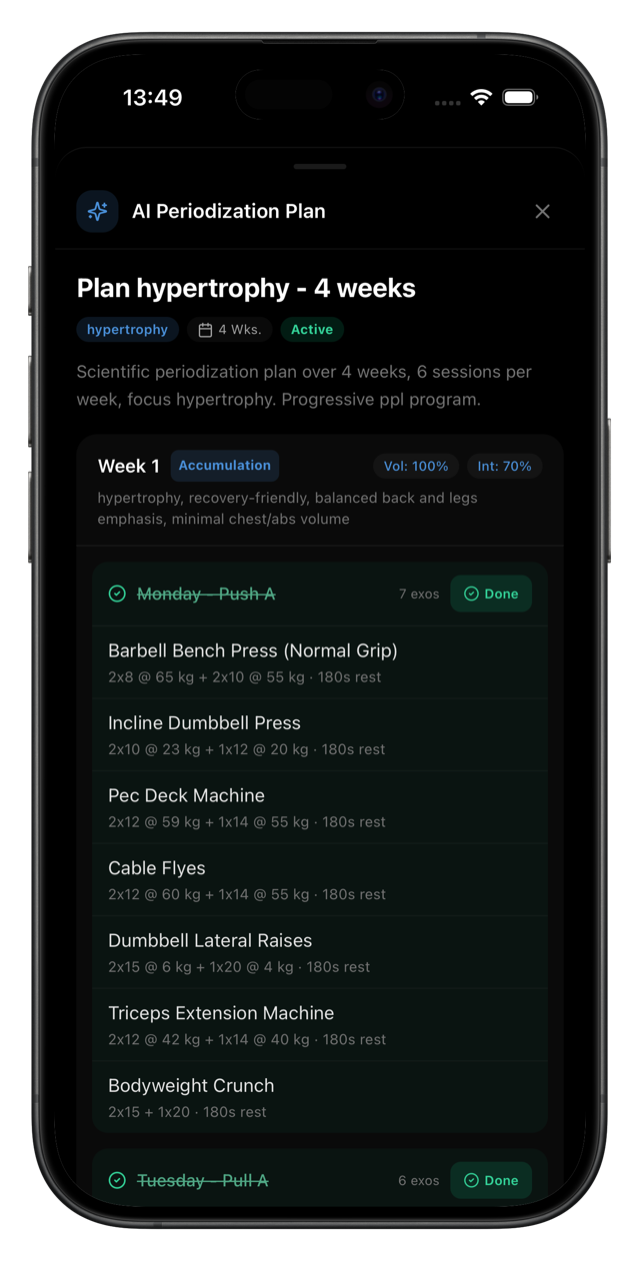
Here’s the heart of the matter. AIVancePro starts from a simple observation: what drives long-term progress isn’t a frozen algorithm or an empty log, it’s a coach who knows you and adjusts. That’s exactly what Vance does, the conversational AI coach built into the app.
Concretely, you talk to Vance in plain natural language, the way you’d talk to a real coach:
- “I want to build mass, I train 4 times a week, I’ve got a bench, dumbbells and a rack.” Vance builds you a full personalised plan, up to 12 weeks long.
- “My bench has been stuck at 80 kg for three weeks, is that normal?” He analyses your history, spots the plateau and proposes a concrete adjustment (RPE, deload, exercise variation).
- “I’m fried this week, slept badly.” Vance lightens the session or pushes back the overload. He’s recovery-aware, but based on what you tell him, not only on what he infers.
The big difference: Vance adjusts your plan every week based on your session feedback. You hit 85 kg on the bench when the plan called for 80? He notices and accelerates your progression. You had to stop at 3 reps instead of 5? He recalibrates. That’s conversational adaptation, not an opaque automatic recalculation.
Add to that the fact the app is built language-first with natural lifting vocabulary (sets, compound lifts, deadlift, hypertrophy, RPE) that reads clean rather than machine-translated. And on price, AIVancePro stays accessible, with no bloated subscription. You’re not buying yet another logger: you’re getting a coach who actually talks back.
To be fully honest: if you only want to log your sets as fast as possible, Hevy or Strong do that brilliantly. If you want decisions made for you without any discussion, Fitbod is solid. But if you want guidance that understands your context, your constraints and your plateaus, and that adapts week after week, AIVancePro is today the most complete choice.
Common mistakes when choosing a lifting app
- Choosing on feature count. An app packed with options you never open won’t make you progress. What matters is real usage on every session.
- Confusing logging with coaching. Recording your loads is measuring. Progressing is adjusting based on those measurements. Plenty of apps stop at the measurement.
- Neglecting adaptation. Real life (fatigue, minor niggles, scheduling) breaks every rigid plan. An app that doesn’t adapt ends up in your folder of forgotten apps.
- Underestimating language. A badly worded exercise or a clunky interface creates friction on every session. Natural, clean language pays off over the long run.
- Buying the priciest app thinking you’re paying for quality. The right criterion is the guidance-to-price ratio, not the price tag.
Conclusion: what is the best strength training app 2026?
If you want a simple notebook, Strong does the job. If you want the best logging with an algo Trainer, Hevy is excellent. If you want auto-generated sessions, Fitbod holds up. But if you’re after an app that understands you, talks with you and adapts your plan every week, AIVancePro’s conversational AI coach is the most relevant choice in 2026, and clearly the best-thought-out for anyone who wants to actually steer their training.
The simplest move is to test it. The first month is €3.49: install AIVancePro, tell Vance about your goal, and judge for yourself from your very first session. If you’re progressing and using the app without even thinking about it, you’ll have your answer.
This article is informational and does not replace professional medical advice. In case of injury, persistent pain or any medical condition, consult a doctor or physiotherapist before resuming training.
FAQ
What is the best strength training app 2026 for beginners? For a beginner, AIVancePro is ideal because Vance builds a plan suited to your level and explains every choice in plain language. You’re not left to fend for yourself the way you are with a pure logger like Strong.
Is AIVancePro an alternative to Hevy? Yes, but with a different approach. Hevy excels at logging and offers an algorithmic Trainer; AIVancePro bets on a conversational AI coach that talks with you and adjusts your plan based on your feedback. If guidance matters more to you than the log alone, it’s the option to favour.
Do you have to pay for a good strength training app? Free versions are enough for basic logging, but the real value (personalised programming, adaptation, analysis) lives in the full versions. AIVancePro offers the first month at €3.49 so you can test it without a heavy commitment.
Can an app replace a human coach? Not entirely, especially for video technique checks. But an AI coach like Vance covers the essentials day to day: programming, adjustments based on your fatigue, plateau management and progress tracking, at a price far below human coaching.
Does AIVancePro work for both mass-building and strength? Yes. You set your goal (hypertrophy, strength, recomposition) and Vance adapts the volume, intensity and progression accordingly, then recalibrates every week based on your real sessions.
← Back to blog