
A productive morning workout routine isn’t built on motivation, it’s built on a system that survives the days you’re tired, late, or unmotivated. AIVancePro’s conversational AI coach adapts your session to your sleep, schedule, and equipment so every morning compounds toward results, even when life gets busy.
Training before 8 AM isn’t reserved for elite athletes or cold-plunge enthusiasts. It’s a simple strategy to free up your evenings, lock in consistency, and stack progress week after week. The catch: your routine needs to be calibrated for the morning, not copy-pasted from a 6 PM bodybuilder program.
Why morning training actually works
The AM window has three concrete advantages most people fail to exploit. First, decision friction is minimal: if your session starts at 6:45 AM, you haven’t had time to invent an excuse. Second, your work calendar hasn’t eaten your slot yet, no 7 PM meeting overrun to cancel your gym night. Third, across 3-4 weekly sessions, consistency climbs roughly 30% among morning trainees according to behavioral data from multiple tracking apps.
What doesn’t work: waking at 5 AM after going to bed at midnight. True morning productivity rests on 7-8 hours of sleep minimum. Skip that, and you trade muscle for cortisol, your lifts drop within three weeks.
Building a morning routine that sticks
A sustainable morning routine breaks down into four simple blocks: wake-up, hydration, light mobility, training. Skip the 20-minute meditation and gratitude journaling, those add-ons crumble the first time you’re rushed.
Wake-up (5 min): same alarm time every day, weekends included with ±30 min tolerance. Your circadian rhythm rewards regularity more than extreme timing.
Hydration (2 min): 500 ml of room-temperature water. You’ve gone 7-8 hours without drinking, your blood plasma is concentrated and your performance is already in debt.
Light mobility (5-8 min): joint rotations, cat-cow, deep bodyweight squat hold for 30 seconds, active hip and shoulder stretches. Avoid long passive stretching, it can reduce strength by up to 5% in the first hour.
Training (25-45 min): the part that produces results. We’ll get to it.
If you can sustain this sequence 5 days out of 7 for three weeks, you have a routine, not before.
Optimal duration and intensity at wake-up
Your body isn’t warm at 6:30 AM. Your spine is stiff, your nervous system half-asleep, your joints still cold. Pushing a 1RM on the first set is a guaranteed injury within two months.
Simple rule: start at 60-70% of the intensity you’d use at 6 PM, then ramp up. Your first two warm-up sets are non-negotiable, never skipped.
Optimal duration for a sustainable morning routine:
- 30-35 min if you leave for work early
- 45-50 min if you have a bit more flexibility
- 60 min max: beyond that, you sacrifice sleep or breakfast
Intensity climbs with the sets, not with the clock. A short, well-structured session beats a one-hour session interrupted by phone breaks.
What to eat (or skip) before your morning session
The fasted vs. fed debate has split lifters for 15 years. The truth is short:
- Session < 45 min, moderate intensity: fasted works, especially with coffee.
- Session > 45 min or very intense: 20-30 g fast carbs + 10 g hydrolyzed protein 20 min before.
- If you’re bulking: don’t skip this pre-workout snack, you’ll lose tonnage over time.
Concrete morning pre-workout snacks that work: 1 banana + 1 scoop of whey, 1 slice of whole-grain bread + honey, 1 Greek yogurt + oats. Skip eggs, avocado, or anything fatty, they slow digestion and tank your session.
Coffee 30 minutes pre-workout increases force performance by roughly 2-7% according to recent meta-analyses. Keep it simple: black, 150-200 mg of caffeine.
A complete 35-minute morning workout
Here’s a full-body morning session for an intermediate lifter training 2-3 times per week, executable at a commercial gym or at home with a barbell and bench.
Warm-up (5 min): 5 min of moderate cycling or rowing + 10 shoulder rotations + 10 hip swings.
Main block (25 min):
- Barbell squat, 3 sets × 6 reps, 2 min rest
- Bench press, 3 sets × 6 reps, 2 min rest
- Bent-over barbell row, 3 sets × 8 reps, 90 sec rest
- Romanian deadlift, 2 sets × 8 reps, 90 sec rest
- Pull-ups or lat pulldown, 2 sets × 8 reps, 90 sec rest
Finisher (5 min): 3 rounds of 10 push-ups + 10 crunches + 30 sec plank, 30 sec rest between rounds.
This session hits all six major movement patterns (squat, hinge, horizontal push, vertical push, horizontal pull, vertical pull) in under 35 minutes. Three sessions per week of this format are enough to progress over 6 months.
How AIVancePro adapts your routine to your wake-up
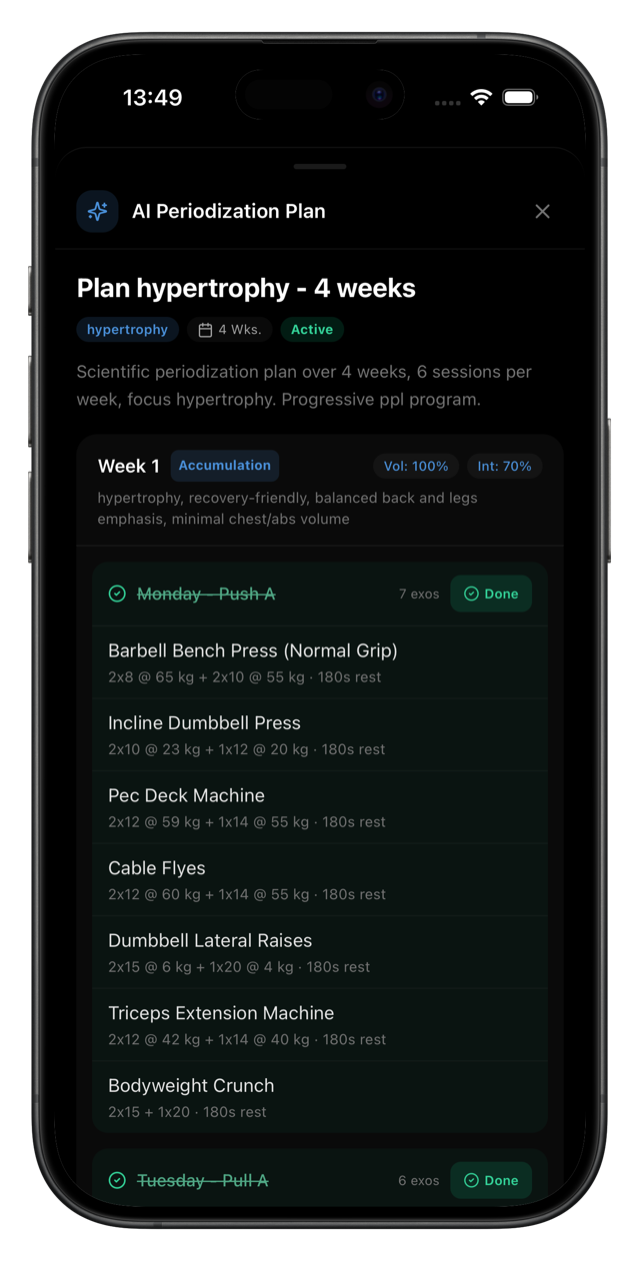
This is where most standardized programs fail: they don’t know you slept badly Tuesday, you have an 8 AM meeting Thursday, and you only have dumbbells in your Airbnb on Friday. AIVancePro integrates these variables in real time through a simple conversation with your AI coach Vance.
You tell him in the morning: “Slept 5 hours, I’m wrecked.” Vance proposes a deloaded session at 70% of planned tonnage, or swaps to a mobility block if fatigue is too high. You say: “I only have 25 minutes.” He recomposes your session around two compound lifts instead of five, without breaking your weekly progression.
The app also tracks your morning consistency and shows you objectively how many sessions you’ve completed before 9 AM this month. Not to guilt-trip, to adjust your plan if you systematically skip Wednesdays because you stay up late Tuesdays.
First month at €3.49 to test the personalization, then €6.99/month. No commitment.
5 mistakes that wreck a morning routine
- Going to bed at midnight and compensating with 3 coffees: you destroy muscle recovery and plateau within four weeks.
- Long passive stretching pre-workout: you lose explosive strength for the first hour. Save stretching for the evening.
- Eating too much right before: cap pre-workout intake at 300 calories within 60 minutes, blood goes to your stomach, not your muscles.
- Trying to do everything in 1 month: a morning routine is a marathon. Add one block at a time (wake-up, then hydration, then training), not all at once.
- Following a program designed for evening training: optimal loads, rest periods, and volumes differ. An 18:00 program will break you at 6:30.
Conclusion
A productive morning workout routine isn’t a question of heroic discipline, it’s a question of system. Lock your bedtime, hydrate on wake-up, structure a 30-45 minute session calibrated to your level, and run the rhythm for 21 days to anchor the habit.
AIVancePro gives you the conversational AI coach that adapts your routine to your sleep, calendar, and equipment, not a rigid program that demands peak form at 6:30 every day. Download the app on iOS (Android also available), first month at €3.49, and start tomorrow morning.
Health disclaimer: the advice above is general. If you have a medical history, joint pain, or are returning from a long break, consult a doctor or physiotherapist before starting an intense training routine.
FAQ
How long until a morning routine becomes automatic?
Count 21 to 30 days to anchor the wake-up-hydration-session sequence as an automatic habit. The first three weeks are the hardest, especially weeks with poor sleep. Hold the line on timing consistency more than on performance.
Should I train fasted in the morning to lose fat?
Not necessarily. A fasted session burns slightly more fat during the workout itself, but your 24-hour calorie balance is the deciding factor. If fasted training makes you skip sessions because you lack energy, eat a small snack and train properly.
Is a morning routine compatible with muscle building?
Yes, provided you supply enough calories across the day and don’t skip the post-workout meal. A protein shake plus oats within 30 minutes after the session is enough to kickstart protein synthesis.
What’s the ideal start time for a morning session?
Between 6:30 and 7:30 AM for most schedules. Earlier works if you sleep accordingly. Avoid training within the first hour of waking without an extended warm-up, your spine and intervertebral discs are sensitive at that moment.
How does AIVancePro pick exercises for my morning session?
Vance asks you 4-5 questions at setup (available equipment, target frequency, goal, physical constraints) and builds a session that respects your available time and current level. You can edit in real conversation: “swap the squat for lunges”, “add 5 minutes of cardio”. The app learns your preferences after each session.
← Back to blog