Hitting a plateau isn’t the end of progress, it’s a signal that your program needs adjustment. With AIVancePro’s conversational AI coach, plateau detection is automatic: the app spots stalled lifts in your logs and adapts volume, intensity, and exercise selection to get you moving again. This guide walks you through the exact levers to pull.
Confirm It’s an Actual Plateau
Before tearing your program apart, make sure you’ve actually stalled. A real plateau means 3 to 4 consecutive weeks with no measurable progression on your main lifts (squat, bench, deadlift, pull-ups). One bad session or a rough week is not a plateau.
Signs of a true plateau:
- Same loads at the same volume for 3+ weeks
- Persistent heaviness even on rest days
- Strength regressing on reference lifts
- Inability to complete usual sets with proper form
First rule out: sleep below 6 hours/night, protein under 1.6 g/kg, chronic stress, or a calorie deficit during a bulk. Fix those before touching the program.
Diagnose the Cause: Volume, Intensity, or Recovery
You can’t adjust what you don’t understand. Three main causes of plateaus:
1. Insufficient volume, 8 weekly sets per muscle and stalled for two months? You’re likely below the minimum effective dose for your level (10-20 sets/week for intermediates).
2. Stagnant intensity, Always training at RPE 6-7, never close to failure. Intermediates need 2-4 RIR on working sets to drive adaptation.
3. Recovery debt, Adding volume for two months with no deload accumulates fatigue that masks real progress.
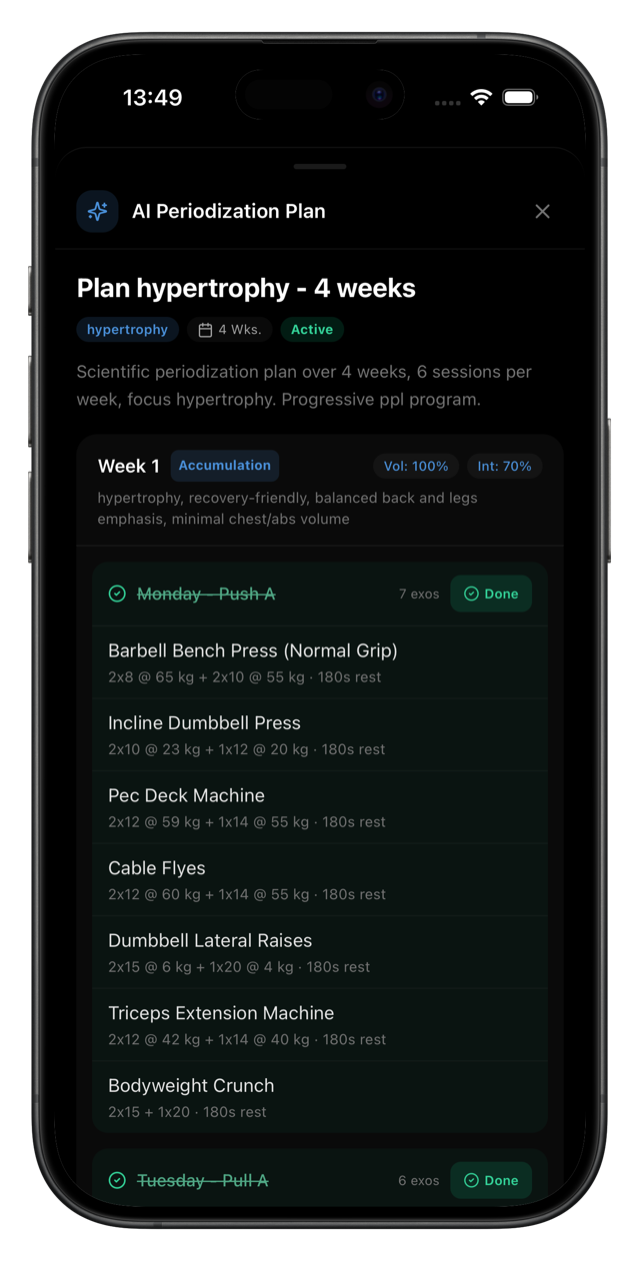
AIVancePro analyzes your last four weeks of sessions automatically (loads, reps, self-reported RPE) and pinpoints which one of the three is your bottleneck. No spreadsheet needed to know whether you’re under-volumed on chest or under-recovered on legs.
Lever 1: Adjust Volume (Sets per Muscle per Week)
Volume is your first lever. General guidelines:
- Beginner: 8-12 effective sets per muscle/week
- Intermediate: 12-18 sets
- Advanced: 16-22+ sets
Stuck at 10 sets/week on chest for six weeks? Add 2 working sets over a 3-week ramp, then reassess. Not 5 sets overnight, you’d blow past your recovery capacity.
Smart volume additions:
- Add a dedicated session for the lagging muscle (PPL → push twice a week)
- Increase sets per session (4 → 5 on main lifts)
- Add complementary accessory work (lateral raises if shoulders stall)
Avoid: doubling volume overnight. You accumulate fatigue faster than capacity, ending up in localized overtraining that worsens the plateau.
Lever 2: Change Intensity and Rep Schemes
If your volume is adequate but your body has “learned” your sets, change rep schemes to force new adaptation.
Schemes that work when you plateau:
- 3-5 heavy reps (85-90% 1RM) on main lifts for 4 weeks
- Cluster sets, 3x3 reps with 15-20s intra-set rest at 80% 1RM
- Drop sets on the final exercise of a muscle group (1-2 sets max)
- Tempo work, 3-1-1 (3s eccentric, 1s pause, 1s concentric) to intensify without changing load
Critical: change ONE variable at a time. Change reps + tempo + exercises together and you’ll never know what worked. AIVancePro’s AI coach proposes 3-4 week blocks with one modified variable, you test, you measure, you keep what works.
Lever 3: Schedule a Deload Week
When volume climbs and intensity stays high for 6-8 weeks, your nervous system needs to catch up. A well-executed deload unlocks 80% of plateaus caused by accumulated fatigue.
How to deload properly:
- Keep the same session count
- Cut volume by 40-50% (3 sets instead of 5)
- Drop intensity to 60-70% of usual loads
- Keep the same exercises (don’t experiment now)
Duration: 5-7 days. Too short = not enough recovery. Too long = lost adaptations.
Many intermediates never deload and plateau thinking they need to “push harder.” Wrong. Program a deload every 6-8 weeks of hard training, and your long-term progress will outpace anyone grinding nonstop.
Lever 4: Change Exercise Selection (Sparingly)
Swapping exercises can break a plateau, but it’s the most overused lever. Beginners switch exercises every 4 weeks thinking they’re “stimulating the muscle differently”, result: they never master any movement and plateau across the board.
Rule: only swap a main lift if you’ve spent 8+ weeks on it with no progress despite adjusted volume and intensity.
Good swaps:
- High-bar squat → low-bar squat (or vice versa)
- Flat bench → incline bench at 30°
- Conventional deadlift → Romanian deadlift
- Barbell row → T-bar row or single-arm row
Accessory exercises can rotate every 4-6 weeks for variety and to hit different muscle angles.
Lever 5: Let AIVancePro Adapt in Real Time
Manual adjustment means keeping a spreadsheet, calculating RPE, comparing four weeks of data, and deciding which variable to modify. Most lifters lack the time or expertise to do it right.
AIVancePro does it automatically:
- Plateau detection, the algorithm spots lifts that haven’t progressed in three weeks
- Tailored suggestion, based on your history, the coach proposes volume addition, deload, or intensity change
- Adaptive plan, every next session integrates the proposed adjustments
- Built-in conversational AI coach, talk to the AI if you disagree or have constraints (limited equipment, short on time, minor injury)
Available on iOS, first month at €3.49, about the cost of a coffee to test a structured approach instead of “I’ll change exercises on feel.”
When to See a Professional
If you’ve plateaued for 3+ months despite proper volume, intensity, and nutrition adjustments, it might be something else: a biological deficiency (ferritin, vitamin D, testosterone), chronic sleep issues, or an underlying hormonal disorder. See a doctor for full blood work before continuing to guess.
Conclusion
Adjusting your workout when you plateau comes down to four levers: volume, intensity, recovery, exercise selection, applied one at a time, measured over 3-4 weeks. Most plateaus stem from low volume or recovery debt, not from bad exercise choices. To automate this analysis with a plan that adapts to your data, AIVancePro’s conversational AI coach handles it, first month at €3.49, no commitment. Test it, judge it on results.
Health disclaimer: This content is informational and does not replace professional medical or coaching advice. If you experience persistent pain, abnormal fatigue, or unusual symptoms, consult a healthcare provider. Any resumption or intensification of training should match your overall physical condition.
FAQ
How long before I consider myself plateaued?
3 to 4 weeks with no measurable progress on main lifts (load, reps, or both). One bad session or rough week is not a plateau.
Should I always add volume when I plateau?
No. If you’re already doing 18+ sets/week on a muscle, more volume worsens fatigue. Diagnose first: insufficient volume, intensity too low, or recovery debt?
How long should a deload last?
5 to 7 days, cutting volume (-40 to -50%) and intensity (-30%) while keeping the same frequency and exercises.
Does changing exercises break a plateau?
Sometimes, but it’s the most overused lever. Mastering a lift for 8-12 weeks beats rotating every 4 weeks and never tapping its full potential.
Does AIVancePro really adapt the program automatically?
Yes. The AI coach analyzes your last four weeks, detects stalled muscles, and proposes specific adjustments (volume, intensity, exercises). Accept, modify, or refuse them via the built-in conversational chat.
← Back to blog