Calculating your optimal training volume isn’t about doing the most sets possible, it’s about finding the exact point where your body adapts without overreaching. AIVancePro’s conversational AI coach adjusts that volume session by session based on your fatigue, history, and goals, so every hard set counts. Here’s how to calculate it yourself and understand why mismanaged volume is the #1 cause of plateaus.
What Training Volume Is and Why It Matters
Training volume is the total work you impose on a muscle over a given period. The most useful unit is hard sets per muscle per week, sets taken close to failure (RIR 1-3). Total tonnage (weight × reps × sets) is also tracked, but hard sets are what drive hypertrophy in the research.
Too little volume → no reason to adapt. Too much volume → fatigue accumulates faster than recovery, and performance crashes. Optimal volume is the window where stimulus triggers growth without exceeding your recovery capacity.
That window is exactly what AIVancePro calculates from your real-world data, but understanding the logic lets you challenge and refine it with your AI coach.
MEV, MAV, MRV: The Scientific Framework in Three Numbers
Mike Israetel (Renaissance Periodization) popularized three thresholds that structure the conversation:
- MEV (Minimum Effective Volume), the minimum below which you don’t grow.
- MAV (Maximum Adaptive Volume), the sweet spot where you grow the most for reasonable fatigue cost. This is your target.
- MRV (Maximum Recoverable Volume), the ceiling above which you stop recovering between sessions.
Reference values for an intermediate lifter (hard sets/week):
| Muscle | MEV | MAV | MRV |
|---|---|---|---|
| Chest | 8 | 12-16 | 22 |
| Back | 10 | 14-20 | 25 |
| Quads | 8 | 12-18 | 20 |
| Hamstrings | 6 | 10-14 | 18 |
| Shoulders | 8 | 14-18 | 22 |
| Biceps | 6 | 10-14 | 20 |
| Triceps | 6 | 10-14 | 18 |
These numbers are a starting point, not absolute truth. Genetics, sleep, stress, and nutrition shift them by ±30%.
How to Calculate Your Current Volume Per Muscle (Step by Step)
Before optimizing, measure your actual volume.
Step 1, List your weekly sessions. Write down every exercise across every session.
Step 2, Count hard sets per muscle. A set counts if you finish 1-3 reps from failure. Warmups and sets at RIR 5+ don’t count.
Step 3, Attribute sets to target muscles. Bench press = 1 set for chest. You can count 0.5 set for triceps and 0.25 for front delts if you want to be precise.
Step 4, Add up per muscle over 7 days. That’s your real weekly volume.
Step 5, Compare to MEV/MAV/MRV ranges. Below MEV explains why you’re stuck. Above MRV explains why you keep getting injured.
The first pass takes 20 minutes. After that, you know. With a workout journal logging it automatically, the calculation is instant.
Adjusting Volume by Experience and Goal
Optimal volume is not a fixed number. It moves with your level and shifts with your goal.
Beginner (0-1 year of consistent training), stay near MEV. 8-12 sets/week per muscle is enough. Adding weight to the bar will drive more progress than adding sets.
Intermediate (1-3 years), aim for MAV. 12-18 sets/week per muscle. This is where technique quality and exercise selection start to matter most.
Advanced (3+ years), you approach MRV. Volume must be periodized (accumulation phases + deloads) or you stop recovering.
By goal:
- Hypertrophy, MAV is the target, RPE 7-9, sets of 6-15 reps.
- Pure strength, lower volume (MEV to low MAV), higher intensity (>85% 1RM), sets of 1-5 reps.
- Cutting, drop volume 10-20% versus your bulking phase. Recovery is slower in a calorie deficit.
How AIVancePro Calculates Your Optimal Volume Automatically
That’s exactly the calculation AIVancePro runs for you, updated every session. The integrated conversational AI coach combines four data streams:
- Your real history, weight, reps, RPE logged on every set.
- Your reported recovery, three quick pre-session questions; the AI infers your daily state.
- Your level and goal, set initially, refined over weeks.
- Your equipment and constraints, gear available, time per session, days per week.
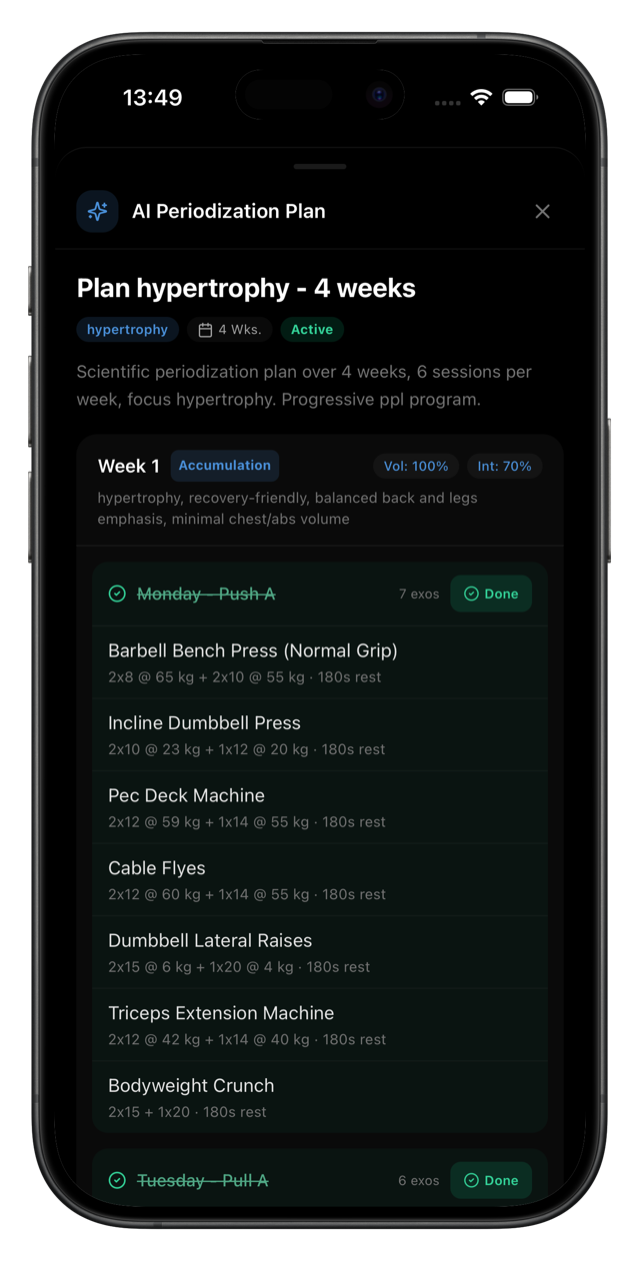
From there, the app proposes a weekly volume per muscle that stays in your MAV zone, and adjusts automatically when you miss sessions, stack RPE 10s, or progress faster than expected on a lift. You can debate each call with the coach, why 14 chest sets this week instead of 16, why a deload at week 4 instead of week 6, and it explains in plain language.
First month is €3.49 (then €6.99/month). Cheaper than a single PT session, but the tuning happens every day.
Five Mistakes That Sabotage Your Volume
- Counting warmup sets. Only sets near failure drive hypertrophy.
- Stacking volume on a saturated muscle because “it should be working.” If you haven’t recovered, you’re banking fatigue, not muscle.
- Ignoring between-session recovery. A muscle needs 48-72 hours. Hitting chest three times a week without spreading the intensity is wasted work.
- Holding the same volume year-round. MRV shifts with your progress. Without periodization, you stagnate or break.
- Confusing volume with fatigue. 25 sets will exhaust you but won’t beat 16 well-executed sets for growth.
When and How to Increase Volume (and Run a Deload)
Volume isn’t static, it should follow progressive accumulation plus deload cycles.
Increase volume: if after 2 weeks you hit all your rep targets at the planned RPE without struggle, add 1-2 sets to the target muscle the next week. No more.
Signs you need a deload: performance drops two sessions in a row at the same loads, RPE balloons on familiar weights, sleep degrades, motivation tanks. Deload = -40 to -50% volume for one week, intensity preserved. You come back stronger.
Typical cycle: 4 weeks of accumulation (volume climbs gradually) + 1 deload week. Repeat 2-3 times then full reset.
AIVancePro triggers these deloads automatically when the AI detects plateau signals in your history. You don’t have to think about it.
Conclusion
Calculating your optimal training volume means moving past “more is better” to “right is better.” Measure your current volume, locate yourself against MEV/MAV/MRV per muscle, and grow that volume in small steps. That’s the foundation of sustainable progress, no injury, no plateau.
If you want this calculated for you every session, auto-adjusted to real fatigue and real performance, install AIVancePro (available on iOS and Android, App Store / Google Play). First month €3.49, then €6.99/month. Your conversational AI coach calculates, adjusts, and explains. You just execute.
Health disclaimer: this article is informational. If you’re returning to training after injury or have any joint or cardiovascular condition, consult a healthcare professional before increasing your training volume.
FAQ
How many sets per muscle per week to build muscle?
For an intermediate lifter, target 12-18 effective sets (close to failure) per muscle per week. Beginners can progress with 8-12.
How do I know if my volume is too high?
Performance drops on the same lifts from session to session, sleep degrades, you don’t want to enter the gym, soreness lasts more than 72 hours. Cut volume by 30% for a week and watch.
Should isolation sets count the same as compound sets?
Yes for counting volume on the target muscle, but compound lifts tax the nervous system harder. If you squat 4 sets, you can credit 0.5 set to glutes on top of the quad count.
Is volume more important than intensity?
Both matter. Short-term, intensity (load near max) drives strength. Mid-term, weekly effective volume drives hypertrophy. You need both.
How often should I deload?
Every 4-6 weeks for an intermediate. The more advanced you are, the more often you need one. A good workout journal (or an AI coach) programs them automatically when it detects fatigue signals in your history.
← Back to blog