
You hit 40 and you want to (re)start lifting? Good news: strength training after 40 remains one of the most powerful tools to preserve muscle, bone density and energy for the long haul. This guide gathers practical tips to make progress, avoid injuries and squeeze maximum value from every session, whether you’re a beginner or coming back after a long break.
Why Lifting After 40 Is Non-Negotiable
From age 30-35 onward, your body naturally loses 0.5 to 1% of muscle mass per year. This phenomenon, sarcopenia, accelerates after 40 if you do nothing. The downstream effects: less strength, slower metabolism, easier fat gain, declining posture.
Resistance training is the single most powerful counter we know of. A 2019 study from Quincy College found that 30 minutes of strength work twice a week was enough to reverse much of age-related muscle loss within six months. At 40, you haven’t missed the window, you’re at an ideal moment to rebuild.
Beyond aesthetics, training after 40 protects:
- Bones (higher mineral density, osteoporosis prevention)
- Joints (stronger stabilizers around knees, hips, lower back)
- Metabolism (each kilo of muscle burns ~13 kcal/day at rest)
- Testosterone and insulin sensitivity
- Mental health (documented drops in anxiety and depressive symptoms)
What Actually Changes Physiologically After 40
Understanding the changes prevents you from training like a 25-year-old and ending up injured. Three big shifts:
1. Recovery takes longer. Your body repairs muscle microtears more slowly. A heavy leg day might need 72-96 hours of recovery instead of 48 at 25. Ignoring this signal leads straight to injury or overtraining.
2. Tendons and fascia lose elasticity. This is injury cause number one in 40+ lifters. Muscles adapt faster than tendons, if you load too quickly, tendons give first.
3. Anabolic hormones (testosterone, GH, IGF-1) decline. Don’t panic: the drop is gradual and lifting itself stimulates their production. But it explains why muscle gain is slower, not impossible, just slower.
Picking the Right Exercises (And Avoiding the Traps)
After 40, efficiency beats volume. Focus on compound movements that hit multiple muscle groups at once:
- Squat (goblet or box variations if mobility is limited)
- Romanian deadlift (kinder on the lower back than the conventional pull)
- Bench press or weighted push-ups
- Pull-ups or lat pulldowns
- Barbell or dumbbell rows
- Standing or seated overhead press with strict form
Skip or modify: behind-the-neck press (rough on aging shoulders), heavy good mornings, deep dips without solid technique. The risk-reward ratio doesn’t favor you on these after 40.
Prioritize controlled range of motion over maximum loads. A clean rep at 80% of your 1RM is exponentially more productive, and safer, than a sloppy rep at 95%.
Building a Smart Program
Classic trap: trying to train 5-6 times per week. After 40, that’s rarely sustainable. Three well-executed sessions beat five rushed ones every time.
Sample push/pull/legs split, three days a week:
- Monday (push): bench press, overhead press, dips, lateral raises, cable triceps
- Wednesday (pull): assisted pull-ups, dumbbell rows, seated cable rows, dumbbell curls
- Friday (legs): goblet squat, Romanian deadlift, walking lunges, standing calf raises
Set/rep ranges: 3-4 sets per exercise, 6-12 reps. The 6-8 range builds raw strength, 8-12 drives hypertrophy. Alternate weekly.
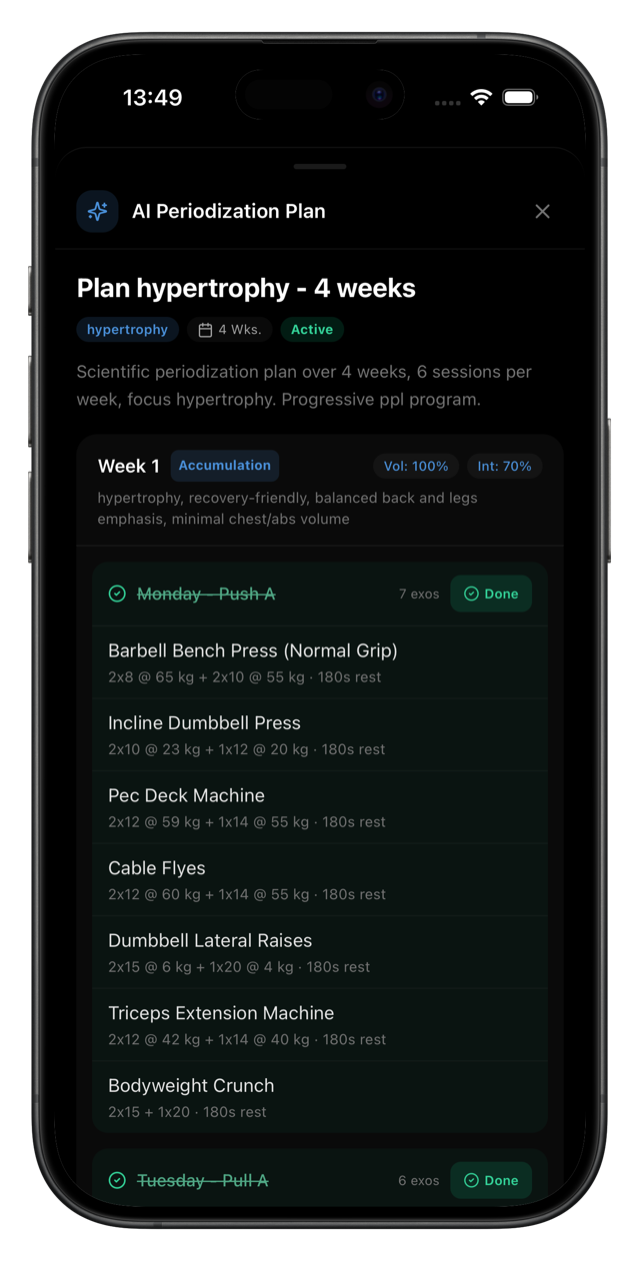
Progressive overload: add 1-2 kg or 1 rep per week. No more. After 40, patience pays. This is exactly the kind of progression AIVancePro automates, its conversational AI coach adjusts your loads week by week based on actual performance.
Recovery: The Variable Everyone Underestimates
After 40, what you do between sessions matters as much as the sessions themselves.
Sleep. Aim for 7-8 hours. Growth hormone peaks during deep sleep. Cut screens 30 minutes before bed, keep your bedroom cool (18-19°C / 65-66°F).
Mobility and stretching. 10 minutes of hip/shoulder mobility before training and 5 minutes of light stretching after dramatically reduce injury risk.
Active walking. 30-45 minutes on rest days speeds recovery without taxing your nervous system.
Stress management. Chronic cortisol sabotages muscle recovery and testosterone. Meditation, breathwork, social life, anything that lowers cortisol shortens recovery time.
Nutrition and Protein Needs After 40
Protein needs rise with age because of anabolic resistance: your body uses amino acids less efficiently than at 25.
Aim for 1.6 to 2 g of protein per kilogram of body weight per day. For a 180 lb (82 kg) male, that’s 130-160 g daily. Optimal distribution: 30-40 g per meal, four times throughout the day.
Top sources: eggs, chicken, fish, cottage cheese, legumes, whey as a snack. Don’t skimp on healthy fats (avocado, olive oil, nuts), they fuel hormone production.
Hydration: 35 ml per kg of body weight, around 2.8 L for 80 kg. Chronic dehydration amplifies joint pain.
Common Mistakes to Avoid
Picking up where you left off. If you bench-pressed 220 lb at 30 and haven’t touched a bar in 8 years, don’t load 175 lb on day one. Restart at 50% and rebuild over 4-6 weeks.
Skipping the warm-up. At 25, you can get away with it. At 45, it’s a guaranteed injury. 5-10 minutes of light cardio plus progressive warm-up sets on your first compound.
Ignoring pain. Normal muscle soreness is not the same as a sharp joint pang. If something pinches in a joint, stop. Mismanaged tendinitis equals six months of forced rest.
Comparing yourself to younger lifters. You’re not in the same category anymore. Compare yourself to yourself three months ago. That’s the only metric that matters.
Conclusion
Strength training after 40 isn’t a luxury or a fad, it’s a direct investment in your quality of life for the next 30-40 years. With a smart program, careful recovery and adapted nutrition, you can not only maintain your fitness but actually build a stronger, more resilient body than you had at 25. The formula comes down to three words: consistency, progression, patience. If you want a program that adapts automatically to your age, level and actual recovery session by session, AIVancePro can be a solid starting point, the app is on iOS and the first month is €3.49.
Health note: this article is informational. If you’re returning to training after 40 following a long break, or you have an underlying medical condition (cardiac, joint, metabolic), consult your doctor before starting. A stress test is often recommended past 40.
FAQ
How often should you train at 40?
Three strength sessions per week is the sweet spot for most 40+ lifters. It allows 48 hours of recovery between sessions and stays compatible with work and family life. You can add 1-2 light cardio sessions on rest days.
Can you build muscle after 40?
Yes, absolutely. Muscle gain is slower than at 25 (count on roughly 50% of a young beginner’s first-year potential), but it’s very real. Late starters often build 8-13 lb of lean mass in their first consistent year.
Which supplements actually help after 40?
The essentials: vitamin D3 (often deficient), omega-3s (anti-inflammatory), creatine monohydrate (3-5 g/day, long-term safety is well documented along with strength and cognitive benefits). Whey protein is convenient but optional if your diet already covers your needs.
Do you need cardio on top of lifting after 40?
Yes, ideally 150 minutes per week of moderate activity (brisk walking, cycling, swimming) in addition to strength training. This protects your heart and speeds inter-session recovery.
How long until you see results?
First sensations in 2-3 weeks (strength, energy). First visible changes in 6-8 weeks. Clear transformation in 4-6 months with a consistent program. The more consistent you are, the steeper the curve.
← Back to blog