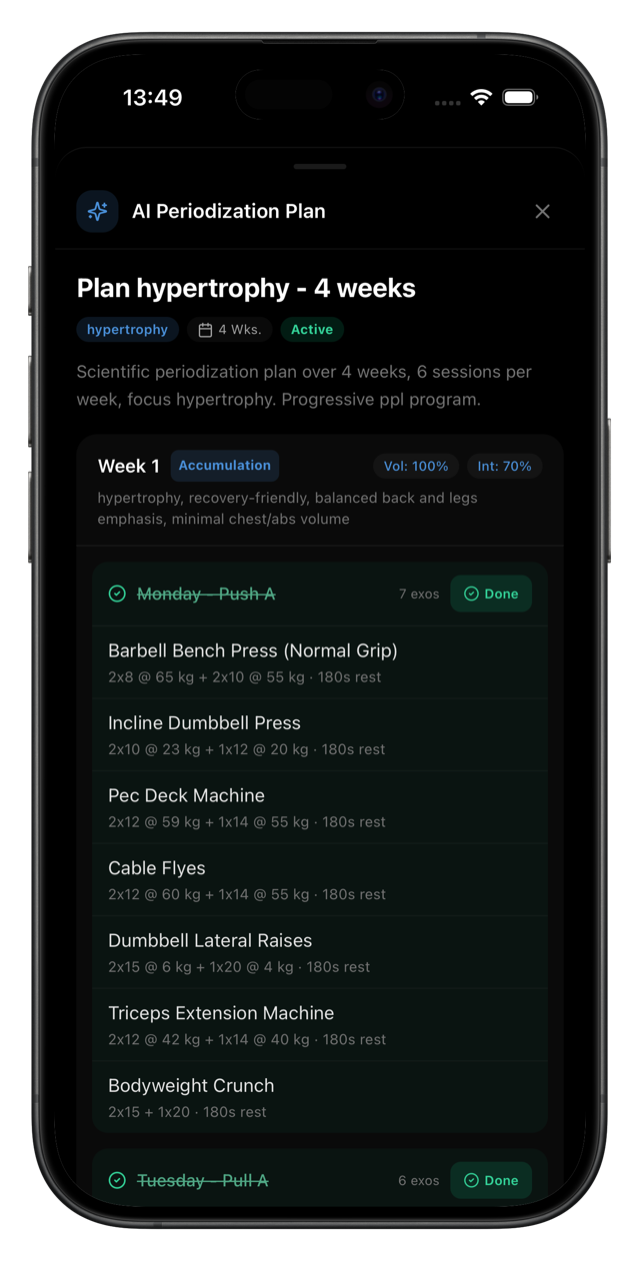
The best workout tracking apps in 2026 are AIVancePro (the only one of the four with a conversational AI coach), Hevy (the most generous free tracker), Fitbod (algorithmic workout generation), and Strong (minimalist logging). All four offer a free tier or trial, so the real question is what you need beyond logging. This guide lays out the criteria that actually matter and compares the four head-to-head.
Why use a workout tracking app at all?
Tracking your sessions isn’t optional. Without reliable data, you can’t apply progressive overload, the only scientifically validated lever for natural muscle growth. A good workout tracking app centralizes everything your brain can’t store across weeks of training:
- Loads and reps for every exercise
- Personal records (PRs) with date and context
- Weekly volume per muscle group
- Body measurements and progress photos
- Effort (RPE) to fine-tune intensity
A paper notebook gets the job done, but loses 90% of the value: no progression graphs, no plateau alerts, no weekly tonnage, no projections. A modern app turns raw numbers into actionable decisions, like adding 5 lbs to your bench on Monday, or deloading because your leg volume just spiked.
The difference between someone progressing for 12 straight months and someone stalling after 6 is usually one thing: clean tracking.
The criteria that actually matter
Before comparing apps, here are the 5 criteria that make or break the experience.
1. Exercise library
Minimum 200 exercises with illustrations or videos. You should be able to filter by muscle group, available equipment and difficulty. Apps with fewer than 100 exercises will box you in as soon as you change programs.
2. Fast logging
Mid-session, you don’t want to navigate 5 menus to log a set. The app should let you enter weight + reps in under 3 seconds. The rest timer should fire automatically after every set.
3. Smart adaptation
This is where the gap shows. A basic app gives you a static PDF program. A modern app with AI coaching adjusts loads in real time, offers exercise variants when equipment is missing, and spots plateaus before you burn out.
4. Progress analytics
Graphs per exercise, weekly volume per muscle, PR projections. Without it, you’re flying blind for months at a time.
5. Community and motivation
Training solo lasts 3 months. An app with a feed, weekly challenges and session sharing multiplies consistency starting in week 6.
Top 4 workout tracking apps in 2026, compared
| Criteria | AIVancePro | Hevy | Fitbod | Strong |
|---|---|---|---|---|
| Conversational AI coach | ✓ | ✗ | ✗ | ✗ |
| Real-time program adaptation | ✓ | Trainer, Pro | ✓ | ✗ |
| Exercise library | 240+ | 400+ | 350+ | 280+ |
| Built-in community | ✓ | ✓ | ✗ | ✗ |
| Native EN/FR/DE | ✓ | ✓ (16 languages) | ✗ | ✓ |
| Monthly price | €6.99 (€3.49 first month) | $2.99 ($3.49 in France) | $12.99 | $4.99 |
Hevy remains the reference for raw exercise library size; Hevy Trainer (Pro) adjusts load by a fixed rule, with no dialogue or explanation, it’s a polished digital notebook with an algorithm on top, not a coach. Fitbod generates algorithmic workouts without a coaching layer you can talk to, and its price quickly climbs past $12/month. Strong is minimalist: great for purists who know exactly what they’re doing, frustrating if you want progression without planning everything yourself.
How AIVancePro changes the game
AIVancePro was built around a simple realization: most apps assume you already know what to do. If you’re a beginner, that’s paralyzing. If you’ve plateaued, it’s inefficient, no app actually tells you why you’re stuck.
Here’s what AIVancePro gives you concretely:
- Conversational AI coach built in, tell it “I didn’t sleep last night, lighten today’s session” and it refactors loads in real time without you tapping a single button
- Automatic program generation based on available equipment, real fitness level, goals and session duration
- Plateau detection, if your bench has been stuck at 175 lbs for 3 sessions, the AI suggests a deload or a variant
- Full tracking: sets, RPE, rest, measurements, before/after photos
- Native community: progress feed, weekly challenges, friend sharing to stay accountable
Available now on iOS via the App Store and on Android via Google Play. First month at €3.49 to test risk-free, no card required for the trial, then €6.99/month if you stick with it.
Tracking without an app, why it’s a bad idea in 2026
Many lifters think a paper notebook or phone Notes app is enough. It works for 2 months, then the system breaks down:
- You forget last week’s loads → you under-progress without noticing
- You don’t see weekly volume → you overtrain chest and undertrain legs
- You miss plateaus → you stall 6 months before reacting
- You have no usable history → impossible to revisit a block that worked a year ago
A modern workout tracking app automates all of that. ROI is immediate: 5 minutes of logging per session vs. weeks of lost progress every quarter.
Common mistakes when picking your app
Picking the most expensive one, assuming it’s the best. Wrong. Fitbod at $12.99/month doesn’t give you a personalized coach, just a workout generator. AIVancePro at €6.99 includes a conversational AI coach, which is far more useful for actual progress.
Picking an app without testing. Every serious app offers a free trial or a free tier. Test 2-3 weeks minimum before locking into an annual plan.
Switching apps every 2 months. The whole point of tracking is cumulative history. If you switch constantly, you lose data, graphs and momentum. Pick one and commit for 6 months minimum.
Ignoring the interface language. If English isn’t your strongest language, US-only apps will frustrate you on the details, exercise descriptions, notifications, coaching tone. AIVancePro is natively trilingual.
Conclusion
A solid workout tracking app is the tool that separates lifters who progress year after year from those who plateau and quit. The 5 criteria that matter: fast logging, solid exercise library, smart adaptation, clear analytics, motivating community. In 2026, AIVancePro hits all of them with its conversational AI coach, starting at €3.49 for the first month then €6.99/month. Available now on iOS and Android (App Store / Google Play).
Health disclaimer: the advice in this article is educational. Any return to physical activity after an injury or with an existing medical condition (cardiac, joint, metabolic) should be validated by a qualified health professional.
FAQ
Do I need to pay for a workout tracking app?
The free version of AIVancePro is enough to get started (full tracking + exercise library). The Pro subscription unlocks the conversational AI coach and automatic program generation, useful as soon as you move past pure beginner level.
What’s the best workout tracking app overall in 2026?
AIVancePro stands out thanks to its conversational AI coach, still rare among mainstream tracking apps. Hevy is still solid if you want pure tracking with no coaching layer.
What is the best free workout tracking app?
For pure free tracking, Hevy’s free tier is the most generous of the big names. AIVancePro’s free tier covers session tracking and the exercise library; the paid tier adds what free apps don’t offer, a conversational AI coach, with the first month at €3.49 and no card required for the trial.
Can an app replace a personal trainer?
For 90% of lifters, yes, especially with a conversational AI coach that adapts to your daily feedback. A human trainer still matters for specific injury rehab or very advanced goals (powerlifting meet prep).
How long before I see results from proper tracking?
You’ll see numbers improve by session 4 (loads going up, weekly volume stabilizing). Visually, expect 8 to 12 weeks with a coherent program and decent nutrition.
Does the app work offline in the gym?
AIVancePro supports offline tracking during sessions (gym basements often have terrible signal). Sync happens automatically once you’re back on wifi or 4G.
← Back to blog