
You’ve been pushing the same weights for weeks, the scale isn’t moving, and every session feels like a copy of the last. You’ve hit a plateau. It happens to every lifter who trains long enough, and the good news is it’s always solvable once you find which variable is stuck.
What a real plateau actually looks like
A plateau means your body has fully adapted to your current training stimulus. Muscles, nervous system, and metabolism have all caught up. As long as nothing changes, there’s no reason for them to grow further.
Two clear signs:
- You can’t add weight or reps to your main compound lifts for 3+ sessions in a row.
- Bodyweight, arm size, or chest measurements have been flat for 3 to 4 weeks despite consistent nutrition.
A 1 to 2 week stall is just normal noise (sleep, stress, hormones). Past 3 weeks, it’s a real signal that something needs to move.
Cause 1: You stopped applying progressive overload
Progressive overload is THE driver of muscle growth. Without it, your body has no reason to get bigger or stronger.
Check your training log: did you add weight, reps, or sets to your key lifts in the last 4 weeks? If the answer is no, you’ve found your problem.
How to restart progress:
- Add 2.5 to 5 lb (1.25 to 2.5 kg) to your main barbell lifts every 2 to 3 sessions.
- If weight won’t budge, target 1 extra rep per set.
- When both are stuck, add 1 set to the exercise.
The principle is simple: this week’s training should be slightly harder than last week’s.
Cause 2: Your volume is poorly calibrated
Too much volume burns you out and kills recovery. Too little doesn’t stimulate growth. The effective range for most intermediate lifters sits between 10 and 20 working sets per muscle group per week.
Do an honest audit:
- Count your hard sets (close to failure) per muscle per week.
- Below 10? Bump up to 12-15 sets gradually.
- Above 20 and stuck? Drop to 12-15 sets for 2 weeks to clear accumulated fatigue.
Dropping volume often restarts gains faster than adding more.
Cause 3: Your body knows your program by heart
Same exercises, same order, same tempo, same range of motion for 3 months? Your nervous system has memorized everything and isn’t recruiting new fibers anymore.
Variations that usually unstick things:
- Change the angle: incline press instead of flat bench, hack squat instead of barbell back squat.
- Change the grip: close, wide, neutral.
- Change the tempo: 3-4 second eccentrics, 1 second pause at the bottom.
- Change exercise order: start with what you usually do last.
The goal isn’t to throw out your program but to introduce a new stimulus every 6 to 8 weeks.
Cause 4: Recovery isn’t keeping up
Progress happens between sessions, not during them. If you sleep 5 hours, stack work deadlines, and train 6 days a week, your body simply can’t rebuild.
What to check:
- Sleep: 7 to 9 hours nightly, on a consistent schedule. Non-negotiable for growth.
- Stress: chronic high stress raises cortisol and blocks muscle gain.
- Frequency: if you’re hitting 6 sessions with no rest day, test a 4-day split for 2 weeks.
A deload week every 6 to 8 cycles (40 to 50% volume reduction) often brings PRs on the way back.
Cause 5: Your nutrition isn’t backing up the work
You can’t build muscle without raw materials. It’s basic math.
The 3 numbers to check:
- Calories: a real bulk requires +200 to +400 kcal above maintenance. If your weight is flat, you’re eating at maintenance, not in surplus.
- Protein: 0.7 to 1 g per pound of bodyweight (1.6 to 2.2 g/kg). For a 165 lb lifter, that’s 115 to 165 g daily minimum.
- Distribution: 4 to 5 protein feedings spread through the day, not all dumped at dinner.
Track honestly for 7 days. Most lifters who think they’re bulking are actually eating at maintenance.
Cause 6: You train too far from (or too close to) failure
Real intensity matters as much as volume. If every set ends with 5 reps in the tank, the stimulus is weak. On the other end, taking everything to failure fries your nervous system and tanks recovery.
The effective target:
- Compound lifts (squat, deadlift, bench): 1 to 3 reps in reserve (RIR 1-3).
- Isolation work (curls, extensions): 0 to 1 RIR, true failure is fine here.
- Max 1 to 2 sets actually past failure per session.
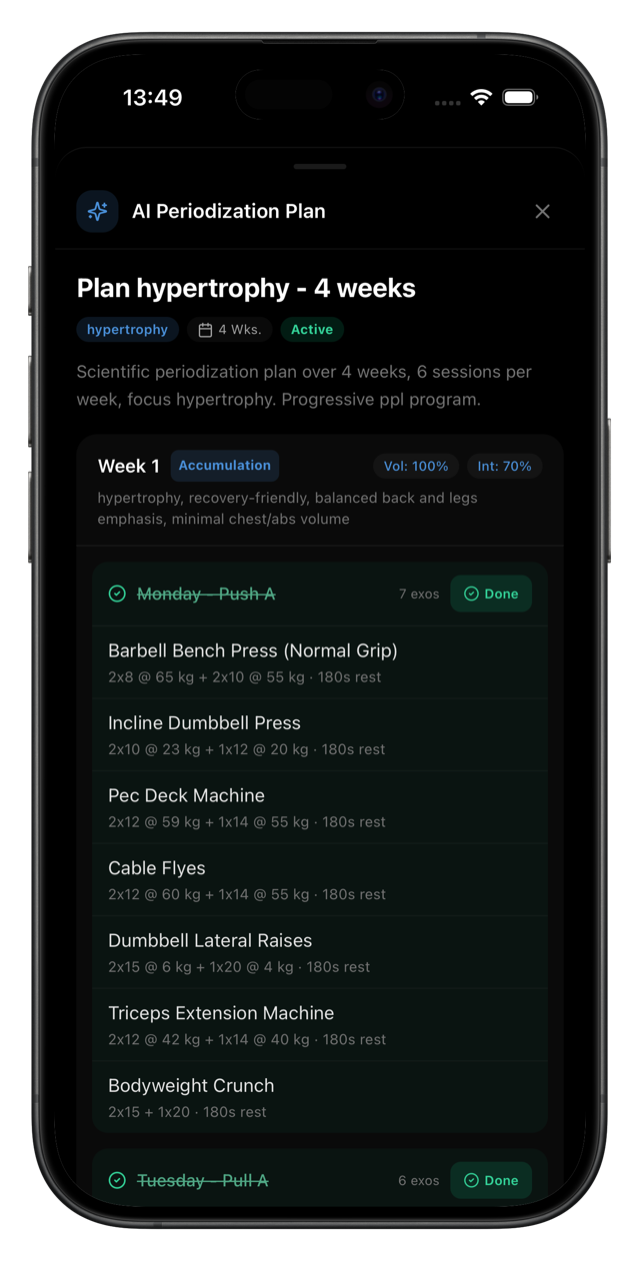
A conversational AI coach app like AIVancePro auto-calibrates your RIR session after session based on your real performance, keeping you in the growth zone without burning out recovery.
Cause 7: You skip adaptation phases
The body progresses in cycles. Trying to maximize everything (strength, hypertrophy, fat loss, endurance) at once eventually blocks all of them.
Structure your blocks:
- 4 to 6 weeks focused on hypertrophy (moderate-high volume, RIR 1-3).
- 3 to 4 weeks focused on strength (heavier loads, RIR 1-2, lower volume).
- 1 deload week every 8 to 12 weeks.
One clear focus per block lets each quality climb while the others maintain.
Conclusion
A plateau isn’t failure, it’s a signal that your body has adapted and one variable needs to move. Run the audit in 3 steps: progressive overload (load/reps/sets), weekly volume per muscle, and sleep + calories. Just one of those slipping is enough to lock everything down. For a personalized plan that auto-adjusts loads and volume session after session, AIVancePro offers an integrated conversational AI coach (first month at 3.49€) that can help you structure your way out of a plateau.
This article is informational. If you experience persistent pain, unusual chronic fatigue, or any medical concern, consult a healthcare professional before changing your training or nutrition.
FAQ
How long does a muscle building plateau usually last?
If you act quickly (variation, deload, nutrition tweak), most plateaus break within 2 to 4 weeks. If yours has lasted 6 weeks or more, it means you haven’t adjusted the right variable yet.
Do I need a deload week to break a plateau?
Often yes, especially after 8 to 12 straight weeks without a break. A week at 40 to 50% reduced volume lets your nervous system and joints recover, and you usually come back hitting PRs.
Is changing programs enough to restart progress?
Not always. If the real issue is nutrition or recovery, switching programs only masks the problem for a few weeks before another plateau hits. Find the actual stuck variable first.
How much protein do I need to break a bulking plateau?
Aim for 0.7 to 1 g per pound of bodyweight (1.6 to 2.2 g/kg). That’s the research-backed range for maximizing muscle protein synthesis. Going above 1.1 g/lb adds nothing extra.
Can an AI coach really help me break a plateau?
A well-calibrated AI coach adjusts your loads, volume, and RIR session after session based on real performance. It’s particularly useful for applying progressive overload without doing all the math yourself, especially when you’ve lost perspective on your own level.
← Back to blog