You keep showing up but progress has stalled, sleep is broken and every set feels heavier than it should? Overtraining signs and symptoms are easy to mistake for a simple bad week. This guide gives you the 12 concrete markers to track and the exact protocol to recover without wrecking your gains.
What overtraining actually is
Overtraining syndrome (OTS) is a chronic mismatch between training load and recovery capacity. It’s not a single bad workout or a hard week, it’s a state that builds over weeks or months.
Three levels matter:
- Functional overreaching: 1-2 weeks of planned fatigue followed by a supercompensation rebound. Useful and intentional.
- Non-functional overreaching: 2-4 weeks of declining performance with no rebound. Warning zone.
- Overtraining syndrome: 2+ months of persistent symptoms despite rest. The real deal, it can derail your progress for 6 to 12 months.
Most lifters who think they’re overtrained are actually in poorly managed overreaching. The distinction shapes your recovery plan.
Physical signs you cannot ignore
Your body sends precise signals long before any clinical diagnosis. The main physical overtraining symptoms:
- Chronic fatigue: you wake up exhausted and three coffees don’t move the needle.
- Resting heart rate climbing 5-10 bpm above your baseline for several consecutive days.
- Soreness that won’t quit: DOMS lasting beyond 72 hours, joints aching constantly.
- Recurring injuries: tendinitis, strains, niggles stacking up.
- Sleep disruption: trouble falling asleep, frequent night wakings, unrefreshed mornings.
- Weakened immunity: catching every cold, frequent throat or sinus issues.
- Appetite changes: either total loss or uncontrollable sugar cravings.
No single sign proves overtraining. It’s the accumulation across several weeks that confirms it.
Psychological symptoms that hit first
Overtraining isn’t only muscular. Your nervous system and hormonal balance take the first hit, and it shows up mentally:
- Sudden loss of motivation despite previously loving training.
- Irritability: snapping at coworkers, family, traffic.
- Anxiety or mild depressive mood with no clear trigger.
- Concentration problems, foggy memory at work.
- Drop in libido.
These emotional symptoms often appear before the physical ones. If you suddenly dread the gym after months of looking forward to it, that’s a major red flag.
Performance markers that don’t lie
Your training log speaks before your body does. Watch:
- Plateau or regression on your main lifts (squat, bench, deadlift) after a steady linear progression.
- Inflated RPE: a weight you used to rate 7/10 suddenly feels like 9/10.
- Failing reps you used to crush cleanly the week before.
- Cardio decline: heart rate climbing faster at the same effort, slower between-set recovery.
- Heart rate variability (HRV) dropping. If you wear a smartwatch, this is one of the earliest objective signals.
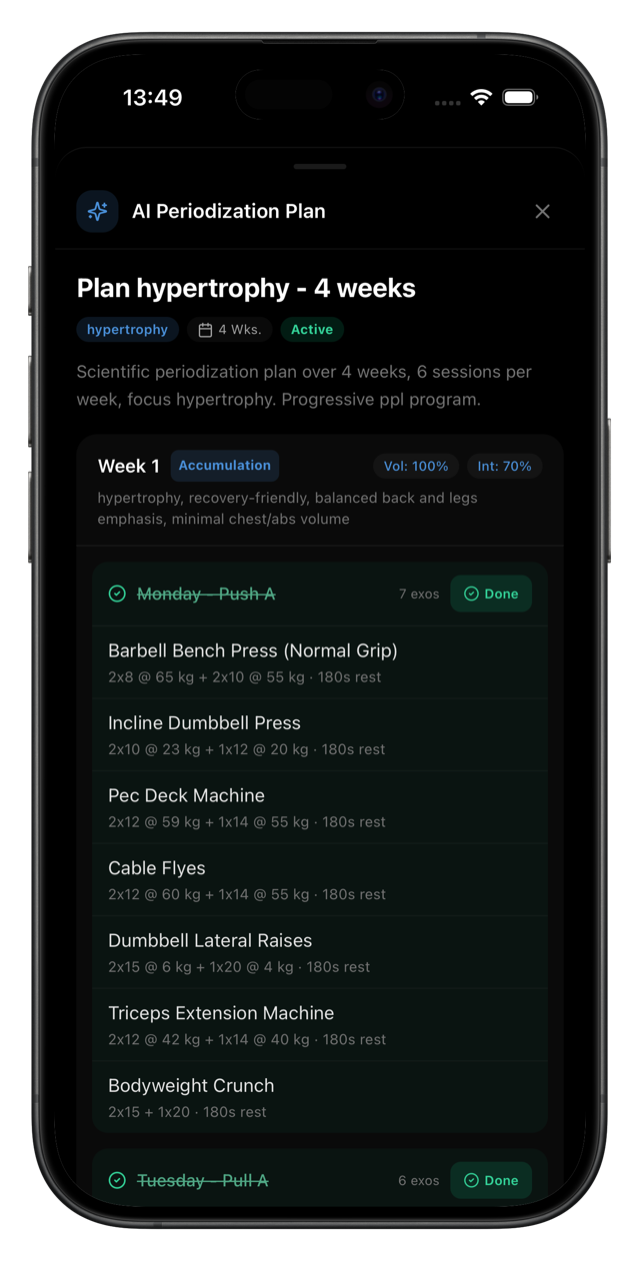
A training log or a smart app makes these signals obvious. AIVancePro’s conversational AI coach detects regressions on your key lifts automatically and adjusts load accordingly.
How to confirm you’re really overtrained
No single blood test diagnoses overtraining, but this combination is highly suggestive:
- 3+ physical signs from the list above, present for at least 2 weeks.
- Measurable regression on at least one main lift (-5% load at equivalent RPE).
- The rest test: take 5-7 full days off. If you bounce back, it was overreaching. If nothing improves, it’s likely true overtraining.
- Blood panel with your doctor to rule out deficiencies (iron, vitamin D, B12) or hormonal imbalances (cortisol, testosterone, T3/T4).
Don’t self-diagnose serious cases. If symptoms persist or worsen, see a sports medicine doctor.
The recovery protocol
Once identified, overtraining is treated with deload and patience. The 4-phase plan:
Phase 1, Active rest (1-2 weeks): zero heavy lifting, daily 30-45 min walks, mobility work, gentle stretching. Sleep 8-9 hours minimum.
Phase 2, Gradual return (2-4 weeks): lifting at 50-60% of normal loads, 2-3 sessions per week, volume cut in half. No sets to failure.
Phase 3, Reintegration (4-8 weeks): progressive ramp to 80% of usual loads, add a session back, RPE capped at 7-8.
Phase 4, Normal training: return to your usual programming, but with a deload week every 4-6 weeks to avoid relapsing.
Nutrition: hold maintenance calories or a slight surplus during recovery. Don’t cut during this phase, your body needs fuel to repair.
How to prevent overtraining long-term
Prevention beats cure by miles. Best practices:
- Cyclical programming with planned deload weeks every 4-6 weeks.
- Sleep first: 7-9 hours per night, non-negotiable for muscle and nervous system recovery.
- Mix intensities: alternate heavy and lighter sessions across the week.
- Track your markers: RPE, resting heart rate, sleep quality.
- Listen to your body: one bad workout is fine, three in a row means back off.
Using a conversational AI coach like AIVancePro’s gives you automated tracking of these markers and real-time programming adjustments, something a static paper plan can’t deliver.
Conclusion
Catching overtraining signs and symptoms early saves you months of frustration and stagnation. Watch the combo of chronic fatigue + plateau + poor sleep + lost motivation: if three of those persist for more than two weeks, deload now. A planned week off beats three months of forced injury rehab.
This article is informational and does not replace professional medical advice. If your symptoms persist despite rest or get worse, consult a sports medicine doctor or your primary care physician.
FAQ
How long does it take to recover from overtraining?
From 2 weeks for simple overreaching to 6-12 months for true chronic overtraining syndrome. Most cases resolve in 4-8 weeks with a serious deload protocol.
Can you overtrain on just 3 sessions a week?
Yes, if intensity is too high, sleep is poor or nutrition is inadequate. It’s not session count that matters but the load-to-recovery balance.
How do I tell normal fatigue from real overtraining?
The rest test: 5-7 days off. If you bounce back, it was overreaching. If nothing changes, it’s deeper.
Should I stop training entirely if overtrained?
No, full stop is rarely needed. Active rest (walking, mobility, stretching) speeds recovery compared to total inactivity.
Do whey or supplements help recover from overtraining?
They don’t fix a recovery deficit. Prioritize sleep, sufficient calories and a real deload before reaching for supplements.
← Back to blog