You have run the same number of sets for months, you throw in random exercises whenever you stall, and you honestly do not know whether you are doing too much or too little. The MEV, MAV and MRV training volume landmarks answer exactly that: how many sets per muscle drive progress without burning you out. AIVancePro, the conversational AI coach, tunes that volume session after session from your real recovery, but understanding the landmarks yourself already changes everything.
In short
MEV, MAV and MRV are three weekly volume landmarks, measured in sets per muscle. MEV is the minimum to grow, MAV the range where you gain the most, MRV the ceiling your body can recover from. Most lifters progress best between 10 and 20 hard sets per muscle per week, starting low and building up over time.
What are MEV, MAV and MRV?
These landmarks come from Renaissance Periodization, popularized by Dr. Mike Israetel. They place your training volume, meaning the number of hard sets per muscle per week, on a scale that runs from the bare minimum to the limit of what you can recover from.
Four markers define the scale:
- MV (Maintenance Volume): the volume that keeps your muscle without growing it.
- MEV (Minimum Effective Volume): the smallest number of sets that still triggers growth.
- MAV (Maximum Adaptive Volume): the range where your progress-to-fatigue ratio is best.
- MRV (Maximum Recoverable Volume): the ceiling beyond which you accumulate more fatigue than you recover.
| Landmark | What it means | Effect on the muscle |
|---|---|---|
| MV | Maintenance volume | You hold, you do not gain |
| MEV | Minimum effective volume | Slow but real growth |
| MAV | Maximum adaptive volume | Best progress |
| MRV | Maximum recoverable volume | Ceiling, beyond it is overreaching |
The point is not to lock onto one number all year. Your volume should travel through this zone: start near MEV, climb toward MRV over the weeks, then drop back to recover. That cycle is what separates a guessed program from a piloted one.
How do you find your MEV?
To find your MEV, start low, around 8 to 10 sets per muscle per week, then watch your progress over 2 to 3 weeks. If your loads or reps climb, that volume covers your MEV. If nothing moves while sleep and nutrition are in check, add 2 sets and reassess.
Your MEV depends on your training history, sleep and stress. A beginner triggers growth with very little volume. The more advanced you get, the higher your MEV climbs, because your body adapts to the stimulus. That is one reason a frozen program always stops working eventually: your MEV from a year ago may be your maintenance volume today.
For a starting estimate based on your level and frequency, see our guide on how to calculate your optimal training volume instead of guessing.
MAV: where you grow the most
MAV is the sweet spot. It is the volume range where each extra set still pays off, before fatigue starts eating into your gains. For most muscles and intermediate lifters, MAV sits roughly between 12 and 18 weekly sets.
According to the Schoenfeld, Ogborn and Krieger (2017) meta-analysis, there is a dose-response relationship between weekly volume and hypertrophy: beyond 10 sets per muscle per week, growth is clearly higher than with low volume. So MAV is rarely below 10 sets for anyone serious about building muscle.
In practice you do not stay glued to your MAV. You spend most of your mesocycle there, where the magic happens, then push slightly beyond it at the end of the block to trigger one last wave of adaptation before deloading.
MRV: the ceiling you should not camp above
MRV is your recovery ceiling. As long as you stay below it, you absorb the work and progress. When you exceed it for too long, the symptoms show up: dropping performance, achy joints, poor sleep, flat motivation. These are often the first signs of overtraining you feel.
The classic trap is piling on sets thinking more is better. Past your MRV, you are no longer building, you are digging a fatigue hole. The fix is not more volume but pulling it back for a deload week, then restarting near your MEV.
How to apply MEV, MAV and MRV across a mesocycle
The logic fits in one line: start low, build up, deload, repeat. Concretely, over a 4 to 6 week mesocycle:
- Week 1: start at MEV, for example 10 sets for chest.
- Weeks 2 to 4: add 1 to 2 sets per muscle each week, heading toward MRV.
- Deload week: cut volume in half to let fatigue come down.
- Next cycle: restart one notch higher than your previous starting point.
This progressive climb is volume overload, the complement to load progression. If you want to lock in your working set count first, check how many sets per muscle per week actually fits your goal.
How AIVancePro tunes your volume automatically
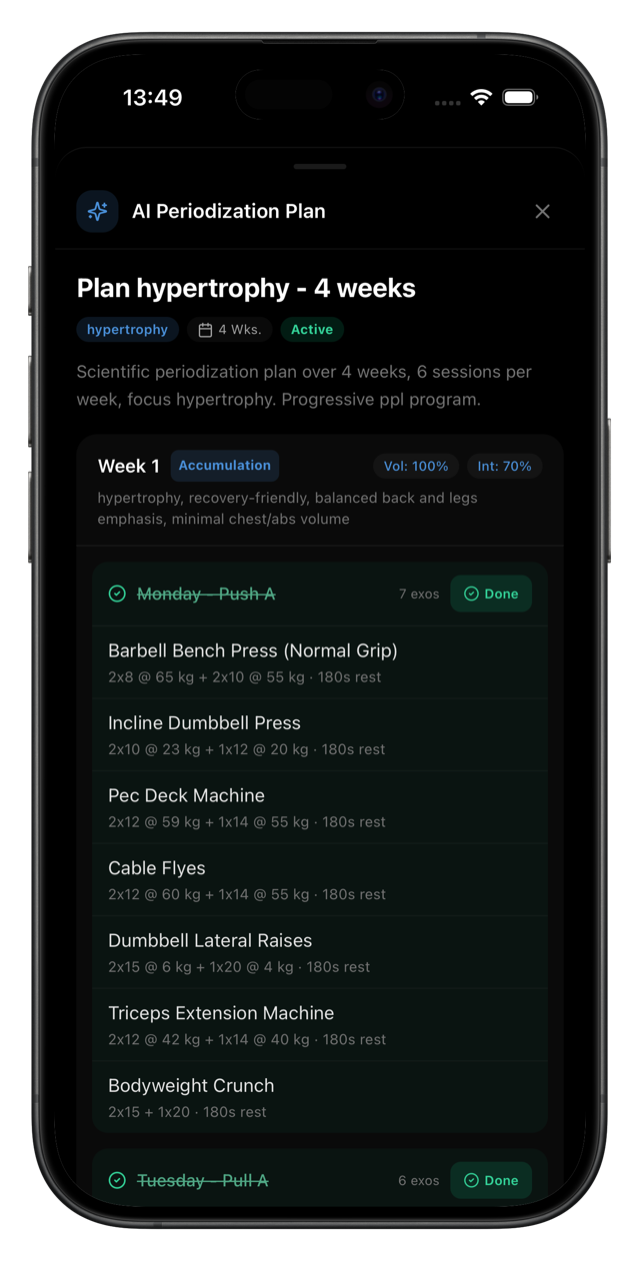
The problem with steering your own volume is that you have no objective read on your real fatigue. You guess. AIVancePro reads your session data instead. If you complete your 12 back sets with rising loads and controlled effort, Vance, the AI coach, adds a set next week to push you toward your MAV. If your performance stalls or drops two sessions in a row, it understands you are approaching your MRV and schedules a deload before you get hurt.
You bench 85 kg instead of 80? Vance recalibrates your volume and target load, and explains why. That is the job a human coach at 40 to 60 euros a session would do, except the app does it every session, for the price of a coffee the first month. If you keep stalling despite the work, the same logic helps you break a muscle building plateau.
How many sets per muscle by experience level?
As a simple rule: a beginner progresses toward 8 to 12 sets per muscle per week, an intermediate toward 12 to 18, an advanced lifter can tolerate 18 to 22 sets on some muscles. These are MEV-to-MRV ranges, not targets to hit in week one.
| Level | MEV-to-MRV range (sets/muscle/week) |
|---|---|
| Beginner | 8 to 12 |
| Intermediate | 12 to 18 |
| Advanced | 18 to 22 |
Keep in mind that large muscles (back, legs) often handle more volume than small ones (biceps, calves), which already get indirect work. Adjust muscle by muscle, not in one block.
Conclusion
MEV, MAV and MRV are not powerlifter jargon: they are the lens that turns a guessed program into a piloted one. Start at the minimum effective volume, live in the adaptive zone most of the time, and never camp above your recovery ceiling for long. If you do not want to run this math by hand every week, AIVancePro does it for you: Vance adjusts your volume session after session from your real recovery. The first month is 3.49€, and the subscription is cancelled in the App Store or Google Play (shortcut in the app: Settings → Subscription → Manage). Try it, and let your coach manage your workload.
This article is for informational purposes and does not replace professional medical advice. If you feel pain, are injured, or have a medical condition, consult a doctor or physiotherapist before adjusting your training.
FAQ
What is MEV in simple terms?
MEV (Minimum Effective Volume) is the smallest number of sets per muscle per week that still drives progress. Below it, you only maintain. For most people it sits around 8 to 10 weekly sets.
How many sets per muscle to build muscle?
Most lifters grow best between 10 and 20 hard sets per muscle per week. Start near 10, build up gradually, and judge by your real performance rather than a fixed number.
How do I know I have exceeded my MRV?
Your loads drop two sessions in a row, you sleep poorly, soreness lingers, and motivation tanks. Those are the classic signals. The answer is not more volume but scheduling a deload week.
Do MEV, MAV and MRV apply to bodyweight and home training?
Yes. Volume is counted in hard sets regardless of equipment. Pull-ups, push-ups and dips follow the same build-up-then-deload logic, using variations to keep the intensity high.
Should warm-up sets count toward volume?
No. Only effective sets close to failure count toward your MEV, MAV and MRV. Light warm-up sets do not create the stimulus these landmarks measure.
← Back to blog