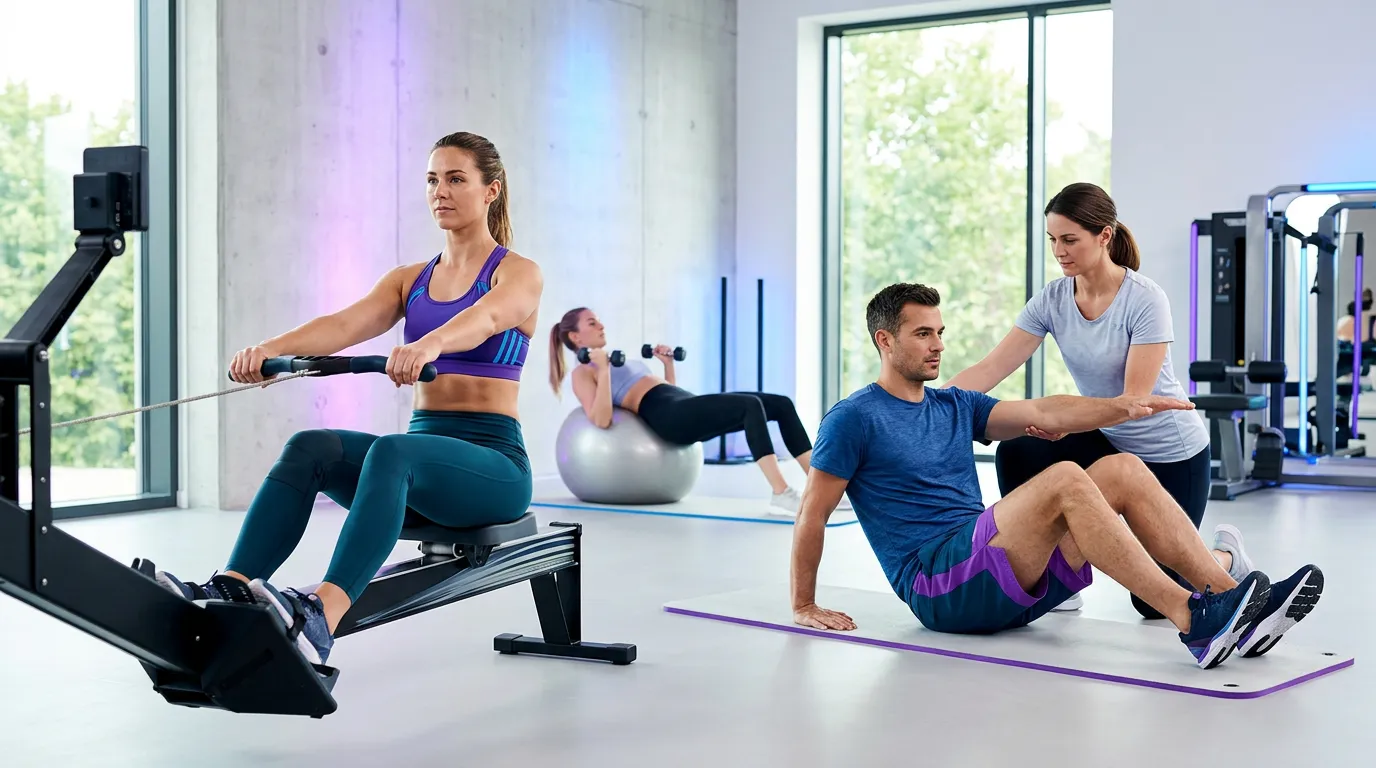
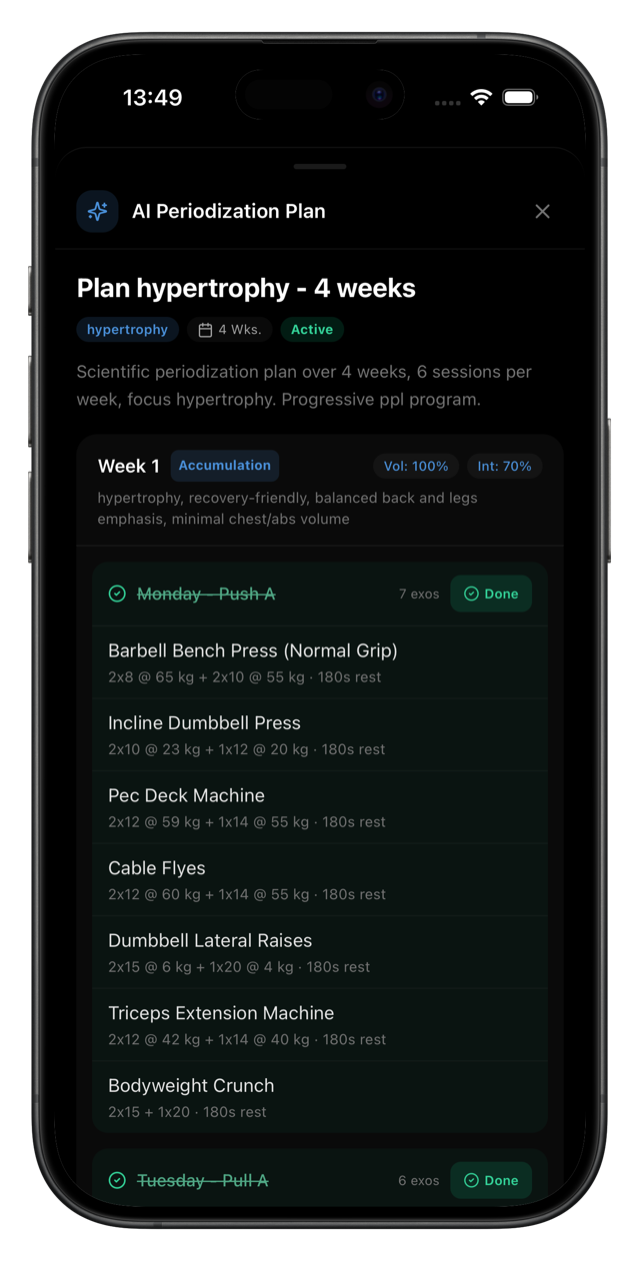
An injury doesn’t mean shutting down everything. Shoulder tendinitis, knee pain, a lower back tweak: most lifters make the mistake of stopping completely for weeks, losing muscle and motivation, then crawling back to the gym below their previous level. The smarter move is finding alternative exercises when injured so you keep training what can be trained. AIVancePro’s conversational AI coach, Vance, rewrites your program in seconds based on the injured area, so each session still counts despite the setback.
Why You Shouldn’t Stop Completely
Total rest is rarely the right strategy. Unless your doctor strictly prescribes it (fracture, severe muscle tear, post-op), stepping away from the gym for four to eight weeks creates three big problems.
First, you lose 5 to 10% of strength per week of total inactivity, especially in the first two to three weeks. This applies to healthy muscle groups too, not just the injured area.
Second, you break your routine. Coming back to the gym after a long break is statistically when most people quit. Keeping adapted sessions running, even at 50% intensity, maintains the mental momentum.
Third, controlled movement around an injury can actually speed up healing. Blood flow delivers nutrients to repair tissue. Total immobilization is now reserved for specific cases, your physical therapist will explain better than I can, but the days of “rest absolutely” are largely gone.
The 3 Golden Rules for Training Around an Injury
Before you start swapping exercises, lock these three principles in your head.
Rule 1: Zero pain on the injured area during the exercise. Not “a little pinch,” not “it stings but it’s fine.” If it hurts, stop. Pain is an alarm signal, not a challenge.
Rule 2: Progressive loading. Restart the substitute exercise at 40-50% of your usual load, even if the healthy side could push more. You’re testing coordination, not setting PRs.
Rule 3: Get medical clearance for serious injuries. Rotator cuff tendinitis, disc herniation, partial ligament tear in the knee: don’t guess what you can do on your own. See a physical therapist or sports doctor before improvising.
Shoulder Injury: Keep Training Your Upper Body
The shoulder is the most mobile and most fragile joint. Common issues: rotator cuff tendinitis, subacromial impingement, instability.
Exercises to typically avoid: barbell overhead press, heavy lateral raises, full range push-ups, dips, wide-grip pull-ups.
Concrete substitutes:
- Incline dumbbell press → incline push-ups (hands on a high bench), range limited to pain-free zone
- Overhead press → seated neutral grip dumbbell press, reduced range
- Lat pulldown → low-cable row pronated grip, elbows tucked
- Lateral raises → rotator cuff work with light bands (external rotations)
- Standing biceps curl → seated incline curl (shoulder locked by the bench)
Prioritize rotator cuff strengthening: these are the muscles that stabilize the shoulder. A physical therapist typically prescribes band external/internal rotations, isometric wall presses, and floor Y-T-W raises.
Knee Injury: Protect Your Lower Body Mass
Patellar tendinitis, patellofemoral pain syndrome, post-sprain recovery: the knee doesn’t forgive execution mistakes.
Exercises to avoid: heavy deep squats, jump lunges, heavy leg extensions, deep leg press.
Concrete substitutes:
- Barbell squat → Bulgarian split squat on the healthy side with wall support, or box squat with a high box
- Leg press → 90° leg press max, no deeper
- Leg extension → light leg extension in reduced range (0-45°)
- Lunges → step-ups on a low step (15-20 cm), healthy side
- Deadlift → trap bar deadlift (less knee flexion) or hip thrust
Isometric work saves the day: 30-60 second wall sits without pain keep the quad active without loading the joint. Same for glutes via single-leg hip thrusts on the healthy side.
Lower Back Injury: Avoid Atrophy Without Making It Worse
Acute low back pain, disc herniation, sciatica: the lower back demands caution but specifically not total immobilization (this matches current sports medicine recommendations).
Exercises to avoid: heavy deadlifts, heavy squats with rounded back, loaded good mornings, classic sit-up crunches.
Concrete substitutes:
- Conventional deadlift → hip thrust or trap bar deadlift with moderate load
- Free squat → wall-supported squat (extra stability)
- Bent-over row → chest-supported machine row (back braced)
- Crunches → front and side planks, bird dogs, dead bugs
Anti-extension work (planks, dead bugs) strengthens the core without loading the discs. This matches the McGill protocols for chronic low back pain.
How AIVancePro Adapts Your Program When Injured
This is exactly where a conversational AI coach changes the game. In most tracking apps you end up alone, scrolling YouTube for substitutions. With AIVancePro, you just declare your injury in the chat: “Twisted my right knee, sharp pain on the kneecap when I bend.”
Vance, the AIVancePro AI coach, then reworks your session in under 30 seconds:
- Substitutes each problem exercise with 2-3 adapted alternatives
- Automatically reduces load for the first sessions
- Tracks your perceived pain session by session
- Suggests a return progression to the original exercises when you’re ready
If pain returns or worsens, you mention it in the chat and the program adjusts again. No need to wait for a coach appointment or dig through an exercise library: you describe, Vance proposes, you validate. The first Pro month is just a few euros, cheaper than a single physical therapy session, and it saves you weeks of lost progress.
When to See a Physical Therapist or Sports Doctor
No app, no AI coach, no blog article replaces a medical diagnosis. See a professional quickly if you notice any of these:
- Pain that persists more than 7 to 10 days despite rest
- Visible swelling or bruising on the joint
- Sudden loss of mobility or strength
- Audible pop or crack at the moment of injury
- Night pain that wakes you up
- Numbness, tingling, or loss of sensation
The PT assesses, identifies the affected structure, and gives you a precise return-to-play protocol. You can then enter those instructions into AIVancePro so Vance integrates them into your program.
Conclusion
An injury isn’t the end of your progress, it’s an adaptation phase. You keep training the healthy areas, you work on mobility, you strengthen the stabilizers around the injured zone, and you progressively return when the tissue has healed. With AIVancePro and its AI coach Vance, your program rewrites itself in real time based on your injury and how you feel. You can test it during your first Pro month at a discounted rate and see exactly how the app handles substitutions.
Health disclaimer: This article provides general information and does not replace professional medical advice. If injured, consult a doctor or physical therapist before resuming training. AIVancePro is a fitness coaching app, not a medical device.
FAQ
How long before I can return to my original exercises after an injury?
It depends on the injury: 1 to 3 weeks for a muscle strain, 4 to 8 weeks for moderate tendinitis, 8 to 16 weeks after surgery. Return when you’re pain-free in full range of motion and your PT clears you.
Can I do cardio if my legs are injured?
In most cases yes: cycling (with a high seat), swimming (without aggressive kicking), rowing if the lower back is fine. Avoid running and jumping until your doctor clears you.
How does AIVancePro know which substitutions to suggest?
Vance draws from a database of 240+ exercises tagged by muscle group, joint loaded, and contraindications. When you declare an injured area, it automatically filters out exercises to avoid and proposes alternatives validated by our team.
Should I take supplements to heal faster?
A balanced diet rich in protein (1.6-2 g/kg/day) covers the essentials. For tendon injuries, some clinicians prescribe collagen + vitamin C, but ask a professional, not a random influencer.
Can I manage alone with AIVancePro without seeing a physical therapist?
For mild pain that clears in a few days, yes. For pain that lingers, disrupts your day, or worsens: no, see someone. AIVancePro complements medical follow-up, it doesn’t replace it.
← Back to blog