You’ve been pushing heavy at the gym for months, your bar numbers keep climbing, yet you don’t gain as much muscle as your buddy who lifts lighter. Or the opposite: you crush hypertrophy sets, your muscles pump up during workouts, but your bench press has stalled at 175 lb. The difference between strength and hypertrophy in your training program is exactly what separates those outcomes. With AIVancePro, your conversational AI coach builds each session around the goal you actually want, pure strength, hypertrophy, or a smart mix, instead of recycling the same generic plan for six months.
Strength and Hypertrophy: Two Goals, Two Different Logics
Strength is your capacity to produce maximum muscular tension on a given movement. It’s measured as a percentage of your 1RM (the max load you can lift once). A powerlifter aims to grow that 1RM on squat, bench, and deadlift. Progress comes first from neural adaptations: recruiting maximum muscle fibers, synchronizing motor units, reducing antagonist inhibition.
Hypertrophy refers to the increase in muscle volume, what most people call getting jacked. It splits into myofibrillar hypertrophy (contractile fiber thickening) and sarcoplasmic hypertrophy (intracellular fluid gain). You want enough mechanical tension and time-under-load to trigger muscle protein synthesis.
In practice: a strong lifter isn’t always huge (look at lightweight powerlifters), and a huge lifter isn’t always exceptionally strong on relative loads (look at certain bodybuilders). The two qualities overlap but never perfectly align.
The Training Variables That Make the Difference
Four variables separate a strength program from a hypertrophy program:
Load (% of 1RM): strength is built on heavy loads (80-95% 1RM); hypertrophy on moderate-to-heavy loads (65-85% 1RM).
Reps per set: 1 to 5 reps for strength, 6 to 12 reps (sometimes up to 20) for hypertrophy.
Total volume: strength uses moderate per-session volume (3-5 sets per exercise); hypertrophy demands higher volume (4-6 sets, 10-20 sets per muscle per week).
Rest intervals: 3-5 minutes for strength to fully recover the nervous system, 60-120 seconds for hypertrophy to sustain high metabolic stress.
These variables interlock: you can’t run 5x5 at 90% with 60-second rests for 12 weeks without breaking something. And you can’t run 4x12 at 65% expecting a new bench PR the week after.
Strength-Focused Program: What It Looks Like
A typical strength program runs 3-4 sessions per week with a focus on heavy compound lifts: squat, bench press, deadlift, overhead press. A classic template:
- Squat 5x3 at 85% 1RM, 4 minutes rest
- Bench press 5x3 at 85%
- Accessories: weighted pull-ups 4x5, weighted dips 4x5, core work
You progress load before progressing volume. Linear periodization (weekly load increase) or undulating periodization (heavy/moderate alternation within the week) structures your mesocycle. Well-known programs: 5/3/1 by Wendler, Starting Strength, Texas Method.
Common mistake: doing sets of 5 reps at 70%, that’s hypertrophy in disguise. To genuinely train strength, you need to be close to failure on loads heavy enough to make you sweat during warm-ups.
Hypertrophy-Focused Program: What It Looks Like
A hypertrophy program accumulates volume per muscle group, varying angles and exercises. The classic chest/back, legs, shoulders/arms split across 4-5 sessions per week remains a staple, as does push/pull/legs across 6 days.
Sample chest/back hypertrophy session:
- Barbell bench press 4x8 at 75%, 90s rest
- Barbell row 4x10
- Incline dumbbell press 3x10
- Lat pulldown 3x12
- Cable fly 3x12
- Dumbbell pullover 3x12
If chest is a priority muscle, our guide to the best chest exercises for hypertrophy explains why each of these pressing and stretch movements earns its place.
Weekly volume per muscle targets 10-20 hard sets, ideally split across 2 sessions to maximize protein synthesis. You progress through progressive overload (load or reps at constant volume) and density work (shorter rests).
Can You Combine Strength and Hypertrophy? Concurrent Training
Good news: yes, and that’s what most intermediate lifters actually do. The most effective method structures each session with a strength block at the start (on the main movement) followed by a hypertrophy block on accessories.
Sample hybrid leg session:
- Barbell squat 5x3 at 85% (pure strength)
- Leg press 4x10 at 75% (quad hypertrophy)
- Romanian deadlift 4x8 (hamstring hypertrophy)
- Dumbbell lunges 3x12 per leg (volume + unilateral)
- Standing calf raises 4x15
This structure captures the best of both worlds: you build your 1RM thanks to the neural stimulus of the heavy squat, and maximize hypertrophy with the accessory volume. Powerbuilding programs (powerlifting + bodybuilding blend) or Westside Barbell’s Conjugate Method rely on this principle.
Trade-off to know: block periodization (4-6 weeks of strength, then 4-6 weeks of hypertrophy) can be more effective for intermediate-advanced athletes. You fully accumulate on one quality, then switch.
How AIVancePro Adapts Your Program to Your Goal
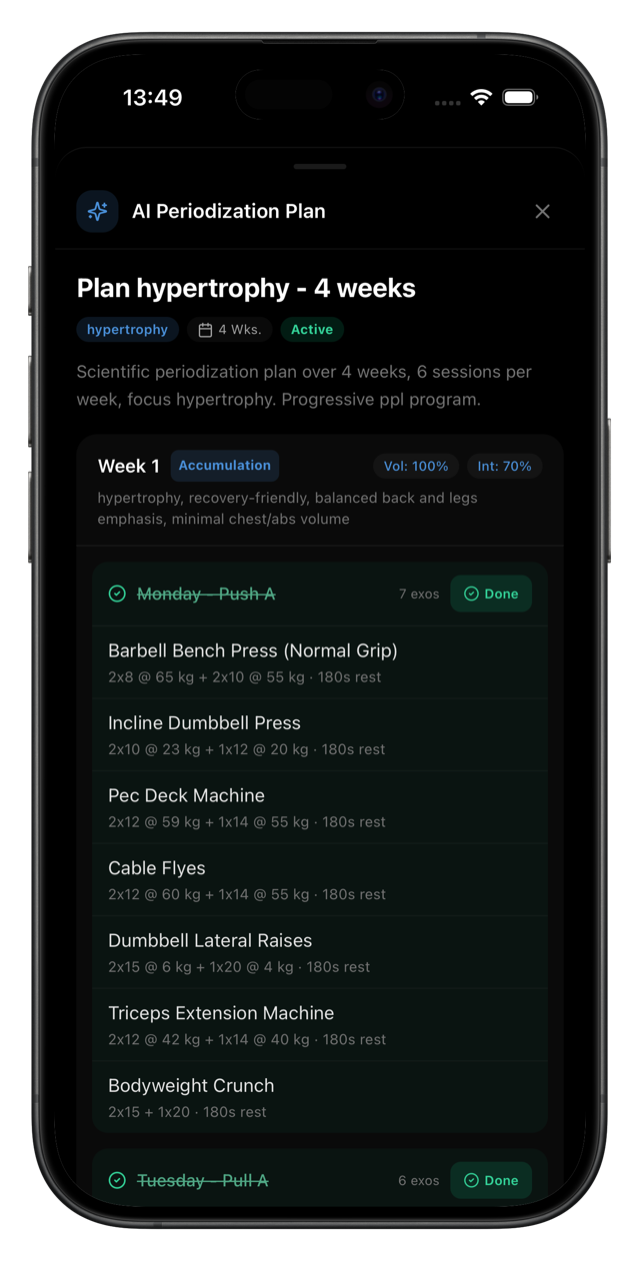
This is exactly where an AI coach makes the difference. On AIVancePro, you start by stating your primary goal (strength, hypertrophy, mix, fat loss) and your experience. Vance, the integrated conversational AI coach, builds a program that respects the variables (% 1RM, reps, sets, rest) tied to your target.
More importantly, the program adapts over the weeks: you log your sets in the app, Vance reads your actual progression, your fatigue, your available equipment, and tunes loads, volume, or rest for the next session. Plateaued on your bench at 175 lb? Vance proposes a 7-day deload then a restart with a fresh intensity scheme. Switching goals mid-cycle (from bulk to cut)? Tell him in plain language and he refactors your plan.
Compared to a spreadsheet or an app that recycles the same generic plan, you keep tight alignment between your stated goal and the actual stimulus imposed on your body. First month at €3.49 to test without commitment, available on iOS and Android.
Recovery, Nutrition, and Progression: The Program Isn’t the Whole Story
Whatever angle you take (strength or hypertrophy), three pillars condition your results beyond the program itself:
Sleep: 7-9 hours support growth hormone secretion and neural recovery. Strength suffers especially from sleep debt (measurable performance drop from 5h/night).
Nutrition: strength tolerates a slight caloric deficit better than hypertrophy. To build muscle, target 1.6-2.2 g of protein per kg of bodyweight and a small caloric surplus (200-400 kcal/day).
Measurable progression: log your loads, reps, RPE. Without data, you can’t tell if your program works. AIVancePro centralizes this automatically from your logged sessions.
Conclusion
The difference between strength and hypertrophy in your program comes down to four variables, load, reps, volume, rest, orchestrated around the goal you’re chasing. Strength is built heavy and explosive on few reps; hypertrophy is built on moderate-to-high volume with sustained metabolic stress. Combining both is possible but demands clear structure: strength block at session start, hypertrophy on accessories, or block periodization if you’re more advanced. Download AIVancePro to generate a program aligned with your real goal, with an AI coach that adapts each session to your progression. First month at €3.49.
Health disclaimer: this article is informational and doesn’t replace a medical professional or a certified coach. Before starting or intensifying training, consult a doctor if you have cardiac, joint, or metabolic conditions.
FAQ
Can you gain strength and mass at the same time?
Yes, especially as a beginner (both qualities progress together during the first 12-18 months). Beyond that, one quality will progress faster than the other depending on your focus.
How long until I see a difference between a strength and a hypertrophy program?
Initial neural strength gains appear in 2-4 weeks. Visible muscular gains from a hypertrophy program take at least 6-8 weeks, with adapted nutrition.
Is 5x5 a strength or hypertrophy program?
It’s a hybrid. At 80-85% 1RM, it primarily develops strength with a secondary hypertrophy effect. That’s why it works so well for intermediates.
Should you do cardio during a strength program?
Yes but moderate: 1-2 low-intensity cardio sessions per week (brisk walking, cycling) won’t hurt strength. Avoid long HIIT sessions that interfere with recovery.
Does AIVancePro offer both strength AND hypertrophy programs?
Yes. You pick your primary goal at sign-up and Vance, the AI coach, builds a tailored program. You can change goals anytime by chatting with him in the app.
← Back to blog