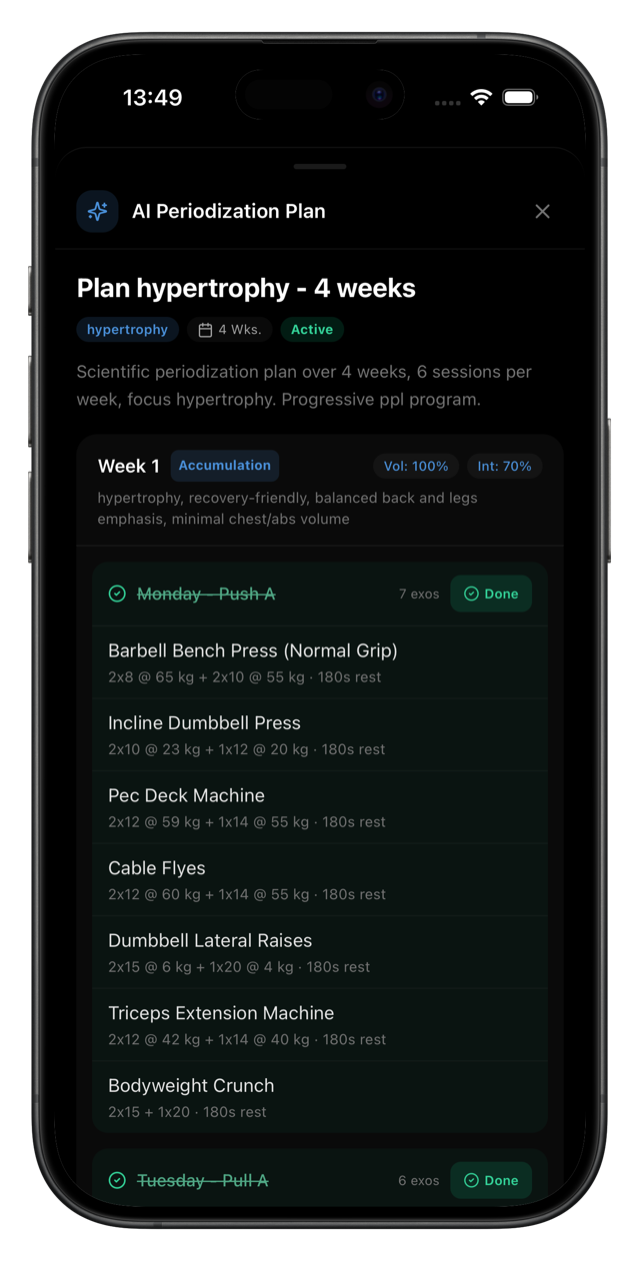
You train 3-4 times a week, you have no competition on your calendar, and you wonder if periodization is overkill for you. It isn’t, and with AIVancePro’s conversational AI coach, each cycle adapts to your real-world progression, fatigue, and equipment without forcing you into spreadsheets or sports-science jargon.
Why Periodize When You’re Not Competing
Periodization isn’t reserved for powerlifters chasing an IPF total. It’s simply organizing your training into blocks with different intents, instead of running the same sessions on loop for six months.
Three concrete reasons to periodize as a recreational lifter:
- Break through plateaus. Your body adapts to repeated stimuli. Without programmed variation, you stall after 8-12 weeks.
- Manage fatigue. Alternating intense blocks with lighter ones improves recovery and reduces injury risk.
- Stay on track. Knowing where you’re heading in 4, 8, or 12 weeks keeps you motivated when daily motivation falters.
The common counterargument, I lift for health, I don’t need a program, doesn’t hold up. A non-periodized routine isn’t healthier, it’s just less efficient.
Periodization Models That Work for Recreational Lifters
Without diving into the terminology jungle (linear, undulating, block, conjugate…), three models work well for non-competitors.
Simplified Linear Periodization
You gradually increase volume and intensity over 8-12 weeks. Example:
- Weeks 1-3: 4 sets × 12 reps at 65% 1RM
- Weeks 4-6: 4 sets × 8 reps at 75%
- Weeks 7-9: 4 sets × 5 reps at 82%
- Week 10: deload (volume halved)
Pro: very readable, ideal if you’re new to periodization. Con: miss a week (travel, sickness) and the whole cycle drifts.
Daily Undulating Periodization (DUP)
You vary intensity within the same week. Example on bench press:
- Monday: 5×5 at 80%
- Wednesday: 3×12 at 65%
- Friday: 4×8 at 72%
Pro: more stimulus variation, great for intermediates. Con: requires precise load tracking.
Block Periodization
You chain 3-4 week blocks with different focuses:
- Block 1: volume (hypertrophy)
- Block 2: strength
- Block 3: strength peak
- Block 4: deload
This is the most powerful model for an intermediate who wants steady progression without burnout.
How AIVancePro Handles Your Cycles Automatically
The classic problem with periodization: on paper it’s simple, in real life you miss a session, your fatigue varies, your equipment changes. An Excel program rarely survives three weeks.
AIVancePro adapts your periodization in real time through its conversational AI coach. Concretely:
- You report your fatigue before the session (wrecked today, slept badly) → the AI adjusts loads and volume for that session without breaking the block.
- You skip a session (work trip, sick kid) → the coach recalculates the rest of the block so the plan stays coherent.
- You change locations (vacation, home workout) → your program adapts to available equipment.
The AI tracks your progression on every exercise and automatically schedules deloads when performance stalls or accumulated fatigue crosses a threshold. You don’t need to understand RIR or RPE, describe your session in natural language and the AI handles the rest.
Building Your 12-Week Block in Practice
If you want to structure a cycle yourself, here’s a template that works for a 4-session/week lifter with 1-3 years of experience.
Weeks 1-4, Volume Block (Hypertrophy)
- 4 sessions/week in upper/lower or push/pull/legs split
- 12-16 sets per muscle group per week
- 8-12 reps per set
- RIR 1-2
Weeks 5-8, Strength Block
- 4 sessions/week, focus on 3-4 compound lifts
- 8-12 sets per muscle group (less volume)
- 4-6 reps per set
- RIR 1-3
Weeks 9-11, Strength Peak Block
- 3-4 sessions, volume reduced
- 4-6 sets per main lift
- 2-5 reps per set
- Personal record attempts on bench, squat, deadlift
Week 12, Deload
- 3 easy sessions, 50% of usual volume
- Same loads but fewer sets
- Full recovery before the next cycle
Important: non-competitive periodization doesn’t follow a peak date. You don’t need to peak for a meet, you just want consistent progress without burning out.
Common Mistakes When Periodizing Without a Coach
I’ve seen intermediates trip on the same issues.
1. Copying a pro program. An athlete training 8 hours a day with two sessions has nothing in common with your 4 sessions after work.
2. Never deloading. Six months without a light week and your progression collapses and you get hurt. Deload isn’t weakness, it’s physiology.
3. Switching programs every month. Periodization means varying parameters (volume, intensity, frequency) while keeping the same key exercises. Not changing every lift every 4 weeks.
4. Underestimating nutrition. A volume block without a caloric surplus, or a strength block without enough protein (0.7-1g/lb/day), won’t work even with a perfect program.
5. Tracking too much or too little. Too much: you obsess over every missed kg. Too little: you have no idea if you’re progressing. The AIVancePro app handles this tracking automatically without spreadsheets.
When to Adjust: Signs Your Cycle Isn’t Working
You don’t need to wait until the end of a block to adjust. Watch for these red flags:
- 3 weeks of stagnation on all main lifts → early deload.
- Poor sleep + irritability → too much accumulated fatigue, drop volume.
- Persistent joint pain (knees, elbows, shoulders) → see a physio and modify exercises.
- Motivation drop across several sessions → often central fatigue, not mental. A deload often resolves it.
AIVancePro’s coach detects these patterns automatically from your session-by-session feedback and proposes targeted adjustments without breaking your overall progression.
Conclusion
Periodization for non-competitive lifters is just organizing your training with a clear direction and varied phases, without the complexity of athletic prep cycles. Whether you choose a linear, undulating, or block model, the key is having a structure that evolves every 3-4 weeks and includes deloads.
If you’d rather not manage this yourself, AIVancePro does it for you: the conversational AI adapts every session to your fatigue, equipment, and actual progression, and plans your cycles without spreadsheets. First month at €3.49 to test a full 4-week cycle, then €6.99/month if you stick with it.
This article is informational. For any medical concerns, persistent pain, or specific conditions, consult a healthcare professional before changing your training.
FAQ
Do I really need periodization if I’m not competing?
Yes, but for different reasons than a competitor. Recreational lifters periodize to avoid plateaus, manage fatigue, and stay motivated, not to peak on a specific date.
How long should a cycle be for a recreational lifter?
8 to 12 weeks, deload included. Shorter, you don’t generate enough adaptation. Longer, fatigue accumulates without reset.
Is undulating periodization compatible with an irregular schedule?
Yes, that’s its advantage: miss Wednesday and you shift the volume session to Thursday without breaking the plan. More flexible than linear cycles.
Is a deload always necessary?
Yes, especially after a sustained strength or volume block. One week at 50% of usual volume is enough. Skipping it means risking 4-6 weeks of stagnation afterward.
Does AIVancePro offer built-in periodized programs?
Yes, the conversational AI coach builds a periodized program adapted to your profile during onboarding and evolves it cycle after cycle based on your actual progression and fatigue, no manual tweaking needed.
← Back to blog