You keep wondering how long a workout should actually last to be effective: 30 minutes, an hour, two hours? The honest answer isn’t a single number, it’s a range that depends on your volume, density, and goal. AIVancePro’s conversational AI coach calibrates the length of every session to your real schedule, your fatigue, and your equipment so no minute is wasted.
The real answer: 45 to 75 minutes of effective work
Research on hypertrophy consistently converges on the same range: 45 to 75 minutes of effective work per session, not counting warm-up and cool-down. This window maximizes useful training volume without tanking your hormones or destroying your focus.
Under 30 net minutes, you struggle to accumulate enough volume to drive serious muscle growth. Past 90 minutes, cortisol climbs, technique slips, and you stack fatigue with no proportional payoff. The gym rats who hang out for two hours aren’t more advanced, they just take longer between sets.
Watch out for the total-clock trap: if you walk into the gym at 6:00 PM and leave at 7:30 PM, but 40 minutes were spent scrolling your phone, your “effective” workout was 50 minutes long. What matters is cumulative time under tension and the number of quality sets, not your check-in time.
The 4 factors that shift your optimal duration
1. Your goal
- Hypertrophy / muscle gain: 50-75 min, 16-22 working sets, 90-180 sec rest.
- Pure strength: 60-90 min, fewer sets but 3-5 min rest between heavy lifts.
- Cutting / muscular endurance: 40-60 min, short rests (30-60 sec), high density.
- General fitness: 30-45 min is plenty in your first year.
2. Your weekly frequency
Training twice a week means denser sessions (60-75 min) to cover every muscle group. Training five times a week in a split lets you drop to 45-55 min per session because the volume is spread out.
Simple rule: the more often you train, the shorter each session can be.
3. Your level
A beginner doesn’t need more than 40-50 min to progress. Their nervous system and tissues can’t absorb massive volume. An intermediate naturally settles at 60-75 min. An advanced powerbuilder can push to 90 min on big compound days without overtraining, as long as they built up to that tolerance gradually.
4. Your equipment and gym crowd
A home dumbbell session rarely runs past 45 min, you flow through it. The same workout at a packed commercial gym on Saturday morning can drag to 75 min just from waiting on the squat rack. AIVancePro factors this in: you tell the app “I have 50 minutes and I’m at the gym,” and it builds a session that fits that exact window.
Anatomy of an effective 60-minute session
Here’s a template that works for 90% of intermediate lifters:
- 0-8 min: warm-up, 5 min of light cardio, joint mobility work, and 2 ramp-up sets on your first exercise.
- 8-30 min: main compound lift, 4-5 heavy sets (squat, deadlift, bench press, pull-up). Rest 2-3 min between sets.
- 30-48 min: 2 accessory exercises, 3 sets each, 90 sec rest. This is where hypertrophy volume accumulates.
- 48-58 min: 1-2 isolation exercises, arms, calves, abs, 12-15 rep range with short rests.
- 58-60 min: cool-down, light stretching, hydration.
This gives you 9-12 effective working sets in an hour, more than enough to drive growth without padding the clock.
The 5 mistakes that needlessly stretch your workouts
- Phone between sets, a “quick” Instagram scroll turns 90 sec of rest into 240. Across 12 sets, that’s 30 extra minutes for nothing.
- Too many different exercises, past 5-6 exercises per session, you’re just dabbling. Four well-loaded exercises beat eight sloppy ones.
- No written plan, deciding each exercise on the spot costs 5-10 min of hesitation. A planned session takes 50 min; the same session improvised takes 80.
- Excessive warm-up, 15 min of cardio + 10 min of static stretching = 25 min wasted. A focused 8-min warm-up does the job.
- Untimed rests, without a timer, 90 sec quickly becomes 3 min. A simple timer shifts your total session time by 15-20 min.
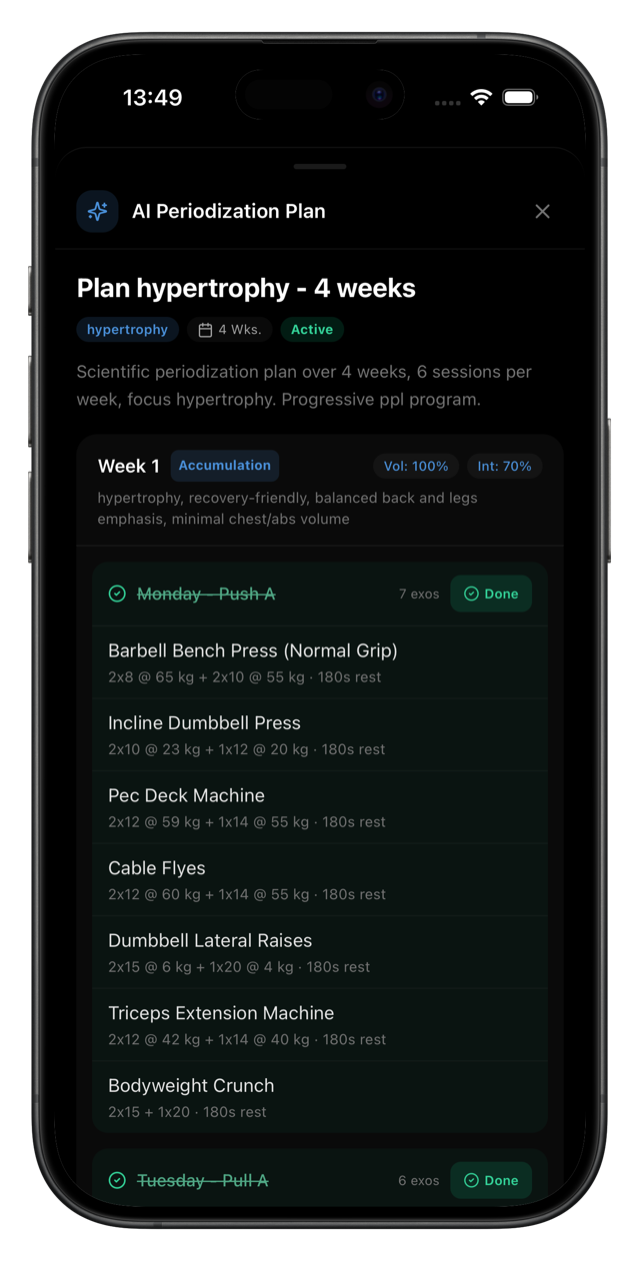
AIVancePro builds these safeguards in: your coach suggests the optimal rest between sets based on your load and goal, and prompts you to start the next one.
How AIVancePro fits sessions to your actual schedule
Most paper programs or classic apps hand you a fixed session: 8 exercises, 4 sets, done. Only got 45 min today? Tough. AIVancePro works differently: open the app, type “I’ve got 50 min tonight, my legs are still sore from yesterday,” and your AI coach rebuilds a session that fits the window while respecting your weekly plan.
Concretely:
- You give your available time, the coach adjusts the number of exercises and sets to land exactly in that duration.
- You give your equipment, the session adapts whether you’ve got a bench and dumbbells or a full commercial gym.
- You give your fatigue, the coach dials down intensity if you flag yourself as poorly recovered.
- You track your rests in-app, set timer baked in, no need for a separate timer.
You walk out of every session knowing the time was used in full, not stretched for show. That’s the edge of a conversational AI coach over a fixed-plan app.
Case study: 3 schedules, 3 optimal session lengths
Case 1, Luke, 28, office worker, 4 sessions/week
He can run 55-65 min sessions on an upper/lower split, 4 days out of 7. Weekly volume well distributed, recovery solid.
Case 2, Sophie, 34, working mom, 2 sessions/week max
Her sessions need to be denser: 70-80 min in full body to compensate for the lower frequency. AIVancePro programs her 6 heavily-loaded compound exercises.
Case 3, Karim, 22, student, 6 PPL sessions/week
He can drop to 45-55 min per session because volume is fragmented over 6 days. Zero benefit to staying 90 min.
Conclusion
The length of an effective workout isn’t a single answer, it’s a 45-to-75-minute range of effective work, modulated by your goal, frequency, level, and equipment. What matters most isn’t how long you stay in the gym, it’s what you do with the sets you sign for. Kill the phone, time your rests, prep your plan, and you’ll see that 60 min is plenty.
If you want to stop asking this question before every session, download AIVancePro and let your conversational AI coach fit the duration and content of each session to your real schedule. First month at €3.49 to try the full Pro app. You give your time window, equipment, and level, the AI coach handles the rest.
Health disclaimer: this article is informational. If you’re returning to training after a long break, an injury, or with a chronic condition, consult a physician or physiotherapist before adjusting your training volume.
FAQ
Can a 30-minute workout be effective?
Yes, as long as it’s dense: 2-3 compound exercises, short rests, high intensity. It’s enough to maintain gains or progress when you’re starting out, but limited if you’re chasing serious hypertrophy in the medium term.
Why do my sessions always run 2 hours?
90% of the time it’s phone breaks, equipment waits, and lack of a structured plan that drag things out. Time your rests for one week, the same session goes from 110 to 65 min with nothing cut from the content.
Should I always add cardio at the end of a strength session?
No. If you’re after hypertrophy or strength, keep cardio on separate days or limit it to 10-15 min at the end of shorter sessions. Tacking 30-45 min of cardio onto every session stretches the workout and can hurt muscle recovery.
How long should my warm-up last?
5 to 10 minutes is enough: 3-5 min of light cardio to raise core temperature, joint mobility on the muscles you’ll train, then 1-2 ramp-up sets on your first exercise. Skip the 20 min of static stretching.
How does AIVancePro adjust the length of my sessions?
You tell the AI coach how much time you have (40, 60, or 90 min), your available equipment, and your fatigue for the day. It adjusts the number of exercises, sets, and rest periods to fit your window while respecting your weekly plan and goal (mass, strength, cutting).
← Back to blog