
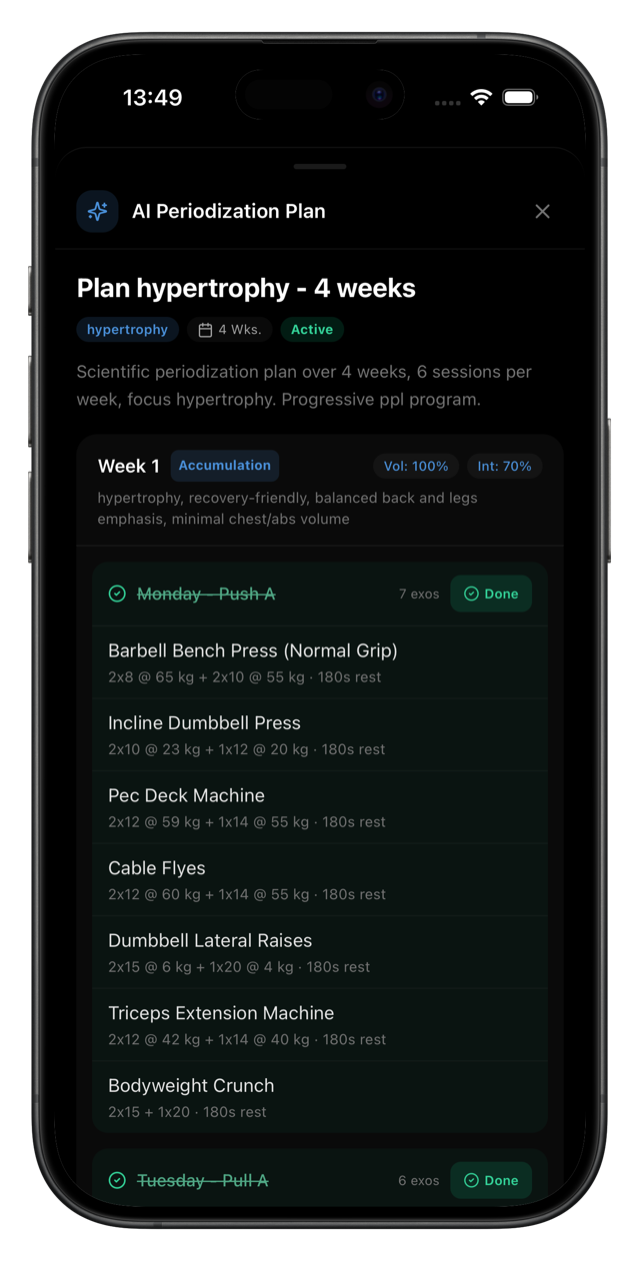
You’ve been training for weeks, you push hard every session, but the bench press won’t budge and the mirror tells the same story it did a month ago. If you keep asking yourself “why am I not building muscle anymore?”, you’re not alone, it’s the wall every self-taught lifter eventually hits after piecing a program together from a YouTube video or a PDF. The good news: a plateau always has a concrete, fixable cause. AIVancePro’s conversational AI coach, Vance, reads your training history to pinpoint exactly where you’re stuck, but before we talk about the app, let’s go through the real reasons.
1. You’re confusing a real plateau with invisible progress
First, are you actually stuck? Without a training log, you have no objective read on your progress. Plenty of lifters “plateau” after adding 5 lb to their squat over six weeks, they just never noticed because they track nothing.
Progress is never linear past the first few months. You no longer add weight every week like a beginner. You now progress in steps: one extra rep here, a small load bump there, cleaner form elsewhere. Before you panic, log your load, sets and reps for four weeks. Then you’ll know whether it’s a genuine plateau or just impatience.
2. Progressive overload has vanished from your program
This is the number one cause. Your body adapts to the demand you place on it. If you do 4 sets of 10 at 135 lb week after week, never adding load, reps or volume, your body has zero reason to build new muscle, it already has everything it needs to handle that session.
Progressive overload simply means doing slightly more over time: +1 rep, a small load increase, +1 set, or shorter rest. Not every session, but over a 4-to-6-week cycle, the trend must climb. If you improvise a different workout every time with no through-line, you make that progress impossible to measure or trigger.
3. Your volume is poorly distributed
Too little volume and the muscle doesn’t get enough signal to grow. Too much and you can’t recover, so you assimilate nothing. The range that works for most intermediate lifters sits between 10 and 20 weekly sets per muscle group.
The classic self-built-program mistake: 25 sets of chest and biceps (the “mirror” muscles) and four sad sets for back and legs. The result, your front upper body stalls from local fatigue while everything else gets too little stimulus. Count your actual weekly sets per muscle. The imbalance is usually surprising.
4. You’re neglecting recovery and sleep
Muscle isn’t built during the session, it’s built during recovery. If you sleep 5 to 6 hours, you’re stressed, and you train the same muscle before it has recovered, you accumulate fatigue without ever banking the gains.
Aim for 7 to 9 hours of sleep, leave 48 hours before hitting a muscle heavy again, and program lighter deload weeks every 6 to 8 weeks. A plateau is very often disguised fatigue: you’re not too weak, you’re too fried to express your strength.
5. Your nutrition doesn’t match your goal
You can’t build muscle from nothing. In a building phase, if you’re not in a slight calorie surplus and you don’t hit roughly 0.7 to 1 g of protein per pound of bodyweight, your progress will cap no matter what you do in the gym.
Conversely, if you’ve been cutting for too long, it’s normal that your lifts stop climbing: your body is surviving, not trying to grow. Be consistent. Decide whether you’re bulking or cutting, and eat accordingly. A gym plateau very often starts on the plate.
6. Your program has been frozen for too long
The exact same program for six months? Your body knows it by heart. Without ever changing an exercise variation, rep scheme or intensity, you stop offering it a new challenge.
The opposite, swapping everything every week (“muscle confusion”), stops you from measuring anything. The sweet spot: keep a stable program for 6 to 10 weeks to apply progressive overload, then evolve one or two variables. That balance is exactly what most self-taught lifters miss, they either never change anything, or change everything.
7. How AIVancePro helps you break the plateau
The self-taught lifter’s real problem isn’t a lack of effort, it’s the absence of an outside eye connecting the dots between sessions. You pushed 185 lb instead of 175? Vance sees it in your history, recalibrates your next session, and explains why it’s adding a back set rather than chest this week.
That’s where AIVancePro’s conversational AI coach changes things: it automatically detects the patterns causing your plateau (unbalanced volume, missing overload, poor recovery) from your real data, then adjusts. You can ask it questions like you would a human coach, except it’s a fraction of a personal trainer’s hourly rate, with a low-cost first month to try it honestly.
Conclusion
A muscle-building plateau is never fate or a lack of “genetics”. It’s almost always one of these seven levers: no tracking, missing overload, poorly distributed volume, sloppy recovery, inconsistent nutrition, or a frozen program. Start by logging your sessions for four weeks, check your progressive overload and your sleep, you’ll fix most cases on your own.
If you want an eye that detects these blocks automatically and adjusts your program session after session, AIVancePro offers its conversational AI coach with a low-cost first month. A solid starting point to stop guessing and make your progress reliable.
Health disclaimer: this article is informational and does not replace professional medical advice. If you experience pain, injury, or have a specific medical condition, consult a doctor or physiotherapist before adjusting your training.
FAQ
I’ve been stuck on bench press for 3 weeks, is that normal?
Yes, it’s common and rarely serious. A 2-to-4-week stall on one lift is usually just accumulated fatigue or missing progressive overload. Check your sleep, try a lighter week, then restart with +1 rep before adding load.
How long before I can really call it a plateau?
If over 4 to 6 weeks, while logging your sessions, you gain no reps, no load and no cleaner execution on your main lifts, then yes it’s a real plateau. Under 4 weeks, it’s too early to conclude.
I’m stuck but I never change my program, is that the problem?
Keeping the same program isn’t the problem, it’s necessary to apply progressive overload. The problem is keeping the same weights. Hold the structure for 6 to 10 weeks but drive volume or intensity up, then evolve one variable.
Do I need a coach to break a plateau?
Not necessarily. Most plateaus resolve with a training log, progressive overload and better sleep. A coach, human or an AI coach like AIVancePro’s, mainly speeds up the diagnosis by spotting what you can’t see in your own data.
Can a plateau come purely from nutrition?
Yes, absolutely. Without a slight calorie surplus when building and enough protein (around 0.7 to 1 g per pound), your progress will cap even with perfect training. If you’ve been cutting for a long time, stalled lifts are expected, that’s the normal trade-off.
← Back to blog