How to Track Your Strength Training Progress
You’re hitting the gym every week but unsure whether you’re actually progressing? Learning how to track your strength training progress is what separates training from improving. Without data, you’re flying blind — you can’t optimize, you can’t course-correct, and you’ll lose motivation right when results plateau.
Why Tracking Progress Changes Everything
Muscle progress isn’t something you guess at — it’s something you measure. The body adapts slowly and visible changes often take weeks to appear. Without tracking, you’ll either overestimate or underestimate your real progress and lose confidence precisely when you’re improving most.
Tracking your sessions gives you three concrete advantages. First, you identify which exercises are working and which are stalling. Second, you apply progressive overload with surgical precision — you know exactly how much to add to each lift each week. Third, you transform motivation: watching your numbers climb week after week is one of the most powerful psychological drivers in lifting.
Sport science research backs this up: lifters who keep a training log progress 30 to 40 % faster on average than those who train by feel. That’s not marginal — that’s the difference between six months of stagnation and gaining four pounds of lean muscle.
The 4 Essential Metrics to Track
Tracking your strength training progress isn’t about logging ten parameters per session. Four well-kept metrics cover 95 % of cases.
1. Weight × Reps (Volume Load)
For every exercise, log the weight lifted, sets performed, and reps completed. Weight × sets × reps gives you volume load, the most reliable indicator of strength-hypertrophy progress.
2. RPE or RIR
RPE (Rate of Perceived Exertion, 1-10 scale) or RIR (Reps in Reserve, reps you had left) shows the true intensity of each set. The same 220 lbs × 8 reps at RPE 7 versus RPE 9 tells two completely different stories.
3. Body Measurements
Arm, thigh, waist, chest. Measured once a month, these numbers reveal where you’re gaining muscle and where you’re holding (or losing) fat — places where the scale alone lies.
4. Progress Photos
Taken every two weeks under identical conditions (morning, fasted, same lighting, same poses), photos capture visual progress that numbers sometimes miss.
How to Track Strength Accurately
Strength is the easiest metric to track and the most predictive of long-term hypertrophy. Three rules to do it right.
Log immediately. Not after the workout, not that evening — between every set. Working memory under fatigue is unreliable; you’ll consistently confuse weight and reps if you wait.
Keep technique consistent. A set of 10 half-reps isn’t the same as 10 full-range reps. Note when you change technique (full ROM, paused, tempo), because it invalidates direct comparisons.
Track your estimated 1RM. You don’t need to test a true 1RM monthly (risky and unnecessary). A simple formula like Epley (1RM = weight × (1 + reps/30)) gives a reliable estimate from your heavy sets. That’s your strength barometer.
For a beginner, expecting 2 to 5 lbs of progress per week on the major compound lifts (squat, bench press, deadlift) is realistic for 4 to 6 months. After that, the rate slows naturally and that’s normal.
How to Track Body Composition
Scale weight is the least useful metric, contrary to popular belief. During a clean bulk you can gain 2 lbs of muscle and lose 1 lb of fat in the same month and only see +1 lb on the scale. Conversely, +4 lbs of water and glycogen can fool you into believing you gained muscle that doesn’t exist.
Useful tools, ranked by reliability:
- Before/after photos (every 2 weeks) — free and precise if conditions stay consistent
- Tape measurements (once a month) — accurate to the millimeter
- Skinfold calipers (Harpenden or Slim Guide) — reliable once you master the protocol
- Bioimpedance scales — variable, useful for trends rather than absolute values
- DEXA scan — gold standard, $50-80 per session, twice a year if you want serious data
The classic mistake is weighing yourself daily and panicking over fluctuations (+/- 2-4 lbs is normal and driven by water, sodium, sleep). Weigh yourself 3 times per week, average the week, then compare weekly averages to each other.
Tools to Automate Your Tracking
Paper journals work, but quickly hit a wall when you want to analyze trends across 3-6 months. That’s where tracking apps make a real difference.
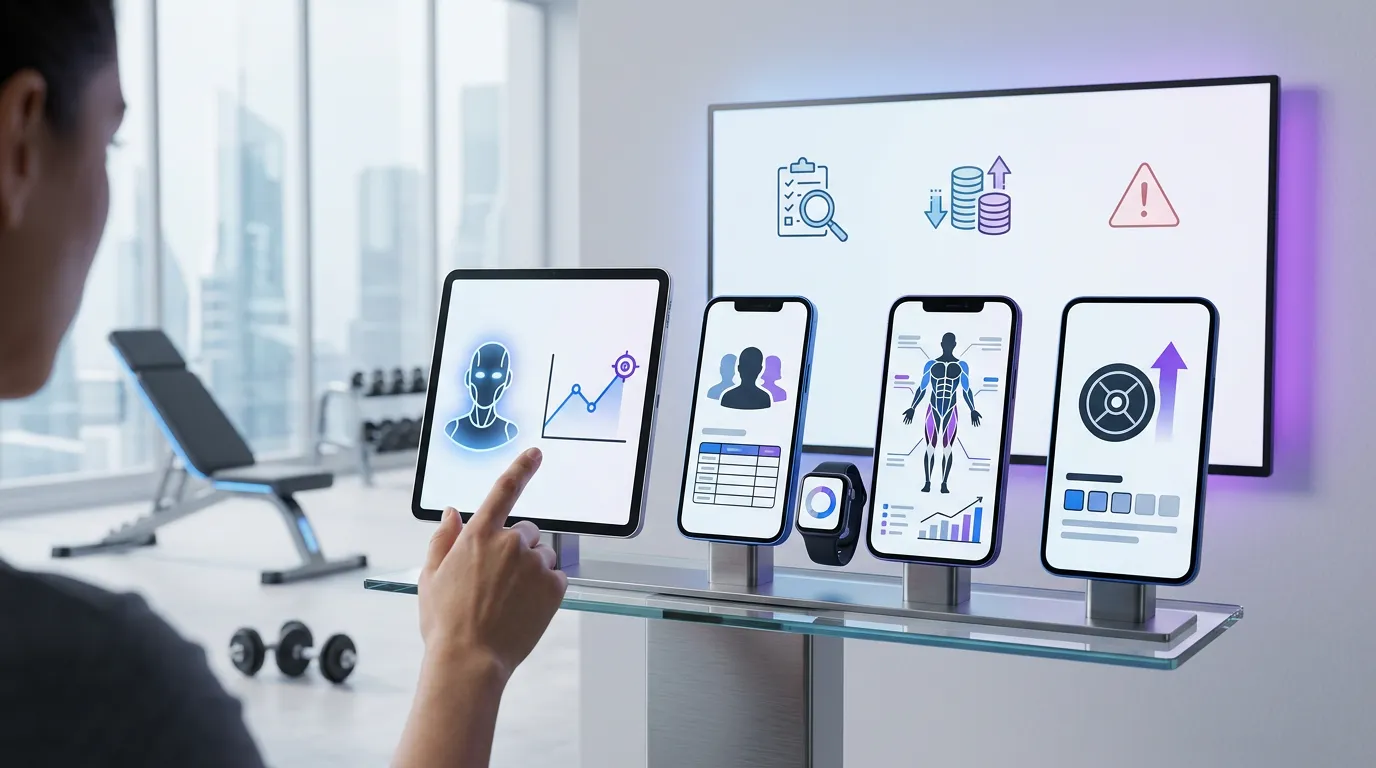
AIVancePro automates this entire layer: you log each set during your workout, the app computes your weekly volume load, estimated 1RM, average load per muscle group, and flags when you stall or when an exercise deserves a new progression. The built-in conversational AI coach then suggests concrete adjustments — raise the load, drop the reps, swap the exercise — based on your own data, not on a generic recipe.
Concretely, the app does three things a paper log can’t:
- Detects plateaus automatically on any exercise (3 sessions without volume progression)
- Suggests your next load based on your RPE and recent history
- Charts your trends for every exercise and muscle group across 4, 12, and 52 weeks
Available on iOS (Android in development), with a first month at $3.99.
Common Mistakes to Avoid
Comparing sessions that aren’t comparable. A workout after 5 hours of sleep doesn’t equal a rested workout. A cut session doesn’t equal a surplus session. Note context (sleep, nutrition, stress) if you want to understand your variations.
Tracking too much. If you measure 12 different metrics, you’ll abandon 10 of them within two weeks. Start with the four essentials (weight × reps, RPE, measurements, photos). Add more only if you have a concrete use.
Changing programs too often. You can’t measure progress on an exercise you do once every three weeks. Keep your main lifts for at least 8 to 12 weeks before judging them.
Forgetting the deload. If you haven’t seen progress in three weeks, it’s not always a programming problem. A week at 60 % volume often lets your body supercompensate and unlock the next phase.
Comparing yourself to other lifters. Genetics, training age, sleep, nutrition — everything differs. The only lifter worth comparing yourself to is you, three months ago.
Conclusion
Tracking your strength training progress isn’t optional — it’s the tool that separates lifters who train for three years with the same body from those who actually transform their physique. The four essential metrics (volume load, RPE, measurements, photos) are enough, as long as you log them consistently. The rest is data noise.
The point isn’t to become the accountant of your gym sessions — it’s to make informed decisions: raise this load, keep this exercise, drop that one. An app like AIVancePro automates the collection and analysis so you can focus on the lifting itself. First month at $3.99, the rest is on you.
Health disclaimer: the advice in this article is for informational purposes only. In case of injury, persistent pain, or underlying condition, consult a healthcare professional before adjusting your training.
FAQ
How long does it take to see measurable progress in strength training?
For strength, you’ll see gains as early as week 2 (neural adaptation). For visible hypertrophy, expect 8 to 12 weeks with consistent nutrition. For measurements, wait 4 weeks before drawing any conclusion.
Do I need to weigh myself daily to track progress?
No, the opposite is more effective. Weigh yourself 3 times a week under consistent conditions (morning, fasted, post-bathroom) and compare weekly averages. Daily fluctuations are noise.
What’s the best progress indicator: weight lifted or body measurements?
Neither alone is enough. Weight lifted reflects strength, which predicts hypertrophy long term. Measurements reflect visible muscle. Tracking both gives you the full picture.
How do I know if I’m really stalling or it’s just temporary?
If you haven’t progressed in volume load on a given exercise for 3 consecutive sessions despite proper sleep and nutrition, you’re stalled. Before that, it’s probably normal variation.
Is a tracking app really necessary?
Not mandatory, but it accelerates everything. A paper log works for 6-12 months, then you hit the wall on trend analysis. An app like AIVancePro automates the calculations (1RM, weekly volume, plateaus) and lets you make decisions in 30 seconds instead of 20 minutes.
← Back to blog