How to Build Your Own Workout Program: Complete Guide
Knowing how to build your own workout program is the difference between spinning your wheels for months and seeing weekly progress. Most people copy a random plan from the internet without understanding the logic behind it, then quit when results don’t show. This guide gives you the full method to create a plan tailored to your level, schedule, and goals.
Define your goal first
An effective workout program starts with a clear, measurable goal. “Getting in shape” is too vague — you need to choose between muscle gain, pure strength, fat loss, or body recomposition. Each goal demands different choices in volume, intensity, and nutrition.
Ask yourself three concrete questions. How many pounds do you want to gain or lose in the next 12 weeks? What strength benchmarks do you target on the big compound lifts (squat, bench press, deadlift)? How many training sessions can you realistically fit into your week without sacrificing the rest of your life?
A beginner aiming to gain 10 lbs of muscle in 6 months will need a radically different program from an intermediate lifter pushing for a 225 lbs bench press. Write your goal down with a deadline. This is the guiding line that drives every decision that follows.
Pick your training frequency
Frequency — how many sessions per week — is the second pillar of your program. Three frequencies work for 95% of lifters: 3 full body sessions, 4 sessions split upper/lower, or 5-6 sessions in push/pull/legs.
If you’re a beginner, go with 3 full body sessions. You hit each muscle group three times a week, which maximizes neuromuscular gains in the early months. After 6-12 months of experience, switch to a 4-day upper/lower split to add volume without wrecking recovery. Past one year of training, push/pull/legs on 5-6 days makes sense if you’re chasing serious mass.
The golden rule: train each muscle at least twice a week. Hypertrophy research is clear — frequency x2 beats frequency x1 at equal volume.
Select your exercises wisely
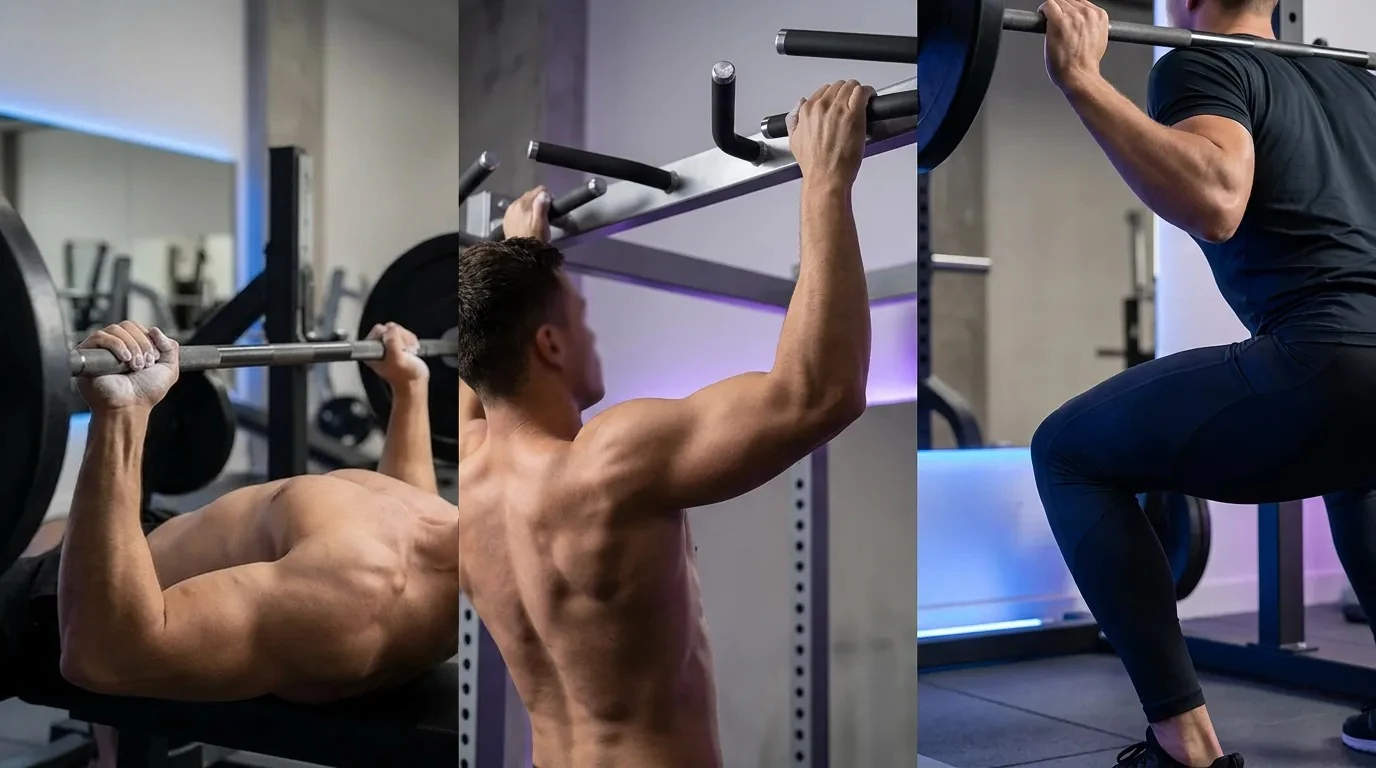
Each session should open with one or two heavy compound lifts: squat, deadlift, bench press, overhead press, pull-ups, barbell row. These movements recruit the most muscle fibers and trigger the strongest hormonal response (testosterone, growth hormone).
Then come isolation exercises to target weak points or muscles you want to bring up: bicep curl, tricep extension, lateral raise, leg curl, weighted crunch. Aim for 60% compound and 40% isolation across the program.
A sample full body session for a beginner:
- Squat — 4 sets
- Bench press — 4 sets
- Barbell row — 4 sets
- Overhead press — 3 sets
- Bicep curl — 3 sets
- Tricep extension — 3 sets
- Plank — 3 sets
Total: 7 exercises, 24 sets, around 60-75 minutes. No need for more.
Calibrate volume and intensity
Volume (sets x reps x load) is the main driver of hypertrophy. For most lifters, target 10 to 20 weekly sets per muscle group. Below 10, you understimulate. Above 20, you pile up fatigue without proportional gains.
Intensity depends on the goal. For strength, work in the 1-5 rep range at 85-95% of your 1RM. For hypertrophy, stick to 6-12 reps at 65-80%. For muscular endurance, go above 15 reps at 50-60%.
Most of your sets should end with 1 to 3 reps in reserve (RIR 1-3). No need to hit failure systematically — it tanks recovery and raises injury risk without measurable gains. Save failure for isolation work at session’s end, once or twice a week max.
Apply progressive overload
A program that doesn’t progress is a dead program. Progressive overload — gradually increasing difficulty week after week — is what forces your body to adapt and grow.
Four levers let you progress:
- Increase load: add 5 lbs when you nail your sets cleanly
- Increase reps: go from 8 to 10 reps before bumping the weight
- Increase sets: add one set to an exercise every 2-3 weeks
- Improve technique: full range of motion, controlled tempo, pause at the bottom
Log your performance every session. Without tracking, you don’t know if you’re progressing. Paper notebook, phone note, or dedicated app — the format doesn’t matter, but do it.
Plan your recovery
You don’t grow in the gym, you grow while you recover. Three levers matter:
Sleep first — 7 to 9 hours a night. A 2019 study on athletes in caloric deficit showed a 60% loss of muscle tissue when sleeping 5.5h vs 8.5h during a cut.
Nutrition second — at minimum 0.7 to 1 g of protein per pound of bodyweight, a caloric surplus of 200-400 kcal/day for muscle gain, or a deficit of 300-500 kcal/day for fat loss.
Deload third — every 6 to 8 weeks, drop volume by 30-50% for one week to let your nervous system and joints recover. You come back stronger the following week.
Let AI structure your program
Building a program by hand takes time, knowledge, and constant adjustment based on results. That’s exactly the role of an integrated conversational AI coach like the one in AIVancePro: you give your goal, level, available frequency, and equipment, and the app generates a calibrated program, then adjusts loads and volume session after session based on your performance.
The algorithm factors in your RIR, weekly progression, and automatic deloads. You no longer have to wonder if you’re doing too much or too little — the app reads the data and adapts. Available on iOS today (Android in development), with a first month at $3.99 to try risk-free.
Conclusion
Building your own workout program comes down to setting a clear goal, choosing a realistic frequency, picking the right exercises, and applying progressive overload with discipline. The rest — recovery, nutrition, deload — is what turns a solid plan into visible results. Start simple, track everything, and progress week after week.
This article is for informational purposes only and does not replace the advice of a healthcare professional or certified coach. Consult a doctor before starting a strength training program, especially if you have a medical history or joint pain.
FAQ
How long until I see results from a workout program?
First strength gains appear in 2-4 weeks (neuromuscular adaptations). Visible hypertrophy takes 8 to 12 weeks with proper nutrition and consistent training.
Should I change my program regularly?
No, not systematically. Stick to the same program as long as you’re progressing (loads, reps, volume). Change it when you stall 3-4 consecutive weeks on main lifts despite good sleep and nutrition.
Can I build an effective program without equipment?
Yes for beginners, up to 6-12 months of practice. Push-ups, pull-ups, dips, single-leg squats, and core work build a strong foundation. Beyond that, external loads (dumbbells, barbell) become necessary to keep progressing.
How many exercises per session?
Between 5 and 8 exercises per session for a 45 to 75 minute workout. Beyond that, form quality drops and recovery becomes problematic.
Should I do cardio in addition to lifting?
A little, yes. 2 to 3 moderate cardio sessions (20-30 minutes) per week improve recovery, cardiovascular health, and don’t interfere with muscle gain. Avoid long intense cardio sessions during bulking phases.
← Back to blog