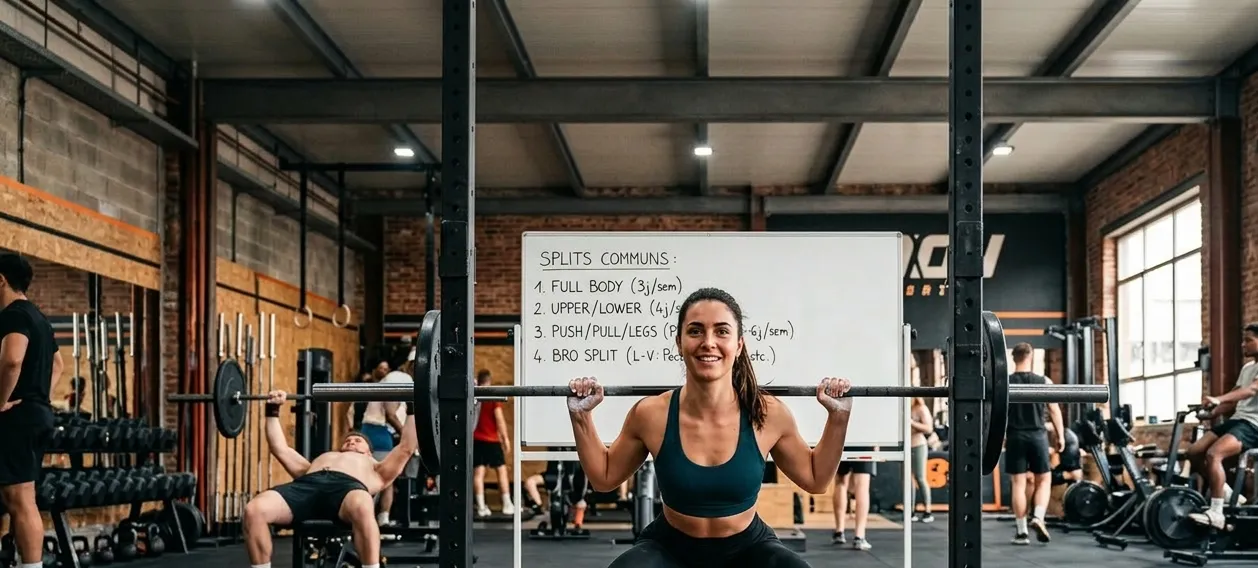
A workout split is how you distribute your muscle groups across your training days. This choice determines your per-muscle stimulation frequency, total weekly volume and recovery capacity. The best split depends on three factors: your experience, your goals and the number of days you can realistically dedicate to the gym each week.
The main workout splits
Full Body — 3 days / week
Each session works the entire body. Ideal for beginners and those with a busy schedule. Each muscle is stimulated 3 times per week, which maximizes muscle protein synthesis (MPS) for novice lifters. Sessions last between 60 and 75 minutes when well structured.
Best for: Beginners (0-12 months of training), limited schedule, returning after a break of more than 4 weeks.
Mon: Full Body A | Wed: Full Body B | Fri: Full Body C
Upper / Lower — 4 days / week
Alternates between upper body and lower body. Excellent balance between training volume and recovery. Each muscle is trained 2 times per week with moderate volume per session (12-16 sets per group per week). Sessions last 50 to 70 minutes.
Best for: Intermediates (1-3 years of training), steady and structured progression.
Mon: Upper | Tue: Lower | Thu: Upper | Fri: Lower
Push / Pull / Legs (PPL) — 6 days / week
The most popular split in strength training. Separates pushing movements (chest, shoulders, triceps), pulling movements (back, biceps, rear delts) and legs (quads, hamstrings, glutes, calves). High volume with a frequency of 2 times per muscle per week. Sessions last 45 to 65 minutes.
Best for: Intermediate to advanced lifters, dedicated trainees who can train 6 days per week.
Mon: Push | Tue: Pull | Wed: Legs | Thu: Push | Fri: Pull | Sat: Legs
Bro Split — 5 days / week
One muscle group per day. High volume per muscle (20-25 sets per session) but low frequency (1 time per week). Research shows that at equal volume, a higher frequency is generally superior for hypertrophy, making this a suboptimal choice for the majority of lifters.
Best for: Advanced lifters (3+ years) seeking maximum volume per muscle group with highly targeted sessions.
Mon: Chest | Tue: Back | Wed: Shoulders | Thu: Legs | Fri: Arms
Detailed split comparison
| Split | Days | Frequency/muscle | Level | Recovery needed | Minimum equipment | Ideal for |
|---|---|---|---|---|---|---|
| Full Body | 3 | 3x/week | Beginner | 48h between sessions | Barbells + dumbbells | Solid foundation, fat loss |
| Upper/Lower | 4 | 2x/week | Intermediate | 48-72h per zone | Full gym | Strength and hypertrophy |
| PPL | 6 | 2x/week | Intermediate+ | 48h per pattern | Full gym | Maximum hypertrophy |
| Bro Split | 5 | 1x/week | Advanced | 7 days per muscle | Full gym + machines | Specialized volume |
Complete 1-week programs
Each program uses the RPE scale to dose intensity. RPE 7 = 3 reps in reserve, RPE 8 = 2 in reserve, RPE 9 = 1 in reserve.
Full Body program — 3 days
Day 1 (Monday) — Full Body A (compound focus)
| Exercise | Sets x Reps | RPE |
|---|---|---|
| Barbell Squat | 4 x 6 | 8 |
| Bench Press | 4 x 6 | 8 |
| Barbell Row | 4 x 8 | 7-8 |
| Dumbbell Overhead Press | 3 x 10 | 7 |
| Dumbbell Bicep Curl | 2 x 12 | 7 |
| Cable Crunch | 3 x 15 | 7 |
Day 2 (Wednesday) — Full Body B (unilateral focus)
| Exercise | Sets x Reps | RPE |
|---|---|---|
| Bulgarian Split Squat | 3 x 10/leg | 8 |
| Incline Dumbbell Press | 4 x 8 | 8 |
| Neutral Grip Lat Pulldown | 4 x 10 | 7-8 |
| Lateral Raises | 3 x 15 | 8 |
| Dips (weighted if possible) | 3 x 8-10 | 7 |
| Plank | 3 x 30-45s | — |
Day 3 (Friday) — Full Body C (hypertrophy focus)
| Exercise | Sets x Reps | RPE |
|---|---|---|
| Romanian Deadlift | 4 x 8 | 8 |
| Dumbbell Bench Press | 3 x 10 | 8 |
| Single-arm Dumbbell Row | 3 x 10/side | 7-8 |
| Machine Shoulder Press | 3 x 12 | 7 |
| Lying Leg Curl | 3 x 12 | 8 |
| Cable Tricep Extension | 2 x 15 | 7 |
Total weekly volume: ~14 sets chest, ~14 sets back, ~12 sets legs, ~9 sets shoulders, ~6 sets arms.
Upper/Lower program — 4 days
Day 1 (Monday) — Upper A (strength focus)
| Exercise | Sets x Reps | RPE |
|---|---|---|
| Barbell Bench Press | 4 x 5 | 8-9 |
| Barbell Row | 4 x 6 | 8 |
| Barbell Overhead Press | 3 x 6 | 8 |
| Supinated Lat Pulldown | 3 x 8 | 7-8 |
| EZ Bar Curl | 3 x 10 | 7 |
| Skull Crushers | 3 x 10 | 7 |
| Face Pull | 3 x 15 | 7 |
Day 2 (Tuesday) — Lower A (strength focus)
| Exercise | Sets x Reps | RPE |
|---|---|---|
| Barbell Squat | 4 x 5 | 8-9 |
| Romanian Deadlift | 3 x 8 | 8 |
| Leg Press | 3 x 10 | 8 |
| Lying Leg Curl | 3 x 10 | 7-8 |
| Standing Calf Raise | 4 x 12 | 8 |
| Cable Crunch | 3 x 15 | 7 |
Day 3 (Thursday) — Upper B (hypertrophy focus)
| Exercise | Sets x Reps | RPE |
|---|---|---|
| Incline Dumbbell Press | 4 x 10 | 8 |
| Seated Cable Row | 4 x 10 | 7-8 |
| Lateral Raises | 4 x 15 | 8 |
| Pec Fly Machine | 3 x 12 | 8 |
| Incline Dumbbell Curl | 3 x 12 | 7 |
| Rope Tricep Pushdown | 3 x 12 | 7 |
| Reverse Dumbbell Flyes | 3 x 15 | 7 |
Day 4 (Friday) — Lower B (hypertrophy focus)
| Exercise | Sets x Reps | RPE |
|---|---|---|
| Bulgarian Split Squat | 3 x 10/leg | 8 |
| Barbell Hip Thrust | 4 x 10 | 8 |
| Leg Extension | 3 x 12 | 8 |
| Seated Leg Curl | 3 x 12 | 8 |
| Seated Calf Raise | 4 x 15 | 8 |
| Ab Wheel | 3 x 10-12 | 7 |
Total weekly volume: ~16 sets chest, ~16 sets back, ~14 sets quads, ~12 sets hamstrings, ~10 sets shoulders, ~8 sets arms.
PPL program — 6 days
Day 1 (Monday) — Push A (strength focus)
| Exercise | Sets x Reps | RPE |
|---|---|---|
| Barbell Bench Press | 4 x 5 | 8-9 |
| Barbell Overhead Press | 4 x 6 | 8 |
| Incline Dumbbell Press | 3 x 10 | 7-8 |
| Lateral Raises | 4 x 15 | 8 |
| Dips | 3 x 8-10 | 7 |
| Rope Cable Tricep Extension | 3 x 12 | 7 |
Day 2 (Tuesday) — Pull A (strength focus)
| Exercise | Sets x Reps | RPE |
|---|---|---|
| Conventional Deadlift | 4 x 5 | 8-9 |
| Weighted Pull-ups | 4 x 6 | 8 |
| Barbell Row | 3 x 8 | 8 |
| Face Pull | 3 x 15 | 7 |
| EZ Bar Curl | 3 x 10 | 7 |
| Hammer Curl | 2 x 12 | 7 |
Day 3 (Wednesday) — Legs A (strength focus)
| Exercise | Sets x Reps | RPE |
|---|---|---|
| Barbell Squat | 4 x 5 | 8-9 |
| Romanian Deadlift | 3 x 8 | 8 |
| Leg Press | 3 x 10 | 8 |
| Lying Leg Curl | 3 x 10 | 7-8 |
| Standing Calf Raise | 4 x 10 | 8 |
| Cable Crunch | 3 x 15 | 7 |
Day 4 (Thursday) — Push B (hypertrophy focus)
| Exercise | Sets x Reps | RPE |
|---|---|---|
| Dumbbell Bench Press | 4 x 10 | 8 |
| Machine Shoulder Press | 3 x 12 | 7-8 |
| Cable Pec Fly | 3 x 12 | 8 |
| Cable Lateral Raises | 4 x 15 | 8 |
| Bar Tricep Pushdown | 3 x 12 | 7 |
| Overhead Dumbbell Extension | 2 x 12 | 7 |
Day 5 (Friday) — Pull B (hypertrophy focus)
| Exercise | Sets x Reps | RPE |
|---|---|---|
| Seated Cable Row | 4 x 10 | 8 |
| Wide Grip Lat Pulldown | 4 x 10 | 7-8 |
| Single-arm Dumbbell Row | 3 x 10/side | 8 |
| Reverse Fly Machine | 3 x 15 | 7 |
| Incline Dumbbell Curl | 3 x 12 | 7 |
| Low Cable Curl | 2 x 15 | 7 |
Day 6 (Saturday) — Legs B (hypertrophy focus)
| Exercise | Sets x Reps | RPE |
|---|---|---|
| Bulgarian Split Squat | 3 x 10/leg | 8 |
| Barbell Hip Thrust | 4 x 10 | 8 |
| Leg Extension | 3 x 12 | 8 |
| Seated Leg Curl | 3 x 12 | 8 |
| Seated Calf Raise | 4 x 15 | 8 |
| Side Plank | 3 x 30s/side | — |
Total weekly volume: ~20 sets chest, ~20 sets back, ~16 sets quads, ~14 sets hamstrings, ~16 sets shoulders, ~12 sets arms.
Choosing your split by goal
Your primary goal should guide your split choice, not just your experience level. Here are recommendations by goal:
| Goal | Recommended split | Frequency | Dominant rep range | Rest between sets |
|---|---|---|---|---|
| Maximum strength | Upper/Lower or Full Body | 3-4 days | 3-6 reps @ RPE 8-9 | 3-5 min |
| Hypertrophy | PPL or Upper/Lower | 4-6 days | 8-12 reps @ RPE 7-9 | 60-120s |
| Fat loss | Full Body or Upper/Lower | 3-4 days | 10-15 reps @ RPE 7-8 | 45-90s |
| Athletic performance | Full Body | 2-3 days | 4-8 reps @ RPE 7-8 | 2-4 min |
| Muscular endurance | Full Body or Circuit | 3-4 days | 15-25 reps @ RPE 6-7 | 30-60s |
For strength, prioritize compound exercises with heavy loads (80-90% of 1RM) and long rest periods. A Full Body or Upper/Lower centered on squats, bench press and deadlifts will be most effective.
For hypertrophy, total volume (number of sets close to failure per muscle per week) is the primary factor. Aim for 12-20 sets per muscle group per week, spread across 2-3 sessions. PPL excels here.
For fat loss, the split matters less than the caloric deficit and maintaining muscle mass. A Full Body 3 times per week with moderate to heavy loads (70-85% of 1RM) is enough to preserve muscle while allowing sufficient cardio and recovery.
Frequency vs recovery: the science behind the choice
Muscle protein synthesis (MPS)
After a strength training session, muscle protein synthesis (the process by which muscle repairs and grows) remains elevated for 24 to 72 hours depending on the lifter’s experience:
- Beginners: MPS elevated for 48-72h after the session
- Intermediates: MPS elevated for 36-48h
- Advanced: MPS elevated for 24-36h only
This means an advanced lifter who trains a muscle only once per week (bro split) spends 4-5 days without growth stimulation for that muscle. By training each muscle 2-3 times per week, you multiply MPS peaks and optimize long-term growth.
Optimal frequency per muscle
The meta-analysis by Schoenfeld (2016) shows that training each muscle at least 2 times per week produces significantly greater hypertrophy gains than once per week, at equal total volume. The difference between 2 and 3 times per week is less pronounced, except for beginners.
Volume distribution
Optimal weekly volume falls between 10 and 20 sets per muscle group for most lifters. Beyond 20 sets, diminishing returns set in sharply and overtraining risk increases. Distribute this volume as follows:
- 2 sessions/week: 5-10 sets per session per muscle
- 3 sessions/week: 4-7 sets per session per muscle
This distribution avoids accumulating too much “junk volume” (ineffective sets performed at the end of a session when fatigue is too high).
To dive deeper into volume and intensity management over time, read our guide on periodization.
Progression and evaluation
Minimum program duration
Stick with the same program for 8 to 12 weeks minimum before changing. The first 2-3 weeks serve as neural adaptation: your body learns the movements and your actual RPE stabilizes. Significant gains come between week 4 and week 10.
Changing programs every 2-3 weeks is one of the most common mistakes. You never allow enough time for progressive overload to produce results.
Metrics to track
Track these indicators each week to evaluate your progress. An app like AIVancePro automates this tracking and generates trend charts for each metric:
- Weight lifted — Are your loads increasing on main exercises? Aim for +2.5% every 1-2 weeks on compounds.
- Total volume (sets x reps x load) — Weekly tonnage should show an upward trend.
- Actual RPE vs target RPE — If your RPE 8s are becoming RPE 6s, it is time to increase the load.
- Measurements and bodyweight — For hypertrophy, track arm, thigh and chest circumference every 4 weeks.
- Sleep quality and fatigue — An indirect but crucial indicator of your recovery capacity.
When to change your program
Change your program if at least 2 of these signals appear:
- Load stagnation for 3 consecutive weeks despite good recovery and nutrition
- Persistent joint pain (not normal soreness)
- Chronic loss of motivation with the current program
- Your goals have changed (switching from strength to hypertrophy, for example)
- You have reached 12-16 weeks on the same program
Common programming mistakes
1. Too much volume, not enough intensity
Doing 30 sets per muscle per week at RPE 5-6 is far less effective than 14-16 sets at RPE 7-9. Each set must be sufficiently close to failure (1-3 reps in reserve) to stimulate growth. Reduce unnecessary volume and focus on quality.
2. Ignoring the “boring” muscles
Neglecting hamstrings, calves, rear delts and stabilizer muscles creates imbalances that lead to injuries. For every pushing set, plan a pulling set. Your push/pull ratio should be at least 1:1.
3. Changing programs too often
“Program hopping” prevents any progressive overload. Stick with your program for a minimum of 8 weeks. Progressive overload (adding 2.5 kg to the bar or 1-2 extra reps) is the primary driver of progression, and it requires time and consistency.
4. Neglecting recovery
Training 6 days per week on a PPL only makes sense if you sleep 7-9 hours per night and your nutrition supports the training volume. With less than 7 hours of sleep, an Upper/Lower 4 days will likely be more productive than a PPL 6 days. Growth happens at rest, not in the gym.
5. Copying an influencer’s program
Programs posted online are rarely suited to your level, proportions and weak points. A program should be built around your specific needs. Use online programs as inspiration, not prescription.
Adapting your program to your schedule
The reality of your schedule takes priority over the “optimal” split on paper. Here are concrete structures based on your availability:
2 days per week
Two Full Body sessions with a focus on heavy compound movements. You can get 80% of the results with just 2 sessions if each one is well executed.
Mon: Full Body (squat, bench press, row, overhead press — 5 exercises, 4x6-8 @ RPE 8) Thu: Full Body (deadlift, incline press, pull-ups, lunges — 5 exercises, 4x8-10 @ RPE 8)
3 days per week
The classic Full Body remains the ideal choice. Alternate between 3 different routines (A/B/C) to vary angles and rep ranges.
Mon: Full Body A (strength — 4x5 compounds) | Wed: Full Body B (hypertrophy — 3x10 mixed) | Fri: Full Body C (endurance — 3x15 isolation)
4 days per week
Upper/Lower is the king split for 4 days. Alternate between a strength day (low reps, high load) and a hypertrophy day (moderate reps, controlled tempo).
Mon: Upper strength | Tue: Lower strength | Thu: Upper hypertrophy | Fri: Lower hypertrophy
5 days per week
Several options: Upper/Lower/Push/Pull/Legs, or a PPL with an additional Upper/Lower day. You can also do an Upper/Lower with a 5th day dedicated to weak points.
Mon: Push | Tue: Pull | Wed: Legs | Thu: Upper (weak points) | Fri: Lower (weak points)
6 days per week
The classic PPL in 2x rotation. Make sure your recovery (sleep, nutrition, stress) is on point. One full rest day per week is non-negotiable.
Mon: Push A | Tue: Pull A | Wed: Legs A | Thu: Push B | Fri: Pull B | Sat: Legs B | Sun: Rest
How to choose your split?
The best split is the one you can follow consistently over several months. Consistency always beats theoretical optimization. If you are unsure, AIVancePro’s AI coach analyzes your profile and availability to recommend the most suitable split. Ask yourself these questions:
- How many days per week can you realistically train, accounting for unexpected events?
- How long have you been strength training with proper technique?
- What is your primary goal: strength, hypertrophy, general health, athletic performance?
- How is your recovery: do you sleep 7+ hours per night? Is your nutrition sufficient?
If you are unsure, start with the simplest split compatible with your schedule. A well-executed Full Body 3 times per week will always outperform a PPL 6 days that you can only sustain 3 weeks out of 4.
To build your program exercise by exercise, check out our complete guide to creating an effective training program. Learn to dose intensity with our article on RPE and intensity. And do not forget to integrate smart periodization for long-term progression.
Want to put these principles into practice? AIVancePro automatically generates the optimal split based on your level, goals and schedule, then adjusts the program as you progress. Download the app for free and get started today.
FAQ
Can you do PPL in 3 days instead of 6?
Technically yes, but each muscle would only be trained once per week, which is suboptimal for hypertrophy. If you only have 3 days, a Full Body will be significantly more effective because it triples the stimulation frequency per muscle.
Do you always have to train on the same days?
No, consistency is more important than specific days. The key is to respect recovery times between sessions targeting the same muscles (minimum 48h). If you need to shift a day, adapt your week without guilt.
Can a beginner start directly with PPL?
It is possible but not recommended. A beginner progresses rapidly with moderate volume — 3 Full Body sessions are enough to maximize gains during the first 6 to 12 months. Jumping to PPL too early means more fatigue for similar results. Start simple, add complexity when you plateau.
How long does a plateau last before changing splits?
A 2-3 week plateau is normal and does not justify a split change. First check your sleep, nutrition and stress levels. If after 4-6 weeks of adjustments (increased calories, improved sleep, deload) the stagnation persists, then consider a split or program structure change.
AIVancePro chooses for you
Don’t want to overthink it? AIVancePro’s AI coach analyzes your profile, availability and goals to automatically generate the optimal split. It selects the exercises, adjusts volume and RPE based on your level, and evolves your program as you progress — without you having to rethink your planning every 8 weeks.
← Back to guides