Recovery is the most underestimated aspect of strength training. Many lifters believe results come solely from training, when in fact the body rebuilds and adapts during rest. This guide covers every aspect of recovery and strategies to avoid injuries.
The critical importance of sleep
Sleep is the primary driver of recovery. It is during deep sleep phases that the body releases most of its growth hormone (GH), essential for repairing muscle tissue damaged by training.
How much sleep do you need?
For strength training practitioners, 7 to 9 hours of quality sleep are necessary. Studies show that chronic sleep restriction (less than 6 hours) can reduce muscle protein synthesis by 18% and increase muscle catabolism. Put simply, sleeping too little effectively cancels out part of the work done in the gym.
Sleep stages and their role
A night of sleep is broken into cycles of approximately 90 minutes, each passing through several stages. Two stages are particularly important for lifters:
- Deep sleep (N3 stages): represents about 15-25% of total sleep time in a healthy adult. This is when the body releases its peak growth hormone (up to 70% of daily GH secretion). Deep sleep is also when blood pressure drops, blood flow to muscles increases and tissue repair is at its maximum. In athletes, this stage can reach 20-25% thanks to the effect of physical fatigue.
- REM sleep (Rapid Eye Movement): represents about 20-25% of total sleep time. This is the stage of dreams, but more importantly the stage where motor memory is consolidated. Movement patterns trained in the gym (squat technique, bench press bar path, coordination) are consolidated during REM. REM deprivation degrades coordination and motor learning ability.
Practical implication: deep sleep phases are more prevalent early in the night, REM later in the night. Going to bed late and cutting sleep short in the morning deprives you of REM. Going to bed early but sleeping too little deprives you of deep sleep in later cycles. In both cases, recovery is compromised. Aim for a full 7-9 hours to cover both.
Improving sleep quality
- Consistency: go to bed and wake up at fixed times, including weekends. The body runs on a circadian rhythm that promotes restorative sleep when it is regular.
- Screens: stop screen use 30 to 60 minutes before bedtime. Blue light inhibits melatonin production.
- Temperature: keep your bedroom between 18 and 20 degrees Celsius. The body needs to cool down to enter deep sleep.
- Caffeine: avoid caffeine after 2 PM. Its half-life is 5 to 6 hours, meaning half the caffeine from a coffee drunk at 4 PM is still in your system at 10 PM.
- Darkness: use blackout curtains or a sleep mask. Even the slightest light source can disrupt sleep quality.
- Training: avoid intense sessions less than 3 hours before bedtime. Elevated body temperature and adrenaline delay sleep onset. If you train in the evening, opt for a moderate session followed by a lukewarm shower.
Stretching and mobility
Static stretching: when and how
Static stretches (holding a position for 20 to 60 seconds) are beneficial for improving flexibility, but timing is crucial:
- After training: a good time to work on flexibility, as muscles are warm.
- Rest days: dedicated 15 to 20-minute sessions to improve overall mobility.
- Before training: avoid. Static stretching before exercise temporarily reduces muscular strength and power.
Joint mobility: the key to longevity
Joint mobility is distinct from simple flexibility. It is the ability to control a joint through its full range of motion under load. Lack of mobility limits your technique and increases injury risk.
Priority areas to work on:
- Hips: essential for squats and deadlifts. Work internal and external rotation.
- Thoracic spine (upper back): crucial for the bench press, overhead press and pull-ups. A stiff thoracic spine forces compensation through the lower back or shoulders.
- Shoulders: work external rotation and full elevation. Essential for any overhead pressing movements.
- Ankles: limited dorsiflexion prevents a deep squat. Calf stretches and specific mobilizations help considerably.
Daily mobility routine (10 min)
- Shoulder CARs (controlled articular rotations): 10 circles each direction
- Cat-cow (spine): 10 reps
- 90/90 hips: 30 seconds per side
- World’s greatest stretch: 5 per side
- Wall ankle dorsiflexion: 15 reps per side
Deload weeks
The deload is a planned week of reduced training volume and/or intensity. Its purpose is to allow the body to fully recover from accumulated fatigue so you can come back stronger. It fits naturally into a training periodization plan.
When to deload
- Systematically: every 4 to 8 weeks depending on your level and training volume.
- Reactively: when you experience persistent fatigue, unusual joint pain or prolonged loss of motivation. Our guide on periodization details the objective fatigue signals (HRV, grip strength, sleep quality) that indicate it is time to deload.
How to structure a deload
Two common approaches:
- Volume reduction: keep the same loads but cut the number of sets in half. You maintain the strength stimulus without accumulating fatigue.
- Intensity reduction: reduce loads by 40-50% while keeping the same volume. Knowing how to calibrate intensity with RPE is particularly useful for fine-tuning deload weeks.
Do not skip the deload out of impatience. It is an investment that pays dividends the following week, when you resume intense training with a fully recovered body. AIVancePro’s AI coach automatically integrates deload weeks into your programming, at the optimal time for your recovery.
Pain vs. soreness: how to tell the difference
Knowing how to distinguish normal soreness from pathological pain is an essential skill for every lifter. Confusing the two leads to either stopping unnecessarily (soreness mistaken for injury) or worsening an injury (pain dismissed as mere soreness).
| Criterion | Soreness (DOMS) | Pathological pain |
|---|---|---|
| Type of sensation | Diffuse, “burning” or muscular stiffness | Sharp, acute, localized (“pinpoint”) |
| Location | Spread across the entire muscle (e.g., the whole quadricep) | Localized to a specific point (tendon insertion, joint, specific area of the muscle) |
| Onset | 24 to 72 hours after training | During the exercise or immediately after |
| Progression | Gradually decreases over 3-5 days; improves with light movement | Persists or worsens over time; does not improve with movement |
| At rest | Little or no pain at rest | Can be painful even at rest (inflammatory pain) |
| Under load | Decreases once warmed up (muscle “loosens”) | Increases with effort or loading |
| Symmetry | Often bilateral (both legs after squats) | Often unilateral (one side only) |
| Swelling / heat | Absent or minimal | Swelling, redness or local heat possible |
Simple rule: if the pain is sharp, localized, unilateral and does not improve within 48 hours, treat it as a potential injury. Reduce the load, modify the movement or stop the exercise. If it persists beyond a week, see a professional.
Recognizing signs of overtraining
Overtraining occurs when training stress chronically exceeds the body’s recovery capacity. It is not simply being tired after a hard session, but a systemic state that requires intervention.
Physical signs
- Persistent performance decline (more than 2 weeks) despite adequate rest
- Elevated resting heart rate (5-10 beats above normal)
- Chronic joint pain that does not improve with rest
- Frequent infections (colds, sore throats): a sign of a weakened immune system
- Sleep disturbances despite fatigue
Psychological signs
- Loss of motivation for training
- Increased irritability, depressive mood
- Difficulty concentrating in daily life
- Anxiety before sessions
If you identify several of these signs, take a full week of rest or an extended deload (10 days). Reassess your training volume, sleep and nutrition before resuming. Well-planned periodization is the best prevention against overtraining. AIVancePro analyzes your accumulated fatigue and automatically adjusts session volume to prevent you from crossing that critical threshold.
Managing DOMS (soreness)
Delayed Onset Muscle Soreness (DOMS) appears 24 to 72 hours after an unaccustomed effort. It is caused by micro-damage to muscle fibers and a local inflammatory response.
What DOMS does not mean
DOMS is not a reliable indicator of training effectiveness. A session can be highly productive without generating any soreness, and vice versa. Severe DOMS often indicates a sudden change in stimulus (new exercise, overly rapid volume increase).
Reducing DOMS intensity
- Light activity: walking, low-intensity cycling or light swimming increases blood flow and speeds up recovery.
- Hydration: drink enough to help flush metabolic waste.
- Gradual progression: the best prevention. Increase volume and intensity progressively to let the body adapt.
- Nutrition: adequate protein intake (1.6 to 2.2 g/kg) and carbohydrates accelerate muscle repair. See our guide on nutrition for muscle building for details.
Supplements for joint health
Supplements do not replace good technique, a well-periodized program or quality sleep. However, some have shown benefits for joint health and recovery.
| Supplement | Scientific evidence | Recommended dose | Useful? |
|---|---|---|---|
| Hydrolyzed collagen | Moderate — several studies show improved joint collagen synthesis, especially combined with vitamin C. Effect is more pronounced for prevention than treatment. | 10-15 g/day, taken 30-60 min before training with 50 mg vitamin C | Yes, for prevention. Good safety profile. Particularly relevant for lifters with high training volume (16-22+ sets/muscle/week). |
| Omega-3 (EPA/DHA) | Strong — well-documented anti-inflammatory effect. Reduces inflammatory markers (CRP, IL-6) and can alleviate joint pain. Also benefits muscle recovery. | 2-3 g combined EPA+DHA per day (approximately 4-6 g of fish oil) | Yes. One of the best research-supported supplements. Useful for both joints and overall recovery. |
| Glucosamine + chondroitin | Low to moderate — studies are contradictory. Some trials show symptom relief in osteoarthritis, others show no significant effect. Little proven benefit for prevention in healthy individuals. | 1500 mg glucosamine + 1200 mg chondroitin per day | Maybe. Worth trying for 2-3 months if you have chronic joint pain. Discontinue if no improvement is felt. |
| Magnesium | Moderate — established role in muscle contraction, sleep quality and cramp reduction. Many lifters are deficient without knowing (poor dietary magnesium, sweating). | 300-400 mg/day (bisglycinate or citrate for better absorption), preferably in the evening | Yes. Useful for sleep (and thus recovery), cramp reduction and overall well-being. Bisglycinate form recommended. |
| Vitamin D | Strong — role in bone health, immune function and muscular strength. Deficiency is very common, especially in winter. Low levels are associated with increased injury risk. | 1000-4000 IU/day depending on blood levels (ideally, get a blood test) | Yes, especially in winter. Maintain a level of 40-60 ng/mL. Supplement if blood levels are low. |
Reminder: these supplements complement a balanced diet, they do not replace it. First prioritize a protein intake of 1.6-2.2 g/kg, a caloric surplus or maintenance adapted to your goal, and 7-9 hours of sleep. See our guide on nutrition for muscle building to build a solid dietary foundation.
Foam rolling (self-myofascial release)
Foam rolling involves rolling on a foam roller to apply pressure to muscle and fascial tissue. It does not actually “break up” adhesions as commonly claimed, but acts primarily on the nervous system by reducing pain tolerance and promoting muscular relaxation.
When to use it
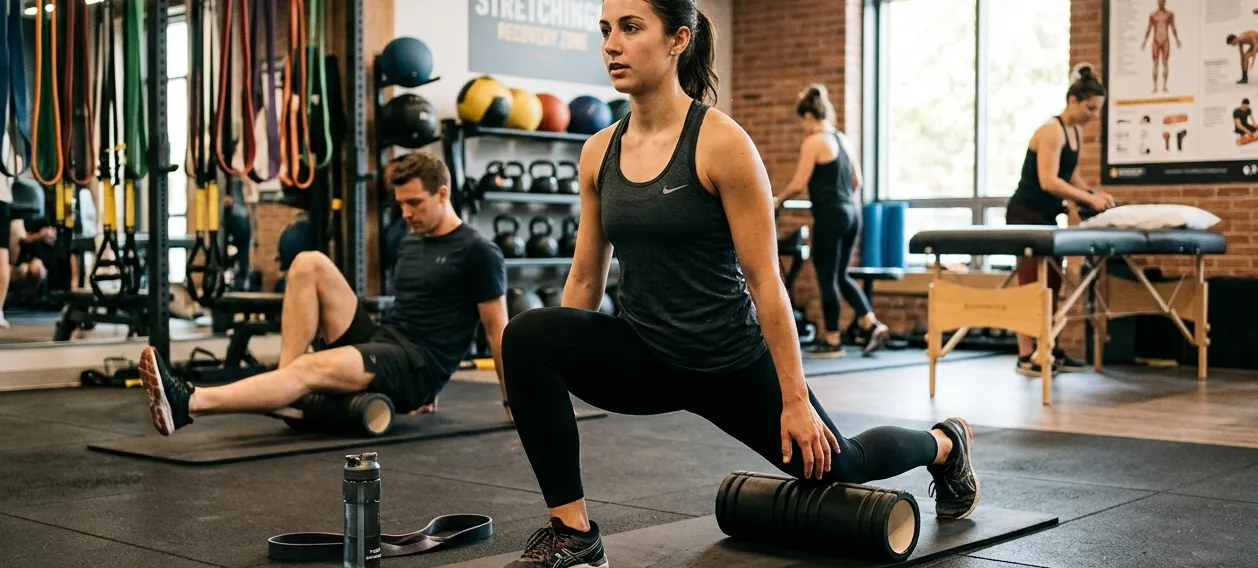
- Before training: 2 to 3 minutes on tight areas to temporarily improve range of motion without strength loss (unlike static stretching).
- After training or in the evening: 5 to 10 minutes to promote relaxation and reduce the perception of tightness.
Priority areas
- Quadriceps and iliotibial band (IT band)
- Glutes and piriformis
- Upper back (thoracic)
- Calves
Avoid rolling directly on joints, the lower back or extremely painful areas. Foam rolling should be uncomfortable but tolerable, not painful.
Returning to training after injury
Resuming training after an injury is a process that requires patience and method. Returning too quickly is the number one cause of re-injury. Here is a three-phase protocol.
Phase 1 — Pain-free range of motion (1-3 weeks)
The goal is to restore mobility in the injured area without provoking pain.
- Work through active ranges of motion (you move the joint yourself) and passive ranges (with assistance or gravity).
- The criterion is simple: zero pain. If a movement causes pain (not just discomfort or stiffness), reduce the range or stop.
- Continue training uninjured areas. A shoulder injury does not prevent you from training legs.
- Light cardiovascular activity (walking, cycling) to maintain general conditioning and promote blood flow.
Phase 2 — Progressive loading (2-4 weeks)
The goal is to gradually reintroduce resistance to the affected area.
- Start at 30-40% of your usual load on the relevant exercise, with high reps (12-20 reps) and a maximum RPE of 5-6.
- Increase load by 5-10% per week while monitoring pain.
- Favor dumbbell exercises (greater freedom of movement) or machine exercises (controlled loading) over free barbell work.
- Continue the mobility work from Phase 1.
- Pain rule: if the exercise causes pain > 3/10 (subjective scale), reduce the load or return to the previous step.
Phase 3 — Full return (2-4 weeks)
The goal is to return to your pre-injury level and resume your normal programming.
- Resume your regular program but starting at 70-80% of your pre-injury loads.
- Progressively work back to your normal loads over 2-4 weeks.
- If you were out for more than 4 weeks, plan a light accumulation mesocycle before resuming an intense block.
- Incorporate specific preventive work for the injured area as a permanent warm-up (for example, face pulls and external rotations for a shoulder injury).
Common mistake: trying to “make up for lost time” by increasing volume or intensity. Your body needs time to rebuild load tolerance. A patient 6-8 week return is far more effective than an aggressive 2-week return that leads to re-injury.
When to see a professional
Certain types of pain should not be ignored. See a physiotherapist or sports medicine doctor if you experience:
- Sudden, acute pain during an exercise (pop, tear sensation)
- Pain that persists for more than 2 weeks despite rest and training modification
- Joint pain (distinct from muscle soreness): swelling, redness, heat around the joint
- Numbness or tingling in the arms or legs during or after exercise
- Sudden loss of strength in a movement you normally handle well
It is better to consult too early than too late. A minor injury treated promptly heals in days. The same injury ignored and aggravated can sideline you for months.
Want to optimize your recovery without overthinking it? AIVancePro automatically monitors your accumulated fatigue, schedules your deloads at the right time and adjusts volume to prevent overtraining. Download the app for free and get started today.
FAQ — Recovery and prevention
Do ice baths (cryotherapy) speed up recovery? Ice baths (10-15 minutes at 10-15 degrees Celsius) can reduce the perception of pain and fatigue after exercise. However, recent studies show that post-training cryotherapy can blunt hypertrophy adaptations by reducing the inflammatory response needed for muscle rebuilding. In practice: use ice baths for recovery between closely spaced competitions or matches, but avoid them routinely after hypertrophy sessions.
How many rest days are needed between sessions for the same muscle group? Generally, 48 to 72 hours is sufficient for a muscle group, but it depends on the volume and intensity of the session. A muscle trained with 4-6 sets at RPE 7-8 recovers in 48 hours. The same muscle trained with 10-12 sets at RPE 9 may need 72-96 hours. This is why programs with a 2x/week frequency per muscle (such as Upper/Lower or PPL splits) are popular: they allow high total volume (10-22+ sets/muscle/week) spread across multiple sessions. To structure this effectively, see our guide to creating your training program.
Does cardio hurt muscle recovery? Not necessarily. Moderate cardio (30-45 min of walking, cycling or swimming at low intensity) promotes recovery by increasing blood flow without creating significant muscular stress. However, intense cardio (HIIT, high-intensity running) uses the same recovery resources as strength training and can compromise gains if total volume is too high. Place intense cardio on days separate from your leg sessions and limit it to 2-3 sessions per week if your primary goal is hypertrophy or strength.
← Back to guides