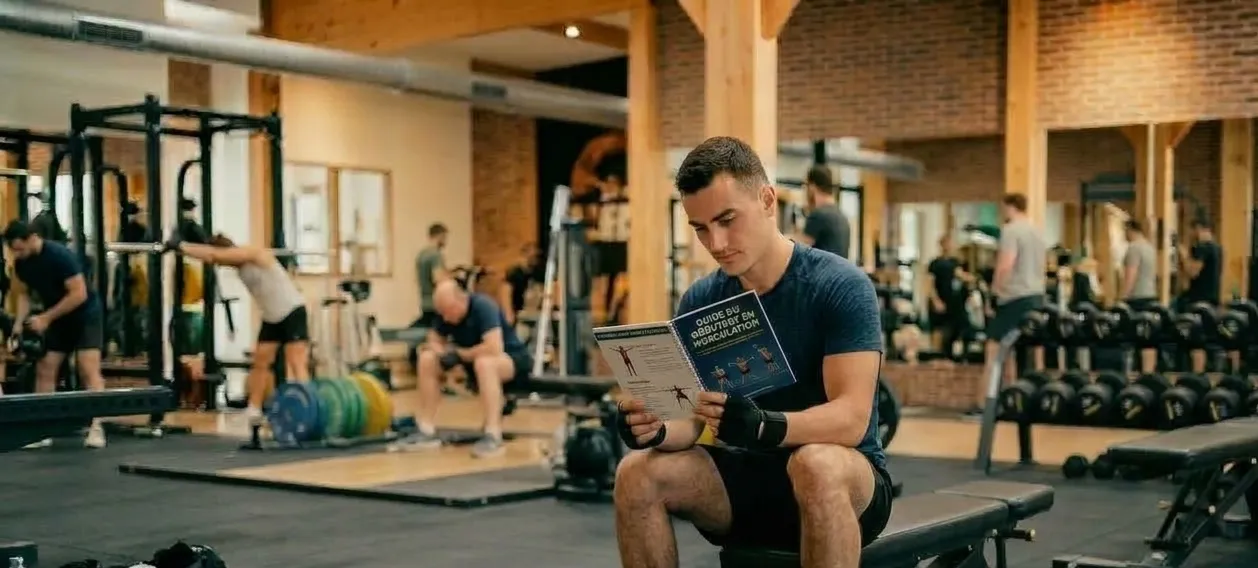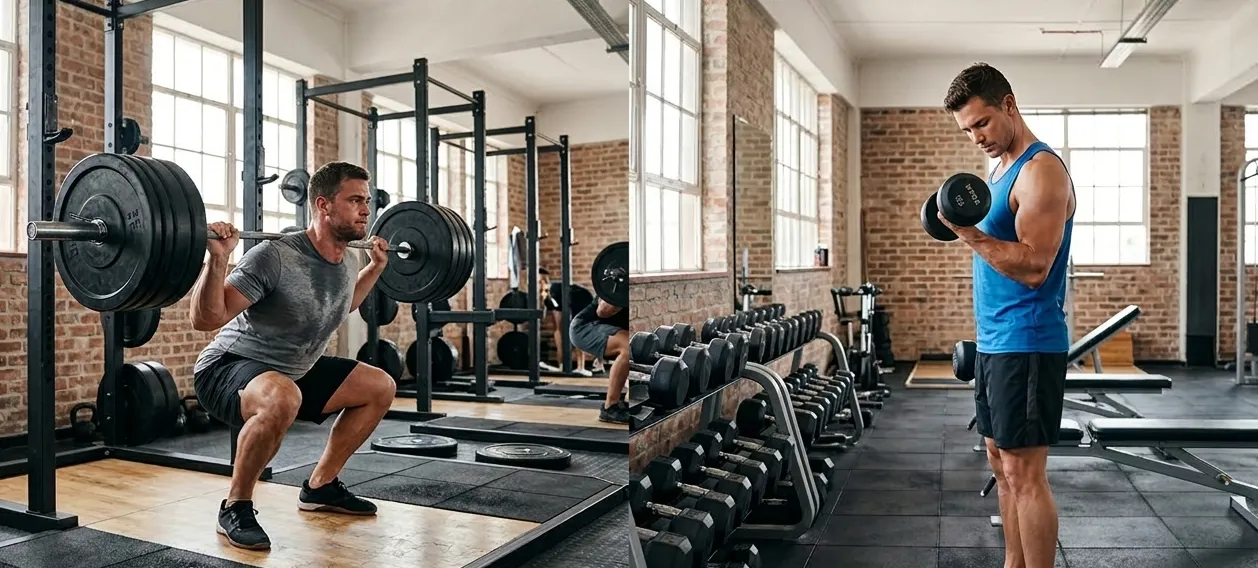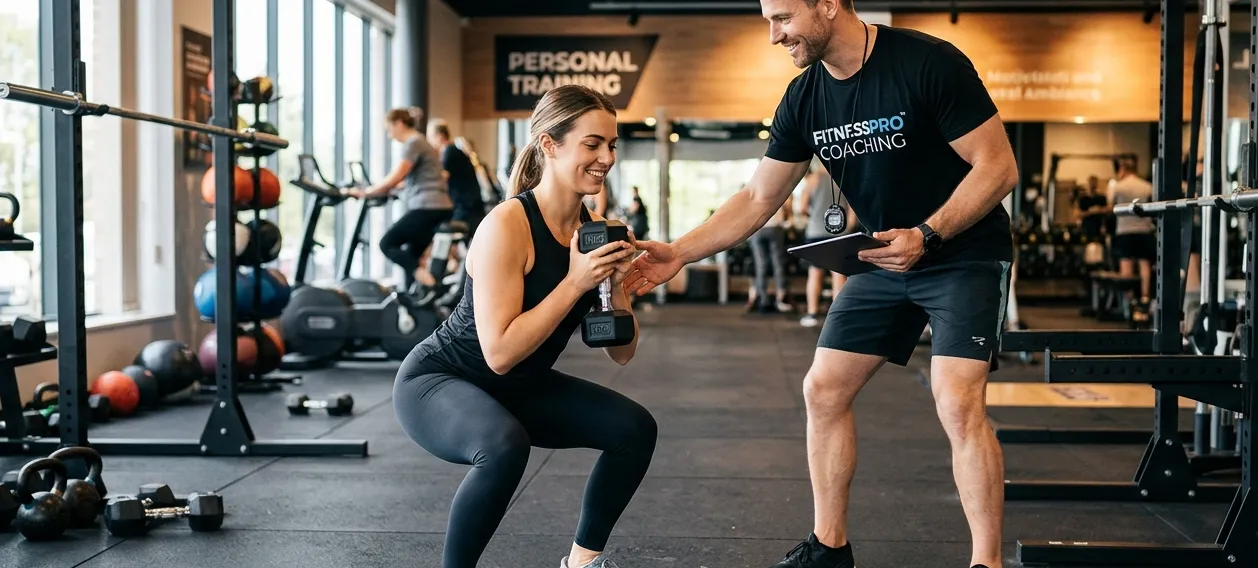
Personal training is one-on-one guidance from a fitness professional. A personal coach designs programs tailored to your goals, corrects your technique and motivates you during every session. According to a study published in the Journal of Sports Science & Medicine (2023), people who train with a coach progress on average 44% faster than those who train alone.
Traditionally reserved for those who could afford rates of $50 to $100 per session, personal training is now evolving rapidly thanks to technology. In the US, the personal fitness coaching market was worth over $14 billion in 2024, and the digital coaching segment has been growing by 25% year over year since 2021 (IHRSA Global Report, 2024).
Benefits of a personal coach
Whether human or powered by artificial intelligence, personalized guidance transforms your training:
- Personalized programs — adapted to your level, goals and physical constraints. No more following generic programs found on the internet.
- Technique correction — injury prevention and movement optimization. A meta-analysis by the ACSM (2024) shows that technical supervision reduces injury risk by 65% among strength training practitioners.
- Constant motivation — accountability and support during tough moments. Simply having someone to report to increases adherence by 78% (Behavioral Medicine study, 2022).
- Accelerated progress — real-time adjustments based on your performance and intensity management (RPE). Tools like AIVancePro automate these adjustments by analyzing your training history.
- Time savings — no more wondering what to do at the gym. Every minute is optimized.
- Progressive education — a good coach teaches you to become autonomous, not dependent.
Traditional Coach vs AI Coach: detailed comparison
Personal coaching is evolving. Artificial intelligence now offers a credible and accessible alternative to traditional coaching. Here is an in-depth comparison.
| Criterion | Traditional Coach | AI Coach (AIVancePro) |
|---|---|---|
| Monthly cost | $200-800/month (1-3 sessions/week) | $6.99/month |
| Availability | Fixed schedule, booking required | 24/7, instant response |
| Personalization | Good (limited by human memory) | Excellent (data-driven, full history analysis) |
| Progress tracking | Manual (spreadsheet, notebook) | Automatic + charts + trends |
| Technique correction | In person, real-time | Detailed instructions + demo videos |
| Real-time adaptation | Yes, direct observation | Yes (history analysis, volume, RPE) |
| Motivation | Physical presence, human relationship | Community + gamification + challenges |
| Injury management | Can observe and adapt immediately | General advice, refers to a professional |
| Nutritional guidance | Personalized advice (if qualified) | Data-driven recommendations |
| Scalability | 1 coach = 1 client at a time | Unlimited, same quality for every user |
| Objectivity | May have personal biases | Purely data-based analysis |
| Knowledge updates | Requires ongoing education | Continuously updated with latest research |
| Commitment | Often 10 sessions or monthly subscription | No commitment, cancel anytime |
Verifying a coach’s qualifications
Choosing a personal coach is a significant investment. In many countries, fitness coaching is regulated by professional certification bodies. Here is how to verify that your coach is qualified.
Recognized certifications
| Certification | Level | Training duration | What it guarantees |
|---|---|---|---|
| ACE Personal Trainer | Entry | ~3-6 months | Fundamentals of personal training |
| NASM CPT | Intermediate | 6-12 months | Exercise science, program design, corrective exercise |
| NSCA CSCS | Advanced | 12-18 months | Strength and conditioning, sports performance |
| ACSM CEP | Expert | 18+ months | Clinical exercise physiology |
| Exercise Science Degree | University | 3-5 years | In-depth scientific foundations |
The NSCA CSCS or NASM CPT are the gold standard certifications for a strength and conditioning coach. Always verify that your coach holds a valid and current certification from a recognized accrediting body.
Red flags to watch for
Be wary of a coach who:
- Holds no recognized certification — a 2-day online certificate does not replace 12 months of proper training.
- Promises unrealistic results — “10 kg of muscle in 3 months” or “visible abs in 30 days” are red flags.
- Gives the same program to every client — personalization is the foundation of coaching.
- Asks no questions about your health — a good coach assesses your medical history, injuries and contraindications before the first session.
- Pushes supplement purchases — especially if they earn a commission.
- Does not document your progress — without tracking, no adjustment is possible. This is actually one of the strengths of AI coaching: AIVancePro automatically records every session and uses that data to optimize your program.
- Uses pseudo-scientific language — “muscle detox,” “activating your dormant metabolism”…
Questions to ask before committing
- What is your certification and when does it expire?
- How long have you been coaching?
- Do you have experience with my profile (beginner, injury, specific goal)?
- How do you structure programming and periodization?
- How do you measure your clients’ progress?
- What is your cancellation policy?
Costs and ROI of coaching
Coaching is an investment. Here is a detailed analysis of costs and return on investment across different models.
Monthly cost comparison
| Model | Frequency | Monthly cost | Annual cost | Included |
|---|---|---|---|---|
| In-person coach | 1x/week | $200-300 | $2,400-3,600 | Supervised session, program |
| In-person coach | 2x/week | $400-600 | $4,800-7,200 | Supervised sessions, program, follow-up |
| In-person coach | 3x/week | $600-900 | $7,200-10,800 | Full supervision |
| Online coach | Program + follow-up | $80-200 | $960-2,400 | Custom program, weekly check-ins |
| AI coach (AIVancePro) | Unlimited | $6.99 | $83.88 | Unlimited programs, auto tracking, 24/7 coach chat |
| Hybrid coaching | 1x/month coach + AI | $70-150 | $840-1,800 | Monthly review + daily AI |
Return on investment analysis
The ROI of coaching is not measured in dollars alone. A University of Florida study (2023) compared three groups over 12 months:
- No coaching group: 38% dropout before 6 months, average 12% strength increase.
- Human coach group (2x/week): 15% dropout, 34% strength increase.
- Digital coaching group (app + AI): 22% dropout, 28% strength increase.
Human coaching remains superior in terms of retention, but the value proposition of AI coaching is unmatched. For $60 per year instead of $5,000, you get 80% of the benefits of human coaching.
What you are really paying for
With a coach at $70/session (2x/week), you spend $560/month. That amount covers:
- 8 hours of direct presence
- Program design
- Weekly adjustments
With AIVancePro at $6.99/month, you get access to:
- Unlimited AI-generated programs
- Automatic tracking of every session
- A 24/7 AI coach to answer all your questions
- Analysis of your training volume and progression
Hybrid coaching models
Coaching is no longer just “human coach OR artificial intelligence.” Hybrid models combine the best of both worlds.
Human coach + daily AI
The most effective model in 2026: a human coach sees you once or twice a month for technical assessments and strategic adjustments, while AI handles your day-to-day training.
In practice:
- The human coach evaluates your technique on complex compound movements (squat, deadlift, bench press)
- The AI generates your daily sessions following the periodization plan set with your coach
- The human coach analyzes the data collected by the AI to refine the strategy
- You get human oversight without the cost of full-time supervision
Online coaching + AI
Online coaching has exploded since 2020. An online coach provides a program and weekly check-ins (often via messages or video calls), while AI fills the gaps between exchanges.
Advantages: lower cost ($80-200/month), geographic flexibility, access to specialized coaches regardless of your location.
Limitations: no in-person technique correction, depends on the quality of your videos and descriptions.
Group coaching + individual AI
Small group training (3 to 6 people) reduces the cost per person by 50 to 70% compared to individual coaching. Each participant then uses AI to personalize their sessions outside the group.
This model is particularly well suited for strength training beginners who benefit from group motivation while still getting personalized follow-up.
Limitations of AI coaching
Being honest about the limitations of AI is essential for making an informed choice. Here is what an AI coach cannot do as well as a human.
Real-time technique correction
A human coach can immediately see if your knees cave during a squat or if your back rounds on a deadlift. AI can provide detailed instructions and demo videos, but it cannot observe your execution in real time (although this technology is evolving rapidly with computer vision).
Our advice: film yourself regularly on your main lifts. Share the videos with a human coach or an experienced community for feedback.
Behavioral and psychological coaching
The human relationship remains irreplaceable for certain aspects:
- Managing stress and anxiety related to performance
- Eating disorders — an AI coach should never replace a healthcare professional
- Motivation during personal crises — a human coach picks up on non-verbal cues
- Adapting to complex emotional situations — grief, burnout, loss of confidence
Fine-tuned injury and pathology management
An AI coach can adapt a program based on a declared injury (avoiding certain movements, suggesting alternatives). However:
- It cannot palpate, test or diagnose
- It does not replace a physical therapist or sports medicine doctor
- The recovery and injury prevention strategies it suggests remain general
Golden rule: for any persistent pain (more than 7 days) or acute pain, consult a healthcare professional before continuing to train.
Clinical nutrition
An AI coach can provide general nutritional recommendations (protein intake, macro distribution, meal timing). But it does not replace a registered dietitian or nutritionist for:
- Therapeutic diets
- Complex allergies and intolerances
- Eating disorders
- Drug interactions
How to choose the right model for you
The best coaching is the one that fits your actual situation. Here is a decision framework based on three criteria.
By experience level
| Your level | Recommended model | Why |
|---|---|---|
| Beginner (0-6 months) | Human coach (5-10 sessions) + AI after | Learn the basic movements with in-person correction, then AI takes over |
| Intermediate (6 months-2 years) | AI coach alone or monthly hybrid coaching | You have mastered technique; AI optimizes your programming |
| Advanced (2+ years) | Hybrid coaching or specialized coach | Fine-tuned optimizations, competition prep, specific weak points |
| Competitor | Specialized human coach + AI support | The specificity of competition prep requires pointed expertise |
By monthly budget
| Budget | Optimal solution | What you get |
|---|---|---|
| Under $10/month | AI coach (AIVancePro) | Personalized programs, full tracking, 24/7 coach chat |
| $50-150/month | AI coach + 1 session/month with human coach | The best of both worlds |
| $200-400/month | Online coach + AI | Expert program + daily AI follow-up |
| $500+/month | In-person coach 2x/week | Full in-person supervision |
By goal
- Fat loss — AI coach + nutritional follow-up with a dietitian. AI handles training, the dietitian handles nutrition.
- Muscle gain — AI coach is sufficient for most people. Volume and RPE-based programming is the key factor, and AI excels in this area.
- Competition prep — A specialized human coach is essential. Peaking, water cuts, posing (bodybuilding) require specific expertise.
- General fitness — AI coach is ideal. Flexibility, minimal cost, programs adapted to your schedule.
- Post-injury rehabilitation — Start with a physical therapist, then transition to AI coaching once the acute phase has passed.
Want to experience AI coaching for yourself? AIVancePro automatically gives you a personal coach available 24/7, personalized programs and complete progress tracking — all for a fraction of the cost of a traditional coach. Download the app for free and get started today.
FAQ
Can an AI coach really replace a human coach?
For 80% of practitioners, yes. If your goal is to progress in strength training with a structured program and performance tracking, AI coaching offers comparable quality to a human coach for a fraction of the cost. The remaining 20% — complete beginners who need in-person technique correction, competitors, and people with complex pathologies — will benefit more from human guidance, at least partially.
How long does it take to see results with a coach?
Initial improvements (strength, endurance, well-being) appear within 3 to 4 weeks with regular training (3x/week). Visible physical changes typically take 8 to 12 weeks. A study by Schoenfeld et al. (2022) shows that well-managed progressive overload, whether by a human coach or AI, produces significant strength gains (+20-30%) over 12 weeks in beginners.
Is AI coaching safe for a complete beginner?
Yes, provided you supplement it with visual resources. AIVancePro provides detailed descriptions and videos for every exercise. We still recommend that beginners take 3 to 5 sessions with a human coach to validate technique on fundamental movements (squat, deadlift, bench press, barbell row), then continue with AI.
How do I know if my current coach is effective?
Ask yourself these questions: am I progressing regularly (weights, reps, volume)? Does my coach document my progress? Does he adapt the program when I plateau? Does he explain the “why” behind each choice? If the answer is no to several of these, it may be time to change your coaching model.
Personal training is a powerful tool, regardless of the format you choose. With AIVancePro, personalized coaching is no longer a luxury reserved for the few — it is a training companion accessible to everyone, right in your pocket. Explore our guides on nutrition for training, recovery and injury prevention, or learn how to create your training program to go further.
← Back to guides