The bench press is probably the most popular exercise in the gym. It is also one where technique has the greatest impact on performance. This guide covers the key technical points, accessory exercises and specific programming to improve your bench press.
Optimal bench press technique
Bench setup
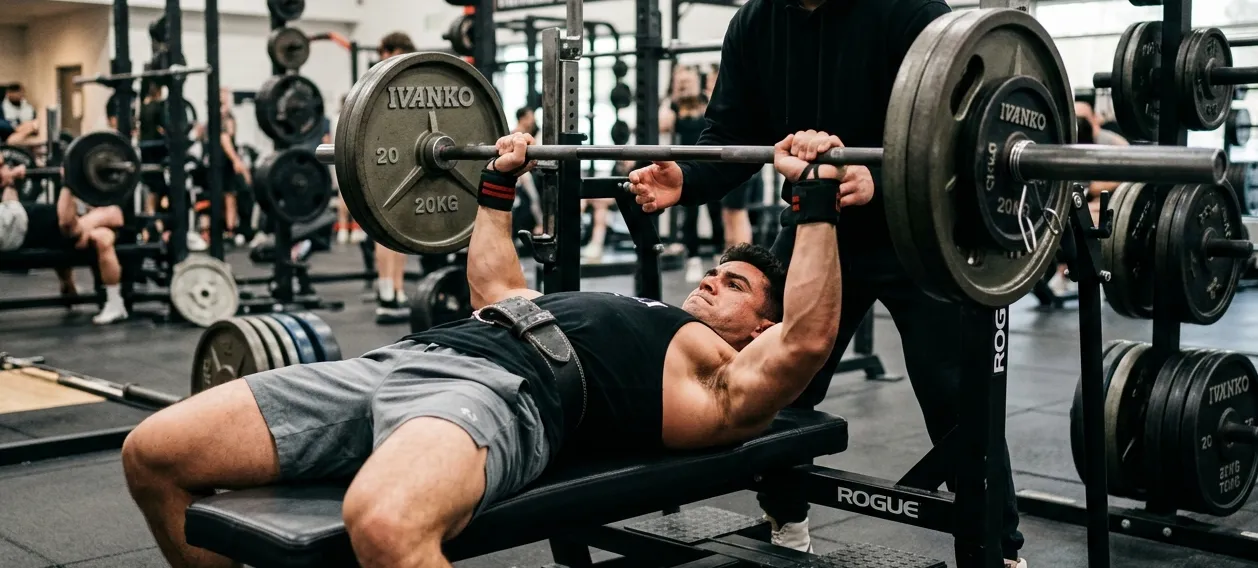
Before even unracking the bar, your positioning on the bench determines the effectiveness of the entire movement:
- Eyes under the bar: lie down so that your eyes are directly under the bar at rest. This ensures a clean unrack and a good bar path.
- Scapular retraction: squeeze your shoulder blades together and drive them into the bench. Imagine trying to pinch a pencil between your shoulder blades. This position creates a stable base and protects the shoulders.
- Back arch: create a natural arch in your lower back. Your glutes and upper back remain in contact with the bench, but your lower back lifts slightly. This arch is not dangerous: it reduces the range of motion (mechanical advantage) and places the shoulders in a safer position.
- Chest up: keep your chest pushed up throughout the movement. If your chest collapses, you lose scapular retraction and force transfer.
Grip width
Grip width affects the muscles targeted and joint comfort:
- Medium grip (1.5 to 1.8 times shoulder width): the best compromise for most lifters. Evenly targets chest and triceps.
- Wide grip (more than 1.8 times): reduces range of motion and places greater emphasis on the chest. More stressful on the shoulders.
- Close grip (shoulder width): emphasizes the triceps. Excellent accessory exercise.
Regardless of width, the bar should rest on the base of the palm, aligned with the forearms. Grip the bar as hard as you can: this activates stabilizer muscles and improves force transfer.
Leg drive
Leg drive is the pushing of the feet into the floor during the movement. Many lifters neglect this component, which can add 5 to 15 kg to your performance.
- Place your feet flat on the floor, slightly behind your knees.
- Push firmly into the floor throughout the entire movement.
- The force generated by the legs transfers through the torso to the bar.
- Keep your glutes on the bench: if they lift off, you are pushing too much upward instead of backward.
Bar path
Contrary to what many believe, the bar does not travel vertically. The optimal bar path forms a slight diagonal arc:
- Unrack: the bar starts above the shoulders.
- Descent: the bar lowers to the lower chest (around nipple line or slightly below).
- Contact: touch the torso with control, no bounce.
- Press: the bar travels back up diagonally toward the shoulders, not straight up. This reverse arc path leverages shoulder and tricep strength at lockout.
Bench press variations
Each variation targets a specific aspect of the movement. Incorporate them into your program as accessory or main exercises depending on your weak point.
| Variation | Primary target | Recommended RPE | When to use |
|---|---|---|---|
| Spoto press (pause 2-3 cm above chest) | Chest and mid-range control | 7-8 | If the bar slows at mid-range; to improve stability without bounce |
| Pause bench (2-3 sec. on chest) | Chest, explosiveness from the bottom | 7-8.5 | If the bar sticks on the chest; to eliminate momentum and strengthen the start |
| Board press (board on chest, reduced ROM) | Triceps, lockout | 8-9 | If the bar stalls in the top third; to overload the lockout |
| Floor press (lying on the floor, reduced ROM) | Triceps, shoulders, control | 7.5-8.5 | If lockout is weak; great for home gym training without a bench |
| Close grip bench (shoulder-width grip) | Triceps, front delts | 7-8 | Universal accessory; excellent tricep volume without excessive fatigue |
| Banded bench press | Acceleration, power | 8-9 | To work speed through the sticking point; intermediate+ lifters |
| Tempo bench (3-4 sec. descent) | Eccentric control, technique | 6.5-7.5 | Technical warm-up, mind-muscle connection, fixing flaws |
Key accessory exercises
For the chest
- Incline dumbbell press: develops the upper chest, often a weak point. 3-4 x 8-12.
- Cable flyes: isolate the chest without shoulder joint stress. 3 x 12-15. Excellent for mind-muscle connection.
- Dips: work the lower chest and triceps. Add weight when bodyweight becomes too easy. 3-4 x 8-12.
For the triceps
The triceps are responsible for the final lockout of the movement. If your bench stalls in the top third, your triceps are likely the weak link.
- Close-grip bench press: the most bench-specific variation. 3-4 x 6-10.
- Cable tricep pushdowns: isolate the triceps without systemic fatigue. 3 x 12-15.
- Skull crushers: target the long head of the triceps, often underdeveloped. 3 x 8-12.
For the shoulders and back
- Overhead press: strengthens the shoulders, which contribute significantly to the unrack and initial push. 3 x 6-10.
- Barbell or dumbbell rows: a strong back is essential for maintaining scapular retraction and stabilizing the movement. 3-4 x 8-12.
- Face pulls: strengthen the external rotators and rear delts, preventing imbalances caused by excessive pressing. 3 x 15-20. This type of preventive work is detailed in our guide on recovery and injury prevention.
Identifying your weak point: diagnostic protocol
To progress effectively, you need to know exactly where your bench press fails. Here is a simple protocol to identify your weak point.
The test
- Warm up normally up to about 70% of your 1RM.
- Load the bar to about 85-90% of your estimated 1RM.
- Perform 1 to 3 reps, focusing on where the bar slows down or stalls.
- Film yourself from the side so you can analyze the bar path in slow motion.
Interpretation
| Observation | Weak point | Deficient muscles | Priority fix |
|---|---|---|---|
| Bar sticks on chest, difficulty initiating the push | Bottom of the movement | Chest (especially sternal portion) | Pause bench, flyes, incline press |
| Bar slows 10-15 cm off the chest then stalls | Mid-range (sticking point) | Chest/tricep transition, front delts | Spoto press, banded bench, overhead press |
| Bar passes the midpoint but stalls before lockout | Top of the movement | Triceps (especially lateral and medial heads) | Board press, floor press, close grip bench, skull crushers |
| Bar drifts laterally or elbows flare back | Technical instability | Shoulder stabilizers, back | Face pulls, rows, slow tempo bench, dumbbell bench |
Repeat this test every 6-8 weeks. Your weak point will evolve as you correct it. AIVancePro analyzes your bench press progression and automatically adjusts accessory exercises to target your identified weak points.
Most common technique errors
1. Loss of scapular retraction
The problem: the shoulder blades lift off the bench during the press, destabilizing the shoulders and reducing force transfer.
The fix: before every set, actively drive your shoulder blades into the bench. Think about “pushing the bench with your back” rather than pushing the bar upward. Corrective exercise: isometric scapular retraction (hold the pinched position for 20 seconds, 3 sets).
2. Bouncing off the chest
The problem: the bar bounces off the chest instead of touching with control. This masks a weakness at the bottom of the movement, prevents development of starting strength and can cause rib injuries.
The fix: regularly practice pause bench (2-second pause on the chest) during moderate-volume sessions. The goal is to develop the ability to produce force from a static position.
3. Elbows flared too wide (angle > 75 degrees)
The problem: the elbows flare too far from the body, overloading the shoulders and reducing tricep contribution.
The fix: aim for a 45 to 60-degree elbow-torso angle. A simple cue: seen from above, your arms should form an arrow, not a T. Practice this at light loads (50-60% 1RM) until the pattern becomes automatic.
4. Unstable or moving feet
The problem: feet slide, lift or shift position during the set. Leg drive is lost, overall stability is compromised.
The fix: plant your feet and push firmly into the floor before unracking the bar. Maintain this tension from start to finish. If your feet slide, try flat-soled shoes (lifting shoes or Converse) or place a non-slip mat on the floor.
5. Bad bar path (straight vertical)
The problem: the bar travels in a straight line from the chest to above the shoulders. This path is inefficient because it does not take advantage of optimal shoulder and tricep mechanics.
The fix: think about pushing the bar “toward the rack” rather than toward the ceiling. The path should form a slight reverse J-curve: touch at lower chest level, then rise diagonally toward the shoulders. Film yourself from the side and compare with the expected bar path.
Bench-specific programming
Ideal frequency
To improve your bench press, a frequency of 2 to 3 times per week is optimal. This may seem high, but the bench press greatly benefits from technical repetition. To organize these sessions into a long-term plan, the principles of training periodization are essential.
Example: 3-session split
- Monday: Competition bench press — 4 x 5 @ 80%
- Wednesday: Close-grip bench press — 3 x 8 @ 70%
- Friday: Tempo bench press — 3 x 6 @ 72% (3-second descent)
Each session has a different objective: the first develops strength with heavy loads, the second targets the triceps, and the third improves control and the eccentric phase.
Complete 8-week program
This periodized program alternates an accumulation block (volume) and an intensification block (strength) to maximize your bench press gains. It assumes 3 bench sessions per week.
Block 1 — Accumulation (weeks 1-4)
Day 1 — Main strength
| Week | Exercise | Sets x Reps | % 1RM | RPE |
|---|---|---|---|---|
| 1 | Competition bench press | 4 x 6 | 75% | 7 |
| 2 | Competition bench press | 4 x 6 | 77.5% | 7.5 |
| 3 | Competition bench press | 5 x 6 | 80% | 8 |
| 4 (deload) | Competition bench press | 3 x 5 | 70% | 6 |
Day 2 — Volume / Variation
| Week | Exercise | Sets x Reps | % 1RM | RPE |
|---|---|---|---|---|
| 1 | Close grip bench | 3 x 10 | 65% | 7 |
| 2 | Close grip bench | 4 x 10 | 67.5% | 7.5 |
| 3 | Close grip bench | 4 x 10 | 70% | 8 |
| 4 (deload) | Close grip bench | 2 x 8 | 60% | 6 |
Day 3 — Technique / Tempo
| Week | Exercise | Sets x Reps | % 1RM | RPE |
|---|---|---|---|---|
| 1 | Pause bench (2 sec.) | 3 x 8 | 67% | 7 |
| 2 | Pause bench (2 sec.) | 3 x 8 | 70% | 7.5 |
| 3 | Tempo bench (3-1-1) | 3 x 6 | 72% | 8 |
| 4 (deload) | Tempo bench (3-1-1) | 2 x 6 | 62% | 6 |
Accessories each day: Incline dumbbell press 3 x 10-12, Face pulls 3 x 15-20, Cable tricep pushdowns 3 x 12-15.
Block 2 — Intensification (weeks 5-8)
Day 1 — Main strength
| Week | Exercise | Sets x Reps | % 1RM | RPE |
|---|---|---|---|---|
| 5 | Competition bench press | 4 x 4 | 82.5% | 8 |
| 6 | Competition bench press | 5 x 3 | 85% | 8.5 |
| 7 | Competition bench press | 5 x 2 | 90% | 9 |
| 8 (test) | Bench press — 1RM or 3RM test | Progressive ramp-up | 95-100% | 10 |
Day 2 — Strength / Variation
| Week | Exercise | Sets x Reps | % 1RM | RPE |
|---|---|---|---|---|
| 5 | Spoto press | 3 x 5 | 78% | 8 |
| 6 | Board press / Floor press | 4 x 4 | 82% | 8.5 |
| 7 | Close grip bench | 3 x 4 | 82% | 8.5 |
| 8 (test) | Light: Close grip bench | 2 x 6 | 65% | 6 |
Day 3 — Technique / Speed
| Week | Exercise | Sets x Reps | % 1RM | RPE |
|---|---|---|---|---|
| 5 | Dynamic bench press | 6 x 3 | 60% + bands | 7 |
| 6 | Pause bench (3 sec.) | 4 x 3 | 80% | 8 |
| 7 | Dynamic bench press | 8 x 2 | 55% + bands | 7 |
| 8 (test) | Rest or light mobility | — | — | — |
Accessories weeks 5-7: Weighted dips 3 x 6-8, Barbell rows 3 x 8-10, Skull crushers 3 x 10-12. Week 8: accessories reduced or removed.
To properly calibrate RPE throughout this program, consult our guide on RPE and intensity management.
Identifying and correcting weak points
Weakness at the bottom (off the chest)
If the bar sticks on your chest and you struggle to initiate the push, your chest is likely the weak point.
- Practice pause bench press (2-3 second pause on the chest) to eliminate momentum and strengthen this position.
- Add flyes and incline pressing to develop chest mass.
- Work on slight explosiveness from the bottom position: pin press (bar starts resting on the safeties).
Weakness at the mid-range (sticking point)
The typical sticking point is about 10-15 cm above the chest. This is where the chest loses its mechanical advantage and the triceps take over.
- Banded bench press adds resistance as the bar rises, forcing acceleration through the sticking point.
- Spoto press (pause 2-3 cm above the chest) specifically targets this zone.
Weakness at lockout (top of the movement)
If the bar slows in the final third of the movement, your triceps are the limiting factor.
- Board press or floor press limits the range of motion and overloads the lockout phase.
- Add direct tricep isolation work: skull crushers, cable pushdowns, JM press.
- Chain bench press progressively overloads the top of the movement.
Practical tips
Film yourself
Place your phone in video mode from the side to analyze your bar path, back arch and elbow placement. Technical flaws are often invisible from the inside but obvious on video.
Work technique at light loads
Regularly dedicate sessions at 50-65% of your max to perfecting every technical aspect: scapular retraction, leg drive, bar path. Technical habits built at light loads transfer to heavy weights.
Be patient
The bench press progresses more slowly than the squat or deadlift. A gain of 2.5 kg per month is already excellent for an intermediate lifter. Consistency is what makes the difference over the long term. Tracking your progression with a tool like AIVancePro lets you visualize that upward trend and stay motivated, even when gains feel slow day to day.
Protect your shoulders
The bench press is one of the most stressful exercises for the shoulder joint. Include face pulls, external rotations and thoracic mobility work in every session. Our guide on recovery and injury prevention details the prevention routines you need.
Want to progress faster on the bench press? AIVancePro automatically generates a personalized bench press program with the right variations, the right volume and periodization adapted to your level. Download the app for free and get started today.
FAQ — Bench press
What is the best frequency for improving bench press? For most intermediate lifters, 2 to 3 times per week is optimal. The key is to vary the stimuli: one heavy session (3-6 reps), one volume/variation session (8-12 reps) and optionally one technique session (tempo or pause). If you can only do 2 sessions, combine strength and technique on day 1 and volume on day 2. Beyond 3 bench sessions per week, fatigue management becomes critical.
Should you touch the chest on every rep? Yes, unless you are deliberately working a reduced range of motion variation (board press, floor press, spoto press). Touching the chest with control (no bounce) ensures full range of motion, complete muscle development and technique transferable to competition. Bouncing must be avoided: it masks a weakness at the bottom of the movement and increases the risk of rib and sternum injury.
How to adapt the bench press if you have shoulder pain? First, distinguish between pain and mere discomfort. If the pain is sharp, localized in the joint and present on every rep, stop the movement and see a professional. If it is mild discomfort, try: (1) checking your scapular retraction, (2) narrowing your grip by one finger width on each side, (3) using a more pronounced back arch, (4) temporarily replacing with floor press or dumbbell bench (greater rotational freedom). See our guide on recovery and injury prevention for a complete protocol.
← Back to guides