Training at home eliminates the two main obstacles to consistency: commute time and peak-hour crowds. With the right equipment and a well-set-up space, a home gym can deliver results on par with a commercial gym. This guide helps you plan your setup based on your budget and available space.
Essential equipment
There is no need to replicate a full commercial gym. With a few well-chosen pieces of equipment, you can perform the vast majority of strength training exercises.
1. The squat rack (or cage)
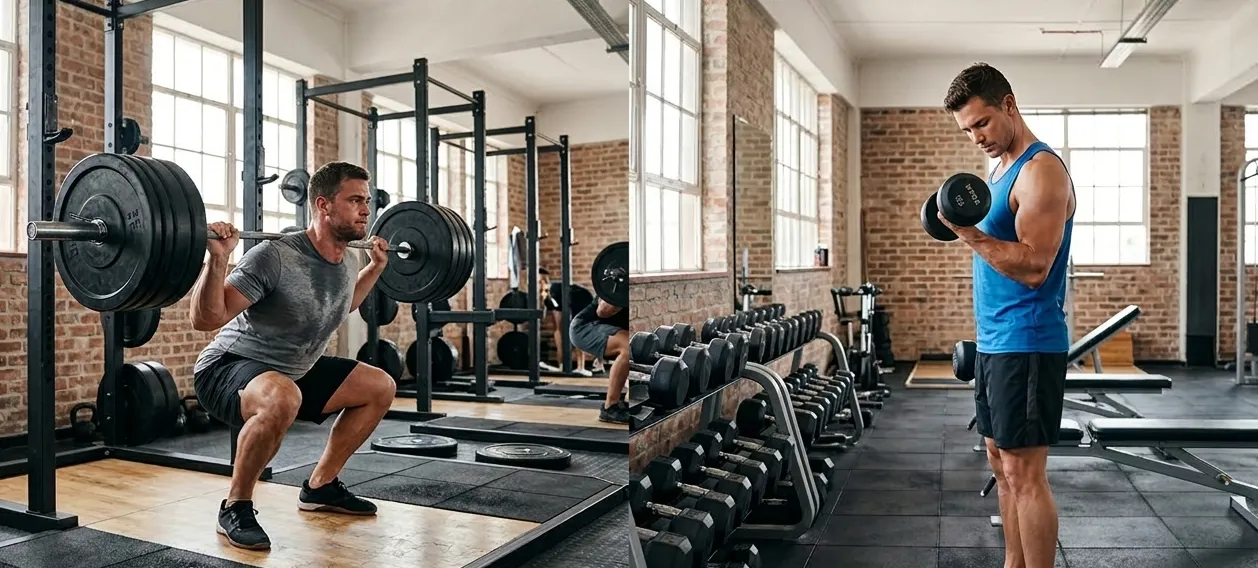
This is the centerpiece of any serious home gym. A squat rack with safeties allows you to safely perform squats, bench press, overhead press, pull-ups (if equipped with a pull-up bar) and many other exercises.
- Full cage (power rack): the safest option, with 4 uprights and adjustable safeties. Ideal if you train alone. Budget: 300-800 EUR.
- Half rack: less bulky, 2 uprights with safeties. A good space/safety compromise. Budget: 200-500 EUR.
- Squat stand: the most compact, but without built-in safeties. Not recommended for training alone with heavy loads. Budget: 100-300 EUR.
2. The Olympic barbell
A 20 kg bar with Olympic dimensions (220 cm, 50 mm sleeve diameter) is the standard. Do not skimp on the barbell: it is the piece of equipment you will use the most, and a quality bar will last decades.
- Features to check: weight capacity (minimum 200 kg), knurling (not too aggressive for comfort), sleeve rotation (important for deadlifts).
- Budget: 150-400 EUR for a good quality bar.
3. Weight plates
Plan for enough weight to progress over the long term. A reasonable starter kit:
- 2 x 20 kg
- 2 x 10 kg
- 2 x 5 kg
- 2 x 2.5 kg
- 2 x 1.25 kg (for micro-progression)
That totals 97.5 kg including the bar, which is enough to get started. You can add plates as you progress. Cast iron plates are the most economical; bumper plates (rubber) are more expensive but protect the floor.
4. The weight bench
An adjustable bench (flat and incline) offers maximum versatility: flat bench press, incline press, decline press, and many dumbbell exercises.
- Stability: the bench should not move under load. Check the maximum weight capacity (minimum 250 kg user + weight).
- Adjustments: at least 4-5 incline positions. A decline position is a bonus but not essential.
- Budget: 150-400 EUR for a solid, adjustable bench.
5. Dumbbells (optional but recommended)
Dumbbells add an extra dimension to your training: unilateral work, increased range of motion, and isolation exercises.
- Adjustable dumbbells: the most space- and budget-efficient choice. An adjustable set from 2 to 32 kg replaces 12 pairs of fixed dumbbells. Budget: 200-500 EUR.
- Fixed dumbbells: more practical (quick changes) but require a storage rack and a larger budget.
Budget by phase: detailed investment plan
Here is a detailed table to plan your investment in order of priority. Each phase is self-contained: you can stop at any phase and still have a functional home gym.
| Phase | Equipment | Price range | Priority | Why |
|---|---|---|---|---|
| Phase 1 — The essentials | Squat rack (full cage) | 300-800 EUR | 1 | Enables safe squats, bench, OHP, pull-ups |
| Olympic barbell 20 kg | 150-400 EUR | 1 | The central tool of any strength program | |
| Plates 100 kg (2x20, 2x10, 2x5, 2x2.5, 2x1.25) | 150-350 EUR | 1 | Enough to start and progress for 6-12 months | |
| Floor protection mats (6-10 m2) | 50-150 EUR | 1 | Protects floor, reduces noise, stabilizes rack | |
| Phase 1 subtotal | 650-1,700 EUR | Covers 80% of basic exercises | ||
| Phase 2 — Versatility | Adjustable bench (flat + incline) | 150-400 EUR | 2 | Bench press, incline press, dumbbell exercises |
| Adjustable dumbbells (2-32 kg) | 200-500 EUR | 2 | Isolation, unilateral work, variety | |
| Additional plates (40-60 kg) | 80-180 EUR | 2 | Medium-term progression headroom | |
| Phase 2 subtotal | 430-1,080 EUR | Complete Upper/Lower or PPL program | ||
| Phase 3 — Optimization | Cable pulley system (rack-mounted or standalone) | 100-400 EUR | 3 | Triceps, back, face pulls, cable crossover |
| Resistance bands (set of 4-5) | 30-60 EUR | 3 | Warm-ups, variable resistance, pull-up assistance | |
| EZ curl bar | 30-80 EUR | 4 | Comfort for curls and skull crushers | |
| Trap bar (hex bar) | 80-200 EUR | 4 | More accessible deadlift, farmer walks | |
| Phase 3 subtotal | 240-740 EUR | Near-equivalent of a commercial gym | ||
| Phase 4 — Comfort | Mirror (150 x 50 cm minimum) | 30-100 EUR | 5 | Technique monitoring |
| Fan / portable AC unit | 30-200 EUR | 5 | Summer comfort | |
| Bluetooth speaker | 20-80 EUR | 5 | Motivation | |
| Wall timer or display | 20-50 EUR | 5 | Rest period management | |
| Phase 4 subtotal | 100-430 EUR | Optimal training environment |
Total budget all phases: 1,420 - 3,950 EUR. Compare this with a gym membership at 40-60 EUR/month, or 480-720 EUR/year. The home gym pays for itself in 2-5 years depending on your initial investment.
Space setup
Minimum floor space
A functional home gym requires approximately 6 to 10 m2 of space. The squat rack takes up about 1.2 x 1.2 m, but you need room around it to load the bar and perform movements safely.
- Minimum length: 3 m (for the 220 cm bar + loading space)
- Minimum width: 2 m (rack + circulation space)
- Height: 2.4 m minimum for pull-ups and standing overhead press
Floor protection
The floor is often the first thing to protect, especially in an apartment. Rubber mats 15 to 20 mm thick absorb impacts, protect the floor and reduce noise. For deadlifts, a lifting platform (plywood + rubber) is ideal.
Ventilation and lighting
A garage or basement can quickly become stifling during exercise. Make sure you have adequate ventilation (window, fan) and sufficient lighting to perform movements safely.
Apartment home gym
Setting up a home gym in an apartment is entirely possible, but requires some extra precautions compared to a garage or basement.
Noise and vibration management
Noise is the primary constraint in an apartment. Your neighbors (especially those below) will feel vibrations if you do not take measures.
- Double-layer mats: first lay a 20 mm rubber mat layer, then a 10-15 mm EVA foam layer on top. This combination absorbs the majority of impacts and vibrations.
- Lifting platform: essential if you deadlift. Build a 2.4 x 1.2 m platform with 2 layers of plywood (18 mm each) between 2 layers of rubber. Total cost: 80-150 EUR.
- Bumper plates required: in an apartment, clanging cast iron plates are not an option. Rubber bumper plates significantly reduce impact noise. Additional budget: +50-100% compared to cast iron.
- No dropped deadlifts: control the descent on every rep. Deadlift pads (cushions under the plates) add an extra layer of absorption.
- Training hours: respect reasonable hours (typically 8 AM to 10 PM, check your building rules). Avoid the noisiest movements (deadlifts, cleans) early in the morning or late at night.
Space constraints
- Compact rack or half rack rather than a full cage to save 30-40 cm of depth.
- Adjustable dumbbells rather than fixed pairs that take up a lot of space.
- Folding bench if space is truly limited (quality is often lower but acceptable for moderate use).
- Vertical storage: hang resistance bands, lifting belt and accessories on the wall or cage.
Floor load capacity
Modern apartments generally support 200-250 kg/m2, which is more than sufficient for a standard home gym. The lifting platform distributes the load over a larger area. If in doubt (older building, wooden floors), consult your building management.
Equipment maintenance and longevity
A well-maintained home gym lasts decades. Here are the essential steps to protect your investment.
Olympic barbell maintenance
The barbell is the most used piece of equipment and the most susceptible to corrosion.
- After every session: wipe the bar with a dry cloth to remove sweat and chalk. Sweat is acidic and accelerates corrosion.
- Every week: clean the knurling with a nylon brush (not metal on chrome or cerakote finishes) to remove buildup.
- Every month: apply a thin coat of 3-in-1 oil or sewing machine oil on the knurling and sleeves. Wipe off excess. Check that the sleeves spin freely.
- Never: store the bar on the ground (moisture), leave weights on the bar between sessions (deformation), or use the bar as a lever for other tasks.
Rust prevention
Rust is the main enemy in a garage or basement, especially in humid regions.
- Dehumidifier: invest in a dehumidifier if relative humidity exceeds 60%. Budget: 50-150 EUR. This is the single most effective measure.
- Cast iron plates: a light surface rust film is normal and does not affect functionality. Scrub with a wire brush and apply a coat of rust-resistant paint if needed.
- Rack: check contact points between safeties and uprights. Apply anti-corrosion spray (such as WD-40) to adjustment mechanisms 2-3 times per year.
Floor mat replacement
Rubber mats wear out over time, especially in high-traffic areas and under the deadlift zone.
- Typical lifespan: 3-5 years for heavy use (5+ sessions/week), 5-8 years for moderate use.
- Signs of replacement: compressed mats that no longer spring back to their original thickness, cracking, persistent odor (rubber degradation).
- Tip: rotate mats between the deadlift zone (heavy wear) and walkway areas (light wear) once a year.
Buying second-hand: a smart approach
Second-hand strength training equipment is often in excellent condition because iron and steel barely wear out. It is a great way to cut your budget by 30-50%.
Where to buy
- Facebook Marketplace / Craigslist / local classifieds: the largest selection and best prices. Search for “power rack,” “Olympic barbell,” “weight plates.”
- Specialized Facebook groups: groups like “Home Gym Community” or “Garage Gym Marketplace” bring together enthusiasts selling quality equipment.
- Gym clearance sales: gyms that close or re-equip often sell their equipment at steep discounts. Watch local listings.
- Yard sales and flea markets: occasionally good finds (dumbbells, plates), but heavy equipment is rare.
Red flags: when not to buy
- Bent or warped bar: place the bar on the floor and roll it. If it wobbles or does not roll straight, it is warped. A warped bar is dangerous and cannot be fixed.
- Sleeves that do not spin: a sign of damaged bearings or internal rust. Deadlifting with seized sleeves damages your wrists.
- Cracked welds on the rack: inspect all weld points, especially on the safeties. A safety that gives way under load is a deadly hazard.
- Collapsed bench padding: a bench whose padding is compressed and no longer springs back will slide under load. Replacing the foam is possible but tedious.
- Deeply rusted plates: surface rust is normal and cleans off easily. Rust that has eaten into the metal (holes, flaking) weakens the plate.
- Price too good to be true: beware of listings with very low prices and generic photos. Scams exist, especially for brand-name adjustable dumbbells.
Test before buying
- Go in person: always see and touch the equipment before paying. No remote bank transfers.
- Weigh the plates: a 20 kg plate should weigh 20 kg (+/- 0.5 kg). Unmarked or no-name plates can be underweight.
- Test the rack: shake it laterally. A stable rack should not move when bolted down or weighted.
- Check the sleeves: load 2-3 plates per side and verify they load and unload smoothly.
- Bring a tape measure: verify that the bar is 220 cm long and that the sleeve diameter is 50 mm (Olympic standard). Bars with 28 mm sleeves (standard) are not compatible with Olympic plates.
Home gym workout programs
Barbell and rack only
Even with minimal equipment, you can build a complete training program. AIVancePro’s AI coach generates programs adapted to the equipment you have available, whether that is a barbell and rack or just a set of dumbbells:
Full Body A
- Squat: 4 x 6-8
- Bench press: 4 x 6-8
- Barbell row: 4 x 8-10
- Overhead press: 3 x 8-10
- Barbell curl: 3 x 10-12
Full Body B
- Deadlift: 4 x 5
- Incline barbell press: 4 x 8-10
- Pull-ups (weighted if needed): 4 x 6-10
- Barbell hip thrust: 3 x 10-12
- Barbell tricep extensions: 3 x 10-12
These sessions target all major muscle groups. Alternate A and B over 3 sessions per week (e.g., Monday A, Wednesday B, Friday A, then the reverse the following week). Apply progressive overload by adding weight or reps each week.
With dumbbells as a supplement
Dumbbells allow you to add isolation exercises and unilateral work: lateral raises, dumbbell curls, single-arm rows, lunges, dumbbell press. This lets you progress to a full Upper/Lower or PPL split. To learn how to choose exercises based on your goals, see our guide on compound vs. isolation exercises.
If you are a beginner, the Full Body program above is an excellent starting point. Intermediates can progress to a 4-day Upper/Lower split with adapted periodization.
Home gym advantages and disadvantages
Advantages
- Time savings: zero commute, zero waiting for equipment. A 60-minute session is truly 60 minutes of work.
- Availability: train at any hour, 7 days a week. Ideal for busy or irregular schedules.
- Hygiene: your equipment, your cleanliness. No one else’s sweat to deal with.
- Focus: no distractions, no obligatory conversations. Maximum concentration.
- Long-term value: an initial investment of 1,000-1,500 EUR pays for itself in 2-3 years of saved gym memberships.
- Music as loud as you want: play whatever motivates you, no headphones needed, at whatever volume you like.
Disadvantages
- Upfront cost: the initial investment is significant, even for a minimal setup.
- Space required: not everyone has a garage or dedicated room.
- Limited equipment variety: no guided machines, multiple cable stations or specialized equipment.
- Motivation: some lifters need the gym atmosphere to stay motivated.
- Safety: training alone with heavy loads requires a rack with properly set safeties and common sense.
Want to get the most out of your home gym? AIVancePro automatically creates personalized programs adapted to your available equipment and tracks your progression session after session. Download the app for free and get started today.
A home gym does not have to completely replace the commercial gym. Many lifters combine both: home gym for main sessions (barbell, dumbbells) and commercial gym 1-2 times per week for specialized machines.
FAQ — Home gym
Is a home gym sufficient to progress as much as in a commercial gym? Yes, for strength and hypertrophy, a well-equipped home gym (rack, barbell, bench, dumbbells) covers 90% of your needs. Compound exercises (squat, bench, deadlift, row, OHP) are the pillars of any effective program and require only basic equipment. Guided machines in a gym offer additional comfort for isolation but are not essential for progress. The key is to apply progressive overload and adapted periodization.
How to stay motivated when training alone at home? The lack of gym atmosphere is the main barrier for many. A few strategies: (1) set a fixed schedule and treat it as a non-negotiable appointment, (2) prepare a dedicated playlist, (3) use AIVancePro to track your progress, visualize your progression and stay motivated through gamification, (4) film your heavy sets to review and measure your technical progress, (5) join an online community of home gym lifters to share your performances. The advantage of a home gym is that the barrier to entry is nearly zero: no commute, no excuses.
Can my garage/apartment floor handle the weight of a home gym? A typical home gym (rack + bar + 200 kg of plates + bench + user) weighs about 350-450 kg total, spread over 6-10 m2. Concrete garage floors easily support this load. In apartments, building codes generally require 200-250 kg/m2 of live load capacity, which is sufficient if the weight is well distributed (lifting platform, mats). The only real risk is dropping a loaded bar from height, which creates a significant point impact. Bumper plates and a good platform eliminate this risk. If in doubt about an older wooden floor, consult a professional.
← Back to guides