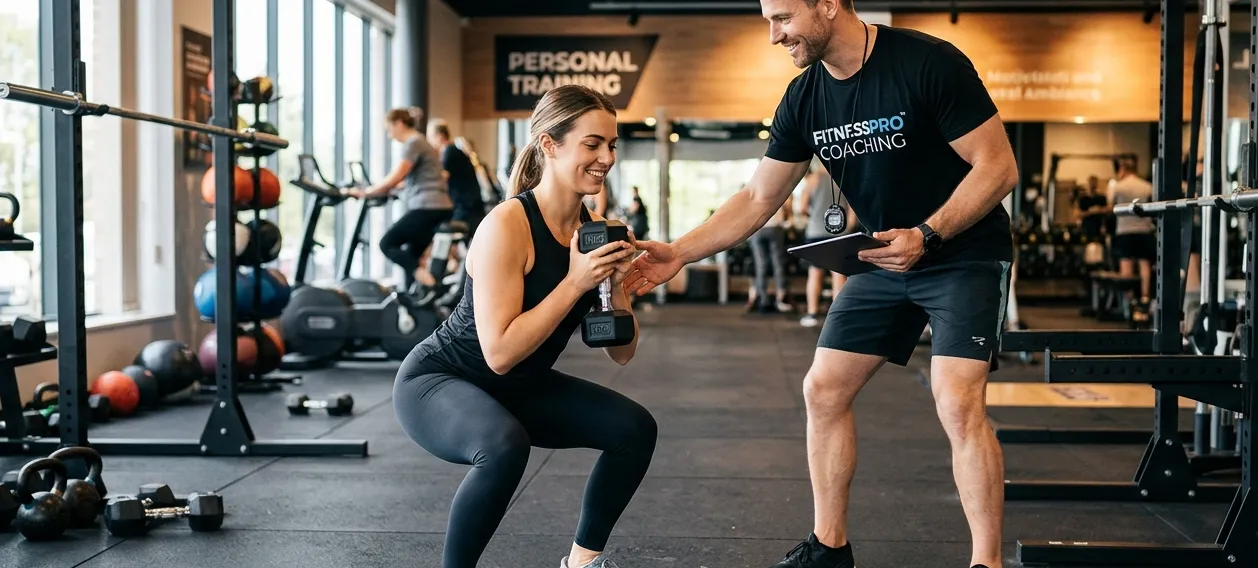
Compound or isolation? Understanding the difference between these two categories of exercises is one of the most important fundamentals for building an effective strength training program. This choice directly impacts your muscle recruitment, strength progression and ability to develop a balanced physique.
Compound exercises (multi-joint)
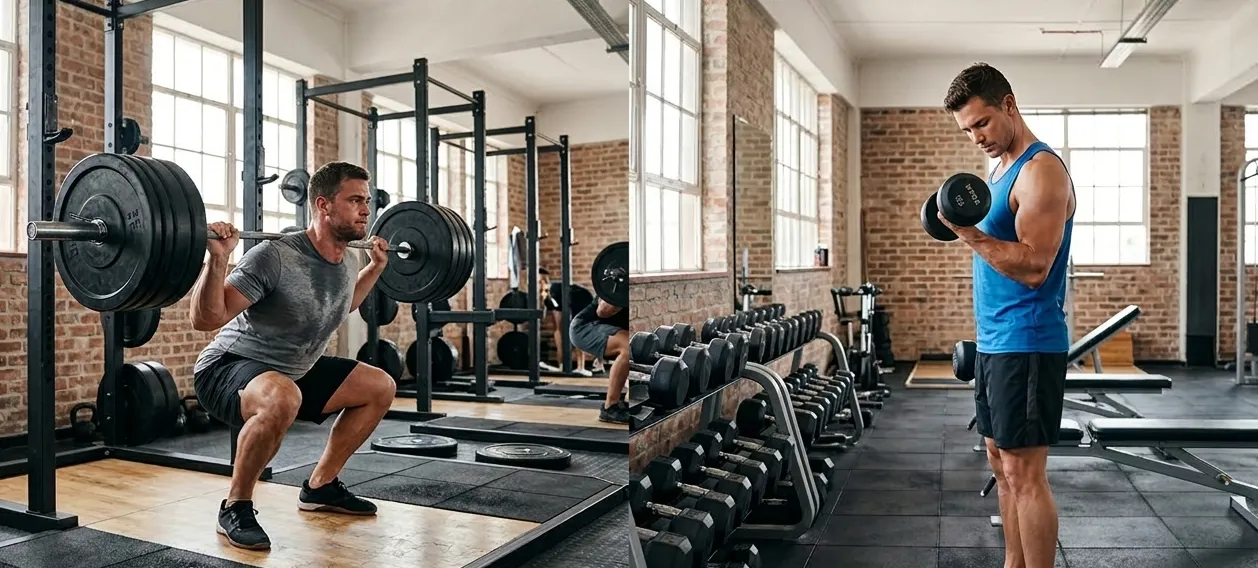
Compound exercises engage multiple joints and muscle groups simultaneously. A squat, for example, involves the ankles, knees and hips in a single coordinated movement.
Why they are so effective
The strength of compound exercises lies in their capacity for massive muscle recruitment. According to EMG (electromyography) data, a compound exercise like the squat or deadlift recruits between 80 and 90% of muscle fibers in the targeted groups, compared to only 40 to 60% for an equivalent isolation exercise (Schoenfeld, 2010). This superior recruitment is explained by the inter-muscular coordination required to stabilize and move the load across multiple joints.
Compounds also trigger a greater hormonal response. A study published in the Journal of Strength and Conditioning Research (Shaner et al., 2014) showed that heavy squats generate a testosterone and growth hormone elevation significantly greater than that observed after leg extensions alone. This systemic response promotes overall muscle mass gain.
Other key advantages:
- Time efficiency: working multiple muscles in one exercise reduces total session duration
- Functional transfer: multi-joint movements replicate everyday and athletic movements
- High caloric expenditure: more muscle mass involved means more calories burned per set
- Coordination development: strengthens neuromuscular connections between muscle groups
Compound exercise examples
- Squat — Quads, glutes, hamstrings, spinal erectors, core
- Bench Press — Chest, triceps, anterior deltoids
- Deadlift — Full posterior chain (spinal erectors, glutes, hamstrings), traps, forearms
- Pull-ups — Lats, biceps, rhomboids, external rotators
- Overhead Press — Deltoids (all three heads), triceps, upper traps
- Barbell Row — Lats, traps, rhomboids, biceps, spinal erectors
To progress on one of the most popular compound lifts, check out our dedicated guide: How to improve your bench press.
Isolation exercises (single-joint)
Isolation exercises target a single muscle or muscle group by engaging only one joint. The bicep curl, for example, only involves the elbow.
Their role in a program
Contrary to popular belief, isolation exercises are not reserved for bodybuilders. They serve several important functions:
- Correcting muscle imbalances: if your triceps lag behind your chest, targeted extensions will address the deficit
- Targeting a muscle with precision: the 40-60% fiber recruitment may seem low, but it is concentrated on a single muscle, maximizing local mechanical stress
- Adding volume without systemic fatigue: a bicep curl fatigues the central nervous system far less than a heavy barbell row
- Training around an injury: when a joint is limited, isolation allows you to continue training unaffected muscles
Isolation exercise examples
- Bicep Curl — Biceps brachii, brachialis
- Tricep Extensions (cable) — Triceps (long head, lateral head, medial head)
- Lateral Raises — Lateral deltoid (middle head)
- Leg Curl — Hamstrings
- Leg Extension — Quadriceps (emphasis on vastus medialis at full extension)
- Dumbbell Flyes — Chest (maximum stretch, minimal tricep involvement)
Detailed comparison table
| Criterion | Compound | Isolation |
|---|---|---|
| Muscles worked | 2 to 6 groups simultaneously | 1 single targeted group |
| Fiber recruitment | 80-90% of fibers | 40-60% of fibers |
| Load potential | High (50-300+ kg) | Moderate (5-50 kg) |
| Caloric expenditure | High (~8-12 kcal/set) | Low (~3-5 kcal/set) |
| Strength gains | Excellent | Limited |
| Precise targeting | Moderate | Excellent |
| Equipment required | Barbell, rack, bench | Dumbbells, cables, machines |
| Injury risk | Higher (demanding technique) | Lower |
| Technical difficulty | High (2-6 months to learn) | Low (immediate learning) |
| CNS fatigue | High | Low |
| Hormonal response | Strong (testosterone, GH) | Negligible |
| Ideal for | Strength, mass, performance | Finishing, balance, targeted volume |
Exercise classification
Not all exercises fit neatly into a binary category. Three levels can be distinguished: compound, semi-compound (two joints but clear dominance of one muscle) and isolation.
| Exercise | Classification | Primary muscles | Secondary muscles |
|---|---|---|---|
| Barbell Squat | Compound | Quads, glutes | Hamstrings, spinal erectors, core |
| Deadlift | Compound | Posterior chain | Traps, forearms, core |
| Bench Press | Compound | Chest | Triceps, anterior deltoids |
| Pull-ups | Compound | Lats | Biceps, rhomboids |
| Overhead Press | Compound | Deltoids | Triceps, upper traps |
| Barbell Row | Compound | Lats, traps | Biceps, rhomboids |
| Lunges | Compound | Quads, glutes | Hamstrings, adductors |
| Dips | Semi-compound | Lower chest, triceps | Anterior deltoids |
| Hip Thrust | Semi-compound | Glutes | Hamstrings |
| Upright Row | Semi-compound | Deltoids, traps | Biceps |
| Face Pull | Semi-compound | Rear deltoids, external rotators | Mid traps |
| Bicep Curl | Isolation | Biceps brachii | Brachialis |
| Tricep Extensions | Isolation | Triceps | — |
| Lateral Raises | Isolation | Lateral deltoid | — |
| Leg Extension | Isolation | Quadriceps | — |
| Leg Curl | Isolation | Hamstrings | — |
| Cable Flyes | Isolation | Chest | — |
| Standing Calf Raise | Isolation | Gastrocnemius | Soleus |
| Shrugs | Isolation | Upper traps | — |
| Wrist Curl | Isolation | Forearm flexors | — |
Exercise order: impact on performance
The order in which you place your exercises has a measurable impact on your performance. The research is clear on this.
The principle: compounds first
A meta-analysis by Simao et al. (2012) covering 31 studies concluded that exercises placed at the beginning of a session produce strength gains 10 to 15% greater than the same exercises placed at the end. In practical terms, if you do your curls before your rows, your rows will be less productive.
The standard recommendation is therefore:
- Heavy compound exercises (squat, bench press, deadlift) — 3 to 5 sets, 3-6 reps
- Accessory compound exercises (lunges, dips, dumbbell rows) — 3 sets, 8-12 reps
- Isolation exercises (curls, raises, extensions) — 2 to 3 sets, 12-20 reps
Pre-exhaustion
The pre-exhaustion technique deliberately reverses this order: you place an isolation exercise before the compound to fatigue the target muscle beforehand. For example, doing flyes before the bench press to “pre-exhaust” the chest.
Studies (Fisher et al., 2014) show that this technique reduces the load used on the compound by 15 to 20%, but increases the muscular sensation (mind-muscle connection) on the pre-exhausted muscle. It is useful for intermediate/advanced lifters who struggle to feel a muscle working during a compound.
Post-exhaustion
Post-exhaustion is the classic and most recommended approach: place isolation after the compound to finish off the target muscle once the synergists are already fatigued. For example, tricep extensions after the bench press.
This method allows you to maximize total volume without compromising performance on your main lifts.
Adapting the ratio to your goals
The famous “80/20 rule” is a good starting point, but the optimal compound/isolation ratio varies depending on your primary goal.
| Goal | Compound/isolation ratio | Rationale |
|---|---|---|
| Pure strength (powerlifting) | 90/10 | Maximize specificity of competition lifts; isolation only for injury prevention |
| General hypertrophy | 70/30 | Solid compound base + isolation for additional volume and lagging muscles |
| Bodybuilding / aesthetics | 60/40 | More isolation to sculpt each group, work angles and weak points |
| Rehabilitation / return from injury | 40/60 | Priority on control, light loads and targeted work; progressive reintroduction of compounds |
| Beginner | 80/20 | Learn fundamental movements before branching out to isolation |
| Senior / general health | 60/40 | Functional compound movements + targeted isolation for fragile joints |
To structure your program according to these ratios, follow our step-by-step guide: How to create an effective training program. AIVancePro’s AI coach automatically adjusts this ratio based on your goal and level, for an optimal balance without the guesswork.
Machines and guided exercises
Machines are often associated with isolation exercises, but this is not always the case. The leg press, for example, is a guided compound movement.
When machines are useful
- Learning: for a beginner who does not yet have the coordination for a free-weight squat, the leg press allows loading the quads and glutes safely. Our beginner’s guide to strength training details this progressive approach.
- Return from injury: fixed-path machines eliminate the need for stabilization, reducing the risk of aggravating a joint injury
- Fatigue management: at the end of a session, when central fatigue is high, a machine allows continued muscle stimulation without stabilization-related risk
- Training alone: without a spotter, machines offer built-in safety features (stops, guides)
The Smith machine debate
The Smith machine (guided barbell) divides the community. Data shows it recruits approximately 20-25% fewer stabilizer muscles than a free-weight equivalent (Schwanbeck et al., 2009). However, it allows heavier loading on the primary movement thanks to the absence of stabilization demands.
Our position: the Smith machine is one tool among many. It should not replace free barbells as the foundation of your program, but it is a valid complement for accessory work, pre-exhaustion, or when conditions do not allow a safe free-weight movement.
When to prioritize isolation
Even though compounds form the base, there are concrete situations where isolation becomes the priority.
Correcting a weak point
If your shoulders lag despite months of overhead pressing, it is probably because your triceps are taking over. High-volume lateral raises (4 sets of 15-20 reps, 3 times per week) will deliver a direct stimulus that compounds cannot provide.
Training around an injury
Lower back pain temporarily rules out squats and deadlifts? Leg extensions, leg curls and hip thrusts allow you to continue training your legs without loading the spine. To manage appropriate intensity during a recovery period, see our guide on RPE and intensity management.
Advanced pre-exhaustion technique
Advanced lifters who have plateaued on a compound can use pre-exhaustion to restart progression. Superset example:
- Cable flyes (15 reps) immediately followed by bench press (8 reps)
- The chest, pre-exhausted, becomes the weakest link in the bench press, forcing maximum recruitment
Additional volume without central fatigue
Isolation exercises allow you to accumulate weekly volume (total number of sets per muscle) without overloading the central nervous system. A lifter can handle 20-25 weekly sets per muscle if some come from isolation, compared to only 12-16 sets if everything is done with heavy compounds (Schoenfeld et al., 2017). AIVancePro tracks your volume per muscle group and alerts you when you are approaching your recovery threshold.
Want to put these principles into practice? AIVancePro automatically selects the right compound/isolation ratio adapted to your goal and level. Download the app for free and get started today.
FAQ
Can you build muscle with isolation exercises only?
Yes, technically. The mechanical and metabolic stimulus from isolation is sufficient to trigger hypertrophy. However, a 100% isolation program would be extremely time-consuming (you would need 3 to 4 exercises to cover what a single compound accomplishes), and functional strength gains would be very limited. In practice, combining both types is always more effective.
Should beginners do isolation work?
The first 3 to 6 months should be devoted mainly to compounds to build a strength foundation and learn inter-muscular coordination. Progressively adding 2-3 isolation exercises is acceptable starting in the second month, particularly for arms and shoulders which respond well to direct stimulus.
How many isolation exercises per session?
For most lifters, 2 to 4 isolation exercises per session is enough. Beyond that, session duration increases without proportional benefit. Prioritize muscles that are not sufficiently stimulated by your compounds: typically the lateral deltoids, biceps, calves and hamstrings.
Can the leg press replace the squat?
The leg press is an excellent guided compound exercise, but it does not entirely replace the squat. The squat recruits more trunk stabilizers, spinal erectors and deep pelvic muscles. If you cannot squat (injury, limited mobility), the combination of leg press + core exercises is a reasonable alternative.
AIVancePro balances for you
AIVancePro’s AI coach applies these principles automatically. When it generates a session, it selects compounds first, adjusts the compound/isolation ratio based on your stated goal, and places isolation at the end to target muscles that did not receive enough volume. The algorithm takes into account your history, identified weak points and your level to deliver the most effective program possible.
To go further in structuring your training, explore our complementary guides:
- Beginner’s guide to strength training — the fundamentals to get started right
- Create an effective training program — structure your week
- Understanding RPE and intensity — dose effort on every set
- Improve your bench press — master the king of upper body compounds