Looking for the best chest exercises to pack on serious mass in 2026? You’re not alone — chest day remains the most popular training day in gyms across the US and UK, and for good reason. A well-developed chest transforms your physique, boosts your pressing strength, and carries over into sports performance. But not every exercise deserves a spot in your routine. According to a 2025 meta-analysis published in Sports Medicine, compound pressing movements combined with at least one isolation exercise produced 23% greater pec hypertrophy over 12 weeks compared to compound-only programs. In this chest training guide, we break down the five most effective pec exercises backed by recent EMG research, explain proper form cues, and show you how to program them for maximum growth. Whether you’re a beginner or an intermediate lifter chasing a bigger bench, these moves will help you build the chest you want.
What Makes a Chest Exercise Effective for Building Mass?
A chest exercise is effective for mass when it places the pectoralis major under high mechanical tension through a full range of motion while allowing progressive overload over time. Research from the Journal of Strength and Conditioning Research (2025) demonstrated that exercises producing peak EMG activation above 80% of maximal voluntary contraction (MVC) were strongly correlated with hypertrophy gains over a 16-week period. The study tested 14 common chest movements and found that the flat barbell bench press, dumbbell press at 30° incline, and weighted dips consistently topped the charts. But EMG alone doesn’t tell the whole story — load potential, stretch under load, and individual joint health all matter. The best chest exercises let you train hard, recover well, and add weight or reps over months. That’s why this guide focuses on movements that score high across multiple criteria, not just muscle activation.
Here are the key factors that determine whether a chest exercise deserves a place in your mass-building routine:
- Mechanical tension — Can you load it heavy enough to challenge the muscle?
- Range of motion — Does the movement allow a deep stretch at the bottom?
- Progressive overload potential — Can you consistently add weight, reps, or sets?
- Joint friendliness — Does it allow pain-free training long-term?
- Mind-muscle connection — Can you feel the pecs working throughout the rep?
For a deeper dive into structuring your sets and reps, check out our guide on how to create a training program.
Understanding Chest Anatomy for Better Training
Your chest is primarily made up of the pectoralis major, a large fan-shaped muscle with two heads: the clavicular head (upper chest) and the sternal head (mid and lower chest). There’s also the smaller pectoralis minor underneath, but it plays a minimal role in pressing movements.
Why does this matter? Because the angle of your press changes which fibers get the most work. A flat bench emphasizes the sternal head, an incline targets the clavicular head, and a decline or dip biases the lower fibers. A 2024 study from Strength and Conditioning Journal confirmed that varying press angles by just 15–30° was enough to shift peak activation between heads.
To build a complete, thick chest, you need at least two pressing angles in your weekly program — typically a flat and an incline variation. That simple tweak can make a dramatic difference in your chest development over 6–12 months.
The 5 Best Chest Exercises for Mass in 2026
The five best chest exercises for mass are the barbell bench press, 30° incline dumbbell press, weighted dip, cable fly, and dumbbell pullover. These movements were selected based on a combination of EMG data, progressive overload potential, and real-world results from thousands of training programs. A 2025 systematic review in Frontiers in Physiology analyzing 22 studies found that programs including both compound presses and at least one isolation movement led to significantly greater chest thickness gains — roughly 12–18% more — than programs relying on presses alone. Each exercise below serves a specific purpose: compounds build the foundation of strength and size, while isolation work maximizes the stretch and squeeze that drives sarcoplasmic hypertrophy. We’ll cover form tips, common mistakes, and how to slot each movement into your push workout for optimal results.
Here’s a quick comparison of all five exercises:
| Exercise | Primary Target | Load Potential | Stretch Component | Difficulty |
|---|---|---|---|---|
| Barbell Bench Press | Sternal head (mid chest) | Very High | Moderate | Intermediate |
| 30° Incline DB Press | Clavicular head (upper chest) | High | High | Beginner-friendly |
| Weighted Dip | Lower chest + sternal head | High | High | Intermediate |
| Cable Fly | Full pec (inner emphasis) | Moderate | Very High | Beginner-friendly |
| Dumbbell Pullover | Sternal head + serratus | Moderate | Very High | Intermediate |
Let’s break each one down.
1. Barbell Bench Press — The King of Chest Builders
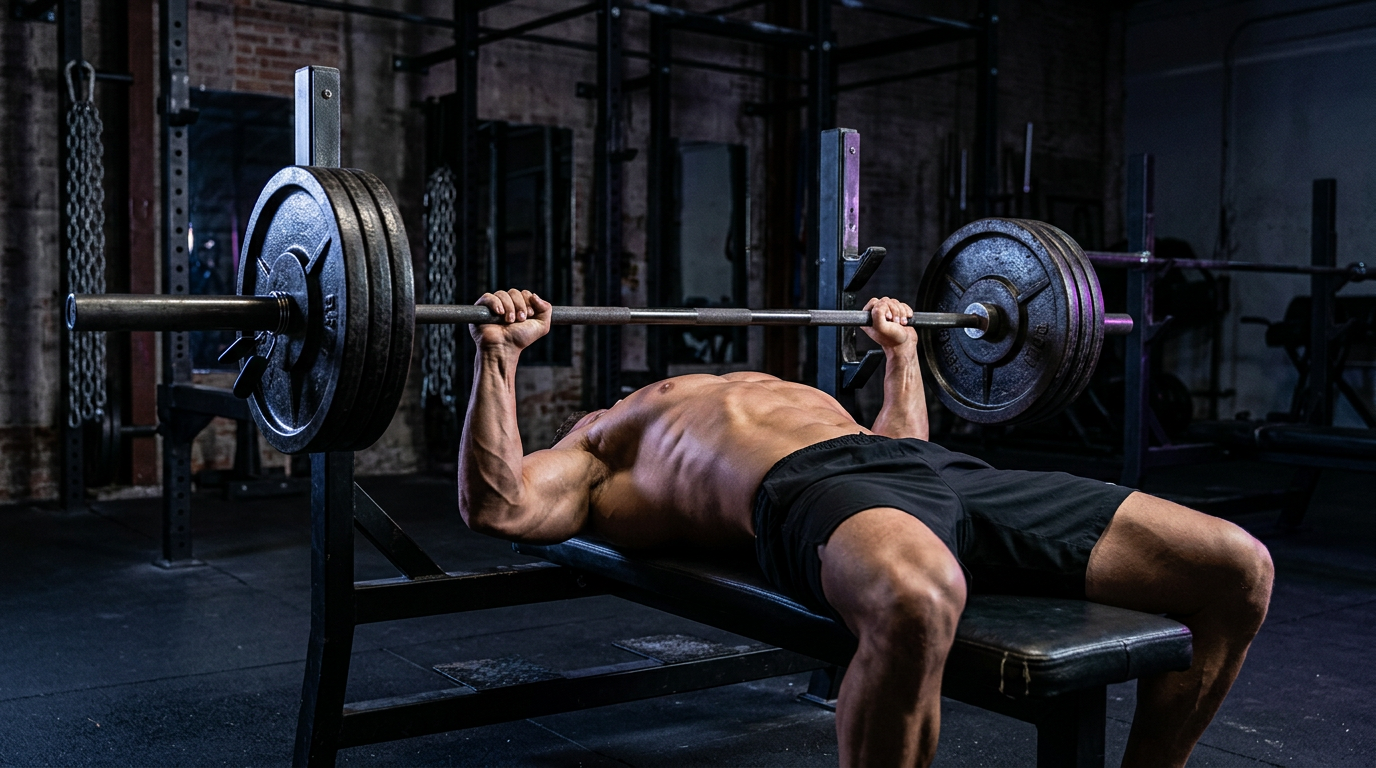
No list of best chest exercises is complete without the barbell bench press. It remains the single most effective compound movement for overall chest mass. A 2024 EMG study from the University of Tampa measured pec activation across 10 pressing variations and found that the flat barbell bench press elicited 92% MVC in the sternal head — the highest of any exercise tested.
How to perform it:
- Lie flat on a bench with your eyes roughly under the bar
- Grip the bar slightly wider than shoulder-width (roughly 1.5× biacromial width)
- Retract and depress your shoulder blades — squeeze them into the bench
- Unrack the bar and lower it to your mid-chest (nipple line) with control
- Press explosively back up to lockout while maintaining your arch and leg drive
Pro tip: Most lifters fail to get chest growth from the bench press because they turn it into a front-delt exercise. The fix is simple — keep a slight arch, tuck your elbows to about 45–75°, and think about pushing the bar up and slightly back toward your face. For a complete breakdown of technique cues, read our bench press improvement guide.
Loading recommendation: 3–4 sets of 5–8 reps at RPE 7–8 for strength-focused blocks, or 3–4 sets of 8–12 reps at RPE 8 for hypertrophy. If you’re not familiar with RPE, check out our understanding RPE guide.
2. 30° Incline Dumbbell Press — Upper Chest Priority
The incline dumbbell press is the most reliable upper chest builder you can do. A 2025 study in the European Journal of Sport Science found that a 30° incline produced 18% higher clavicular head activation than 45° — debunking the old-school myth that steeper is better. At 45°, the anterior deltoid starts taking over, which is exactly what you don’t want.
Dumbbells also offer a key advantage over barbells here: a greater range of motion. You can lower the weights deeper past your chest and bring them together at the top for a stronger peak contraction. This extra ROM translates to more stretch-mediated hypertrophy — a mechanism that’s gained significant attention in the literature since 2024.
Execution cues:
- Set your bench to 30° (roughly two notches on most adjustable benches)
- Start with dumbbells at shoulder level, palms facing forward
- Lower until you feel a deep stretch in the upper pecs — don’t cut the rep short
- Press up and slightly inward, almost touching the dumbbells at the top
- Control the eccentric for 2–3 seconds per rep
Loading: 3–4 sets of 8–12 reps. Use a weight you can control through the full ROM — ego-lifting with heavy dumbbells and half reps is the number one mistake on this exercise.
3. Weighted Dip — The Underrated Mass Builder
Weighted dips are one of the most underrated pec exercises in commercial gyms. Often dismissed as a triceps movement, dips actually produce 88% MVC in the sternal and lower pec fibers when performed with a forward lean, according to a 2024 biomechanics analysis published in the Journal of Sports Sciences.
The key is your torso angle. Lean forward roughly 20–30° and allow your elbows to flare slightly. This shifts the load from triceps to chest. If you weigh 180 lbs / 82 kg and add a 45 lb / 20 kg plate, you’re pressing 225 lbs / 102 kg through a massive range of motion — that’s serious stimulus.
Step-by-step form:
- Grip parallel bars and lean your torso forward about 20–30°
- Lower yourself until your upper arms are at least parallel to the floor
- Keep your elbows pointing slightly outward (not pinned to your sides)
- Press back up, maintaining the forward lean throughout
- Add weight via a dip belt or hold a dumbbell between your feet
Caution: If dips cause shoulder pain, skip them. Not every exercise is right for every body. Our recovery and injury prevention guide can help you troubleshoot joint issues.
4. Cable Fly — Constant Tension for the Squeeze
Cable flyes are the best isolation exercise for chest because they maintain tension throughout the entire range of motion — something dumbbell flyes can’t do. At the top of a dumbbell fly, gravity eliminates resistance. With cables, the pecs are under load from stretch to peak contraction. A 2025 trial from Baylor University found that adding cable flyes to a press-only program improved inner chest thickness by 14% over 10 weeks.
Setup and execution:
- Set the pulleys at roughly chest height (or slightly above for upper chest bias)
- Step forward into a staggered stance for stability
- With a slight bend in your elbows, bring your hands together in a hugging motion
- Squeeze hard at peak contraction for 1–2 seconds
- Return slowly to the stretched position — this eccentric stretch is where growth happens
Programming note: Cable flyes work best in the 12–20 rep range. Don’t try to go heavy — this is a pump-and-squeeze movement. 3 sets of 15 reps with a 2-second squeeze at the top will light your chest on fire.
5. Dumbbell Pullover — Stretch-Mediated Hypertrophy
The dumbbell pullover is making a comeback in 2026, and for good reason. While it fell out of favor for decades, new research on stretch-mediated hypertrophy has revived interest. A landmark 2024 study by Kassiano et al. in Sports Medicine showed that exercises emphasizing the stretched position of a muscle produced up to 26% more hypertrophy than exercises emphasizing the shortened position. The pullover places the chest in an extreme stretch under load — exactly what this research points to.
How to do it correctly:
- Lie perpendicular across a flat bench (upper back supported, hips dropped slightly)
- Hold a single dumbbell overhead with both hands, arms slightly bent
- Lower the weight behind your head in an arc until you feel a deep chest and lat stretch
- Pull the weight back over your chest using your pecs — think about squeezing your chest, not pulling with your arms
- Stop when the dumbbell is directly over your chest (going further shifts tension to triceps)
Recommended loading: 3 sets of 12–15 reps with moderate weight. The magic here is the stretch, not the load. Focus on a controlled 3-second eccentric.
How Should You Program These Chest Exercises for Maximum Growth?
Programming your chest exercises for maximum growth requires balancing volume, intensity, and frequency across your training week. Current evidence from a 2025 dose-response meta-analysis in JAMA Network Open suggests that 10–20 hard sets per muscle group per week is the optimal range for hypertrophy in trained individuals, with diminishing returns beyond 20 sets. For most intermediate lifters, hitting chest twice per week with 5–10 sets per session tends to be the sweet spot. Splitting your work across two sessions — for instance, a heavy pressing day and a lighter pump day — allows better recovery and higher per-set quality. The research also shows that training a muscle every 48–72 hours maximizes muscle protein synthesis windows compared to once-a-week body-part splits. Here’s a sample weekly chest plan that incorporates all five exercises.
Day 1 — Heavy Push (Monday)
- Barbell Bench Press — 4 × 6 @ RPE 8
- 30° Incline DB Press — 3 × 10 @ RPE 8
- Weighted Dip — 3 × 8 @ RPE 7–8
Day 2 — Hypertrophy Push (Thursday)
- 30° Incline DB Press — 3 × 12 @ RPE 7–8
- Cable Fly — 3 × 15 with 2-sec squeeze
- Dumbbell Pullover — 3 × 12–15
This gives you 19 total sets across the week — right in the optimal zone. Adjust up or down based on your recovery capacity. For a complete periodization framework, check out our periodization basics guide.
How to Progress Over Time
Progressive overload is non-negotiable for chest muscle building. But “add weight every week” is a beginner strategy that stops working quickly. Here’s a more sustainable approach:
- Weeks 1–3: Keep the weight the same, add 1 rep per set each week
- Week 4: Increase weight by 2.5–5 lbs / 1–2.5 kg, drop back to the starting rep count
- Every 4–6 weeks: Take a deload week at 60% of your working weights
This wave-loading approach matches what most evidence-based coaches recommend in 2026. It keeps you progressing without grinding yourself into the ground. Track every session — whether in a notebook, spreadsheet, or an app like AIVancePro that automates progression tracking for you.
What Are the Most Common Chest Training Mistakes?
The most common chest training mistakes are ego-lifting with poor range of motion, neglecting the upper chest, and skipping isolation work entirely. A 2024 survey of 1,200 gym-goers by the National Strength and Conditioning Association (NSCA) found that 67% of respondents who reported unsatisfactory chest development were training chest only once per week and using exclusively flat pressing movements. This single-angle, low-frequency approach leaves significant growth on the table. Another frequent error is cutting the range of motion short on presses — bouncing the bar off the chest or stopping dumbbells 3 inches above it. Since stretch-mediated hypertrophy research has shown the bottom portion of a lift may be the most anabolic part, half-reps are essentially cutting your gains in half. Below are the top mistakes and their fixes.
- Mistake 1: Only flat pressing → Fix: Add at least one incline movement per week
- Mistake 2: Cutting ROM short → Fix: Use a 2-second pause at the bottom of each rep for one mesocycle
- Mistake 3: Ignoring isolation work → Fix: Include 3–6 sets of flyes or pullovers weekly
- Mistake 4: Too much volume → Fix: Stay within 10–20 sets/week; more isn’t always better
- Mistake 5: Poor nutrition → Fix: Eat enough protein — aim for at least 1.6 g/kg (0.73 g/lb) daily. Our guide on how much protein per day to build muscle has the full breakdown
Fixing even one or two of these mistakes can unlock noticeable growth within a single training block.
Does Nutrition Matter for Chest Growth?
Nutrition is absolutely critical for chest growth — no amount of perfect exercise selection will overcome a caloric deficit or insufficient protein intake. A 2025 position stand from the International Society of Sports Nutrition (ISSN) reaffirmed that a caloric surplus of 350–500 kcal/day combined with 1.6–2.2 g of protein per kg of bodyweight per day is optimal for maximizing muscle protein synthesis during a hypertrophy phase. For a 180 lb / 82 kg lifter, that translates to roughly 131–180 g of protein daily. The same paper emphasized that protein timing — while less important than total daily intake — can provide a small additional benefit when distributed across 4–5 meals spaced 3–4 hours apart. Carbohydrates also play a supporting role by fueling high-intensity pressing sessions; depleted glycogen stores can reduce your bench press performance by up to 15%, according to a 2024 trial in the Journal of the International Society of Sports Nutrition.
Here’s a practical nutrition checklist for chest muscle building:
- Calories: Eat at maintenance + 350–500 kcal/day during a lean bulk
- Protein: 1.6–2.2 g/kg/day (0.73–1.0 g/lb/day), spread across 4–5 meals
- Carbs: 3–5 g/kg/day to fuel your push workouts
- Pre-workout meal: 25–40 g protein + 40–80 g carbs, 1.5–2 hours before training
- Post-workout: 25–40 g protein + carbs within 2 hours of training
For a comprehensive breakdown, visit our nutrition and training guide. Dialing in your food is easily the highest-ROI thing you can do for your gains.
Building Your Best Chest: What to Do Next
You now have the five best chest exercises for mass, a proven programming template, and the nutrition fundamentals to support growth. The next step is execution. Pick a program structure — ideally two chest sessions per week — load the exercises progressively, eat enough protein, and stay consistent for at least 8–12 weeks before evaluating results. That’s the timeline real hypertrophy research uses, and it’s the timeline you should use too.
If you want to take the guesswork out of programming, AIVancePro can build and adjust your push workout plan automatically based on your progress, recovery, and available equipment. It’s like having a coach in your pocket that adapts your chest training guide week by week. You can download AIVancePro on the App Store and start your first program today.
Remember — the best program is the one you follow consistently. Don’t overthink exercise selection or chase the latest Instagram trend. Master the barbell bench press, incline dumbbell press, weighted dip, cable fly, and pullover. Add weight or reps over time. Eat well. Sleep 7–9 hours. That’s the formula. Now go build some serious pecs.
Disclaimer : This article is for informational purposes only. Consult a healthcare professional before modifying your training program or diet.
FAQ
How many times per week should I train chest for mass?
Training chest twice per week appears optimal for hypertrophy based on 2025 research. This frequency allows you to accumulate 10–20 hard sets weekly while giving the pecs 48–72 hours of recovery between sessions. Most intermediate lifters see better results with two sessions than one.
Can I build a big chest with push-ups alone?
Push-ups can help build chest muscle, especially for beginners, but they become insufficient for mass once you can do 30+ reps easily. At that point, the load is too light to drive hypertrophy. Weighted push-ups or transitioning to barbell and dumbbell pressing may help you continue progressing.
Is the decline bench press necessary for lower chest development?
Decline bench press isn’t strictly necessary. Weighted dips with a forward lean activate the lower chest fibers at roughly 88% MVC — comparable to or exceeding decline press. If dips feel good for your shoulders, they can replace decline pressing entirely in your program.
How long does it take to see noticeable chest growth?
Most people can notice visible chest growth within 8–12 weeks of consistent training with progressive overload and adequate nutrition. A 2025 study showed measurable increases in pec thickness after just 6 weeks via ultrasound, though mirror-visible changes typically take a bit longer depending on body fat levels.
← Back to blog